

The latest developments in the Hormuz Strait have been closely watched by the market.
On May 8, 2026, Foreign Ministry spokesperson Lin Jian said at a regular press conference that the Hormuz Strait is an international waterway, and China is deeply concerned about the impact of the conflict on the large number of ships and crew members stranded in the strait. China believes that the early restoration of the strait’s unimpeded passage and the safety of civilian ships and crew members is in the common interest of the region and the international community. China calls on all parties to take practical measures to prevent the situation in the strait from deteriorating. China is willing to work with the international community to make efforts to promote a ceasefire and ease tensions in the strait.
According to a report by Xinhua News Agency on May 9, Iran is drafting a law related to the Hormuz Strait. The chairman of the Iranian parliament’s National Security Committee said that the parliament has held several meetings with the Foreign Ministry and other relevant agencies to discuss the content of the bill.
In the eyes of Iran’s top leaders, the Hormuz Strait is a trump card that even surpasses nuclear weapons. The Iranian Revolutionary Guard Corps Navy has designated a new shipping route from the southern waters of Hormuz Island to the southern waters of Larak Island, which is called the “Larak Corridor.” No ship is allowed to pass through without the permission of the Revolutionary Guard Corps Navy.
As early as March 30, the Iranian parliament’s National Security Committee passed a bill to charge ships passing through the Hormuz Strait. The bill includes financial arrangements and a fee system in the form of Iranian rials, as well as maintaining the dominant position of the Revolutionary Guard Corps and other armed forces.
Last week, Iran submitted a new proposal to the US through Pakistan, which includes 14 points, mainly on the establishment of a new management mechanism for the Hormuz Strait.
The proposal includes three phases. The first phase includes the gradual opening of the Hormuz Strait within 30 days, with Iran responsible for clearing mines, the US withdrawing from the waters around Iran and stopping new troop deployments.
The US intelligence community has recently warned that the Hormuz Strait is the only chip that Iran can use to counterbalance the US. Even after the war ends, Iran needs to rebuild by collecting tolls.
Just two days ago, the Hormuz Strait crisis talks seemed to have reached a critical juncture. Middle Eastern media predicted that the passage problem would soon see a breakthrough, and mediators such as Pakistan expressed optimism.
However, the Iranian armed forces and US ships have had several skirmishes, with both sides accusing each other of provocation.
The Trump administration is seeking to restart the “Freedom Plan” operation, which uses air and sea power to escort merchant ships through the Hormuz Strait, as early as this week. Trump himself is expected to receive a response from Iran to the US-Iran agreement proposal on May 8.
The two sides are again engaging in a fierce battle, which is not ruled out as part of their long-term strategy to exert pressure and gain a more favorable negotiating position. The current goal of both sides is a memorandum of understanding, rather than a comprehensive peace agreement.
Various signs indicate that the US government is changing its negotiating strategy, that is, to discuss simple issues first and leave the most sensitive issues to be resolved later.
Wall Street has gradually reached a consensus. A survey by Goldman Sachs shows that most investors believe that shipping through the Hormuz Strait will continue to be disrupted after June, with 43% of respondents expecting shipping to return to normal after July, and one-third of respondents expecting Brent crude oil to be between $80 and $90 per barrel by the end of the year.
“No chance of Hormuz opening” has become the market’s pessimistic consensus on the prolonged US-Iran standoff.
About 20% of the world’s oil transportation relies on this waterway, which is still in a state of de facto blockade, forcing giants such as Mediterranean Shipping and Maersk to take a detour. War risk insurance premiums have reached 2.5% of the ship’s value. The oil, shipping insurance, and interest rate markets have been repriced, betting on the coexistence of inflation pressure and economic slowdown risks.
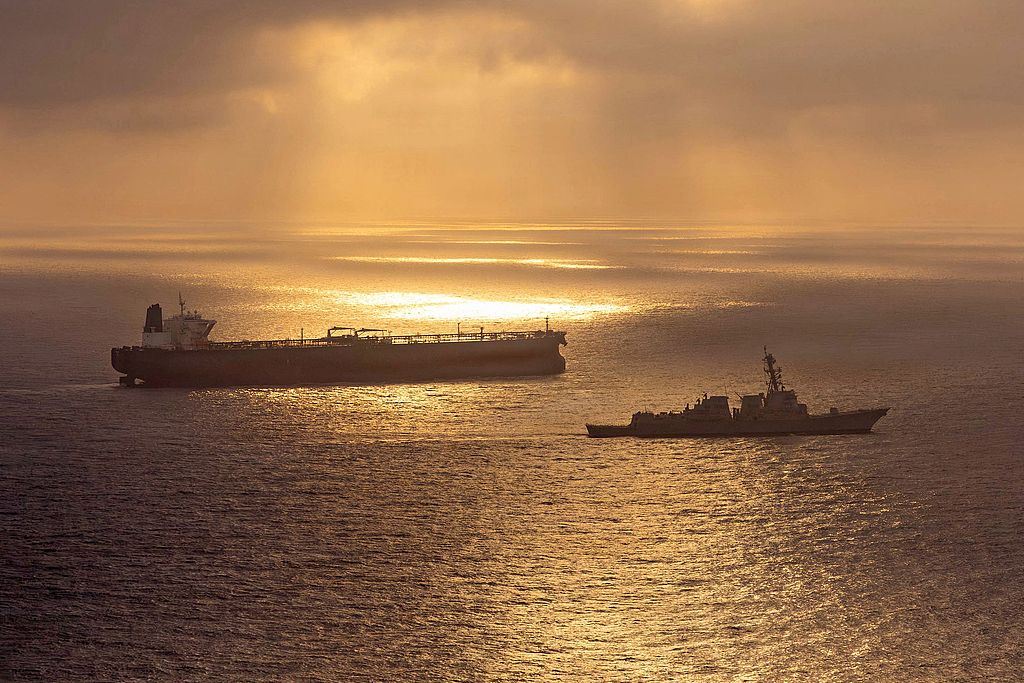
The US Central Command said that since the start of the sea blockade against Iran, the US military has prevented more than 70 oil tankers from entering and leaving Iranian ports. In addition, the US military has “changed” the routes of 57 merchant ships and paralyzed four merchant ships. Currently, the US Navy has three destroyers in the Arabian Sea to enforce the sea blockade against Iran. The US Central Command also said that the blockade action against Iranian ports is “still fully effective.”
Ship tracking data shows that as of 8 am local time on May 8, no large ships have passed through the Hormuz Strait in the past 24 hours. This is the second consecutive day that no large merchant ships have passed through the strait since May 7.
The Hormuz Strait connects the high seas or exclusive economic zones and is a typical international strait. The United Nations Convention on the Law of the Sea stipulates that coastal states shall not restrict or charge tolls on passage. As of April 2026, more than 168 countries and entities have formally approved the United Nations Convention on the Law of the Sea, including China, Russia, Japan, India, and most coastal states and major powers. Iran has not formally approved the United Nations Convention on the Law of the Sea, so it claims not to be bound by the “right of transit passage.” The United States has also not formally approved the law.
CITIC Securities Research Report pointed out that regardless of the development of the US-Iran game, the current market is still in the process of the Hormuz Strait blockade impacting the fundamentals of oil transportation. The opening of the Hormuz Strait will inevitably lead to a scramble for crude oil globally, which will also be transmitted to the oil tanker transportation market.

