

After 40 days at sea, the highly anticipated “Hondius” cruise ship, which was affected by the outbreak, has finally docked and begun evacuating its passengers and crew.
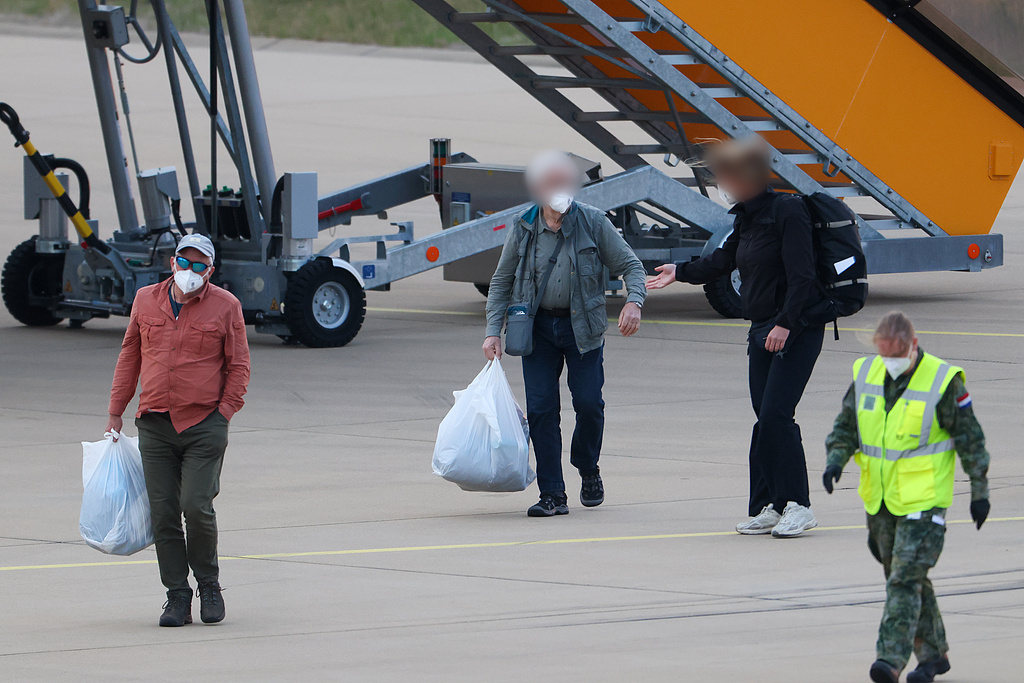
On May 10, local time, the “Hondius” arrived in the port of Gran Canaria, Spain, off the west coast of Africa. As of that afternoon, 49 passengers and crew members from 14 different countries, including Spain, France, Canada, and the Netherlands, had completed their evacuation. The entire repatriation operation is expected to be completed by the next day.
According to CCTV News, Spanish Health Minister Mónica García stated at the evacuation site that all passengers and crew members on board were in good physical condition and showed no symptoms of hantavirus infection.
However, US health officials reported that 17 American passengers on board had undergone hantavirus testing, with one person testing positive but showing no symptoms.
Diana Rohas Álvarez, a WHO health expert involved in the operation, further explained that health personnel boarded the ship to assess the health status of all passengers and crew members. Passengers were evaluated in batches by country and then taken ashore by bus to board flights back to their home countries, where they would undergo further quarantine.
The Dutch-registered cruise ship will need to return to a Dutch port. Approximately 30 people will accompany the ship to the Netherlands under medical supervision.
The “Hondius” set sail on April 1 from Ushuaia, Argentina, crossing the South Atlantic and passing through the Falkland Islands, South Georgia, Tristan da Cunha, Gough Island, and Saint Helena, before its scheduled arrival in Cape Verde on May 3.
On April 11, the first case of illness was reported on board. An investigation into the couple’s travel history revealed that they had visited Argentina, Chile, and Uruguay before boarding the ship. They had arrived in Argentina on November 27 last year, driven for 40 days, and then entered Chile on January 7 this year. They continued their self-drive tour and re-entered Argentina’s Neuquén Province on January 31, before returning to Chile in mid-February.
Most passengers on the cruise were elderly individuals with weaker immune systems, and the ship’s ventilation system and public areas were prone to hiding health risks, making it difficult for passengers to receive timely medical treatment when infected. During the COVID-19 pandemic, the “Diamond Princess” failed to control the outbreak, resulting in 712 passengers and crew members being infected, with a mortality rate of 2.7%.
Years after the COVID-19 pandemic, the global public health community is once again on high alert. The WHO has been working closely with relevant departments in Cape Verde, Spain, the Netherlands, South Africa, the UK, and Argentina, as well as the European Centre for Disease Prevention and Control, to track all individuals, including reviewing flight and ship seating charts, and possibly tracing the movements of certain individuals to see where they have been or who they may have come into close contact with.
As the fact of human-to-human transmission has been confirmed, and case data is being released, most authorities and experts are trying to alleviate public fear.
WHO spokesperson Lindmeier emphasized that hantavirus has been known for about 30 years, with approximately 2,000 cases reported globally each year, and a low incidence rate. The virus is not highly contagious and does not spread easily between people.
Some individuals who had close contact with infected people have tested negative for the virus, which suggests that the risk of hantavirus to the general public is extremely low. Even those who shared cabins with infected individuals did not necessarily contract the virus.
The WHO and some national health departments have confirmed that the hantavirus strain involved in this outbreak is the Andes virus. This virus, found in Latin America, is the only known hantavirus strain that can spread between people, which has further fueled negative speculation and public anxiety.
WHO Director-General Tedros Adhanom Ghebreyesus stated at a press conference that, given the Andes virus’s incubation period of up to six weeks, more cases may be reported in the future. He emphasized that, although this is a serious outbreak, the WHO assesses that the risk to public health remains relatively low.
Meanwhile, countries along the affected route, including Spain, the UK, Cape Verde, the Netherlands, Argentina, Switzerland, and the US, are conducting tracing and control work.
According to the Chinese Embassy in Cape Verde, there are no Chinese citizens on board. Cape Verde, located in West Africa, refused to allow the “Hondius” to dock at the port of Praia, the capital, on May 4, citing a respiratory disease outbreak on the ship.
On May 9, the Yibin City Disease Control and Prevention Center in Sichuan Province reported that online rumors about a Yibin resident, Chen, being linked to the hantavirus outbreak on the “Hondius” were unfounded. Chen had disembarked on March 31, while the first case on the ship did not occur until April 1, and there was no possibility of contact between them.
In response to public concerns about the hantavirus outbreak, the Chinese Center for Disease Control and Prevention (CDC) published an article on May 8 titled “What is hantavirus? How is it transmitted? How can it be prevented?”
The article mentioned that hantavirus is known as “epidemic hemorrhagic fever” in China, which is a high-risk area, especially outside of Qinghai and Xinjiang. Patients are mainly male farmers and workers, but the general population is also susceptible. Severe cases can be fatal if left untreated.
In recent years, the incidence of hemorrhagic fever with renal syndrome (HFRS) in China has been declining. The Andes virus has no natural hosts in China and no human cases have been reported.
