On the 9th, the US Central Command announced that at 5 PM Eastern Time, US forces launched “self-defense strikes” against Iran in response to the downing of a US Apache helicopter near the Strait of Hormuz the previous day. The operation, ordered by President Trump, lasted about four hours. Iranian media reported that the US used the helicopter incident as a pretext to attack southern Iran. On the 10th, Iran’s armed forces retaliated with drones and missiles against US military bases in the Middle East. Iran denies any involvement in the helicopter crash, accusing the US of using the event to justify its aggression. Reuters noted that the violence has cast doubt on prospects for ending the war and further strained an already fragile ceasefire. Iran’s Foreign Ministry spokesman, Baghaei, said on the 10th that continued US ceasefire violations have undermined diplomacy, requiring a reassessment of the situation.
20 VS 21
On the 9th, Trump posted on social media that Iran shot down a US Apache helicopter on a patrol mission over the Strait of Hormuz the day before. “Both pilots are safe. Nonetheless, America must and will respond to this attack.” In an interview with ABC, Trump added, “I think we should respond very strongly, very forcefully.”
The US military stated the helicopter crashed while patrolling off the coast of Oman. The Central Command didn’t specify the cause, only noting the crew was rescued two hours later and is in stable condition. The Associated Press, citing US officials, reported the helicopter crashed after colliding with an Iranian drone, though it’s unclear if the collision was intentional. Iranian state media, citing military sources, said on the 10th that no offensive aerial operations were conducted over the Strait of Hormuz in the past 24 hours.
Around 9 PM Eastern Time on the 9th, the US Central Command announced on social media that the “self-defense strikes” against Iran were complete. The statement said US Air Force and Navy jets precisely targeted Iranian air defense facilities, ground control stations, and radar positions near the Strait of Hormuz. “This operation is a proportional response to recent attacks on US forces and international commercial shipping transiting the region.”
Fox News reported that a senior US official said the strikes hit 20 targets inside Iran. Though the Central Command declared the operation over, the situation remains “fluid,” and the US is prepared for any Iranian retaliation.
In response, Iran’s Islamic Revolutionary Guard Corps (IRGC) called the helicopter crash a “false pretext.” In a statement on the 10th, the IRGC said the US strikes damaged a telecom tower in the Sirik area and destroyed two reservoirs. As retaliation, the IRGC launched drone strikes against the US Fifth Fleet facilities in Bahrain.
Later that day, the IRGC said it used missiles to strike and destroy four key targets at the US Al-Azraq Air Base in Jordan, including a command center and an F-35 hangar. The IRGC also claimed it hit 21 targets at US air and naval bases in the Middle East and shot down an MQ-9 Reaper drone over Jam, Bushehr Province.
The IRGC’s Khatam al-Anbia Central Headquarters warned on the 10th that if US aggression continues, Iran will launch more powerful and widespread strikes on predetermined targets in the Middle East.
Iranian Foreign Minister Araghchi posted on social media on the 10th, saying that despite repeated failures on the battlefield, the US persists in testing Iran’s resolve. “Our powerful armed forces will never ignore any attack or threat.” He warned, “If you want safety, leave our region.”
Iran Warns Gulf Neighbors Again
Axios reported that on the 10th, Iran fired at least four missiles and several drones at US bases in Bahrain, Kuwait, and Jordan.
According to Reuters, Jordan’s armed forces said on the 10th that they intercepted and shot down five missiles heading from Iran toward Al-Azraq. Debris fell in Jordan, but no casualties or damage were reported. Kuwait’s Defense Ministry said it intercepted “hostile aerial targets,” and a Bahraini royal advisor stated on social media that Bahrain’s air defenses repelled Iranian attacks. A US official said initial assessments indicate nearly all missiles and drones were intercepted, with no reports of US casualties or facility damage.
On the 10th, Iran’s Foreign Ministry condemned the US strikes on southern Iran as a flagrant violation of the UN Charter. It reminded countries in the Middle East, especially those on the southern Persian Gulf coast, of their legal and moral duty to prevent the US and Israel from using their territory and facilities to plan, organize, or support aggression against Iran. The statement emphasized that Iran will not hesitate to exercise its inherent right to self-defense, including striking the source of attacks and facilities supporting aggression.
Reuters noted that this latest exchange is one of the largest hostile actions between the two countries since a ceasefire was reached in April. The incident could further hinder peace talks aimed at ending the war and reopening the Strait of Hormuz. The US has repeatedly said a deal is near, but negotiations have stalled since the ceasefire took effect. Meanwhile, Israel-Hezbollah conflict continues in Lebanon, Iran still restricts passage through the Strait of Hormuz, and the US maintains a blockade of Iranian ports.
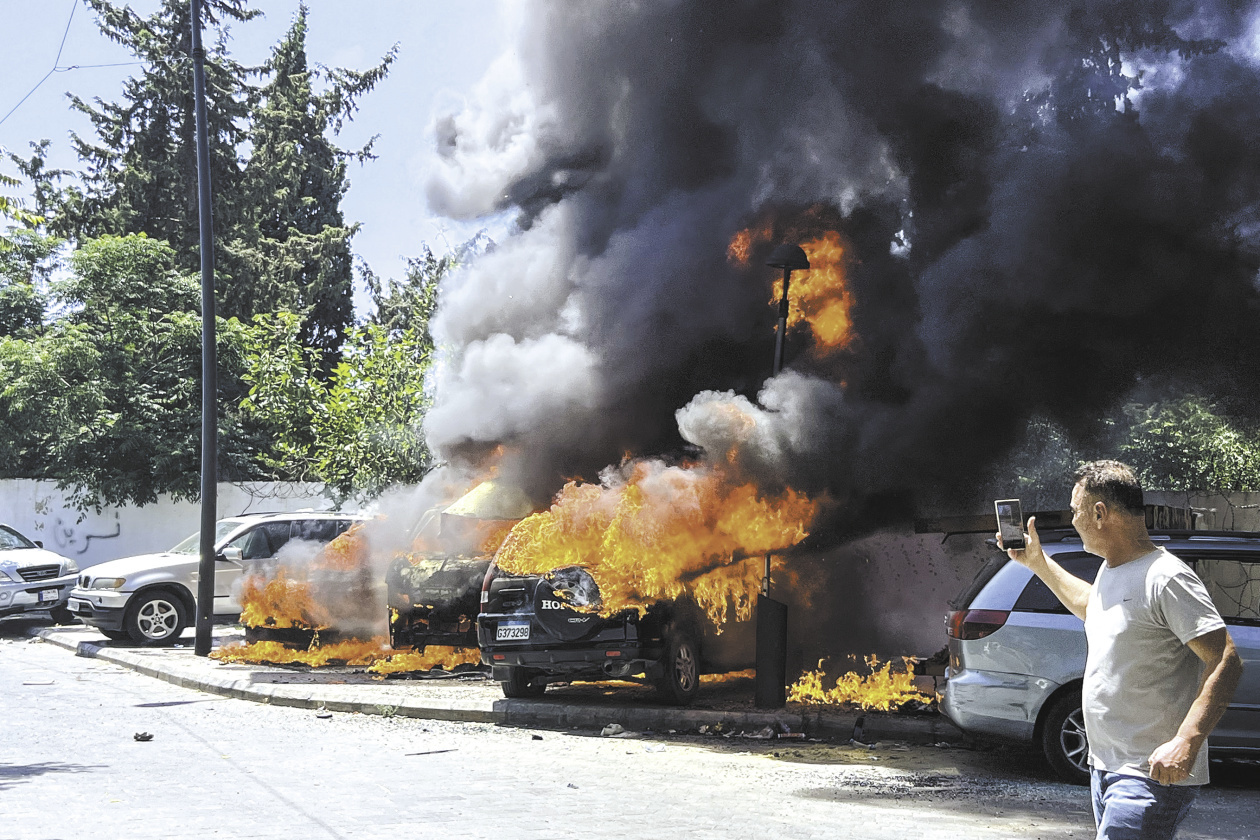
Israel’s military operations in Lebanon are a major complicating factor in US-Iran negotiations. On the 10th, Israel continued its offensive in southern Lebanon. Pictured: A burning car after an attack in the southern city of Sidon. (Visual China)
The Associated Press pointed out that this is the second time this week that hostile parties have tested the ceasefire, following mutual attacks between Iran and Israel on the 8th. This has raised new questions about how much pressure the ceasefire can withstand before collapsing. Both the US and Iran seem to be seeking a way out of the conflict, provided they can claim victory at home. However, Israeli Prime Minister Netanyahu appears determined to pursue more difficult goals: overthrowing the Iranian government, dismantling its nuclear program, and eliminating Hezbollah in Lebanon. This will make compromise increasingly difficult.
Trita Parsi, Executive Vice President of the Quincy Institute for Responsible Statecraft, said Iran’s swift response to the US attack marks a new norm: any US attack must be met with a proportional, severe, and rapid response; otherwise, it would set a precedent for the US to strike Iran with impunity. But he also noted, “Every time something like this happens, I get a sense from both sides that their confidence in reaching a deal is waning.”
US Threatens Iran with Consequences
On the 10th, Trump posted on social media, “Iran has taken too long to negotiate a deal that would have been very good for them. Now they must pay a price!” In an interview with Fox News, he accused Iran of deliberately stalling in peace talks and suggested he might order US forces to target Iran’s power plants and bridges.
CNN reported that Trump did not specify what “pay a price” means. It remains unclear whether this is tough talk to push a deal or a genuine consideration of new action.
Despite Trump’s threats to escalate against Tehran, sources told CNN that a Qatari delegation traveled to Tehran on the morning of the 10th to meet with Iranian negotiators in an effort to bridge differences. A senior White House official also confirmed to Fox News Digital that peace talks between the US and Iran are continuing. “The US has responded to the Apache attack and will continue to apply maximum pressure to facilitate a deal,” the official said.
The Wall Street Journal reported that diplomatic efforts to end the US-Iran war have yet to bear fruit, with both sides still struggling over key issues. The lack of progress means the US and Iran remain locked in a low-intensity conflict, neither willing to accept a bad deal and risk appearing weak. The conflict is entering a new, riskier phase: both sides are trying to maintain pressure and respond to provocations while avoiding all-out war, but the risk of crossing red lines and triggering a dangerous escalation remains ever-present.
According to Iran’s Student News Agency on the 10th, President Pezeshkian said Iran must break free from the “no-war, no-peace” state. Speaking at an event commemorating the late Supreme Leader Ali Khamenei, Pezeshkian said, “War is not in the national interest, but if they attack our territory, we will not surrender or back down.”