

On June 11, German Chancellor Friedrich Merz told the Bundestag that Germany “cannot and will not stand idly by” while the EU takes measures against countries that “don’t play by the rules.” Media outlets like Politico Europe and Bloomberg interpreted this as a signal that Berlin is shifting to a tougher stance on China.
Merz stated that Europe benefits more than any other region from an open and fair global trading system—a point that remains unchanged. But he added, “If others don’t follow the common rules, we cannot and will not stand idly by.”
He warned, “We’ll protect our interests and economy from unfair trade practices that distort competition.”
Bloomberg noted on June 11 that while Merz didn’t name China directly, the context was clear given the EU’s ongoing push for stronger measures against Beijing. Politico Europe said his remarks signaled German support for the EU Commission’s recent hardline trade proposals targeting China.
Merz also mentioned that at the upcoming EU summit, member states will discuss how to sharpen the bloc’s policy tools and leverage the EU’s unified market to promote a fairer, more transparent competitive landscape.
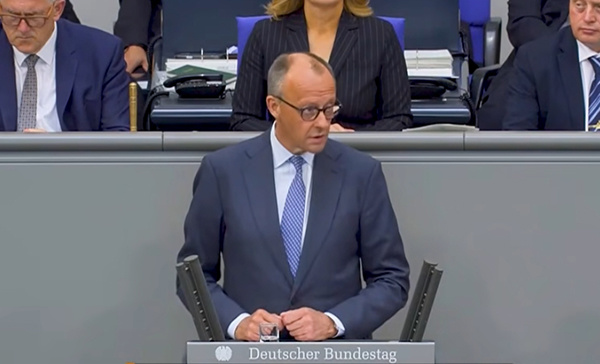
Merz speaking at the German Bundestag on June 11. Video screenshot.
EU leaders are set to meet in Brussels from June 18-19, with a focus on addressing so-called Chinese industrial “overcapacity” and government subsidies. A package of measures is expected to be announced.
Germany has long been a pragmatic voice on China policy within the EU. But with its economy struggling and manufacturing facing rising competition, domestic calls for a tougher line on China are growing, drawing attention to the government’s stance.
Reuters reported on June 11 that Merz appears to be wavering on China, and his coalition government remains divided. Germany’s auto industry fears a trade war with China. Major carmakers like Volkswagen, Mercedes-Benz, and BMW have manufacturing bases in China and worry about impacts on exports to Europe, as well as potential Chinese retaliation.
On the other hand, German steel and pharmaceutical companies are leaning toward supporting the EU’s hardline stance. Noah Barkin, a senior advisor at the Rhodium Group, said the Federation of German Industries has recommended in a confidential memo pushing for stronger “de-risking” policies toward China, even if “it comes with huge costs, including retaliation.”
Within the EU, opinions on how to handle relations with China remain split. The South China Morning Post previously noted that EU member states have long struggled to unify their China policies, and the threat of Chinese countermeasures has further deepened internal divisions. The New York Times also pointed out that reducing reliance on China is extremely tricky for Europe. On one hand, politicians and businesses fear backlash; on the other, consumers love affordable, high-quality Chinese goods.
But as Europe’s domestic industries lose competitiveness, politicians are looking for scapegoats and have revived the “China overcapacity” narrative. Recently, the EU has been rolling out new measures targeting China. The EU Commission’s proposed Industrial Accelerator Act introduces restrictions on foreign investments in batteries, EVs, solar energy, and critical raw materials. A revised Cybersecurity Act draft could even exclude Chinese tech products.
China has already made it clear it will take necessary countermeasures. The Financial Times reported on June 11 that Beijing abruptly canceled two key EU-China dialogues scheduled for this month in Beijing. Insiders said no reason was given, but it’s seen as a signal of displeasure with the EU.
Commenting on Europe’s growing protectionist tendencies, Ding Chun, director of the Center for European Studies at Fudan University and president of the Shanghai European Society, told HA Viewpoint that China has remained restrained and has consistently urged the EU to assess the situation carefully. In fact, China has already introduced measures to safeguard its industrial and supply chain security and to counter extraterritorial jurisdiction, retaining necessary counter tools.
Ding added that China believes Europe should boost its competitiveness through internal innovation, not through market-distorting protectionist measures. All parties should work together to avoid escalating trade frictions down the wrong path.
