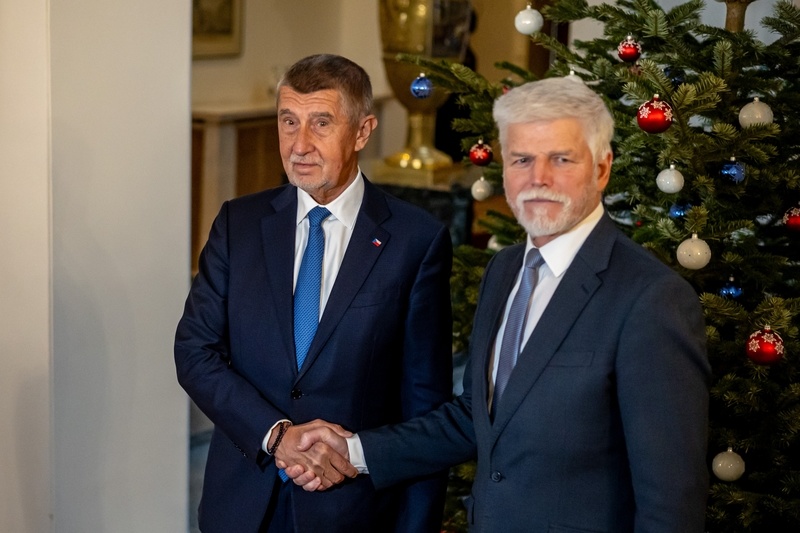
On the morning of June 22, UK Prime Minister Keir Starmer walked into the sunlight of Downing Street, accompanied by his wife and staff. His voice choked with emotion, he admitted that he was no longer the right person to lead Britain. Starmer had once recorded a landslide victory in British politics, but now, after less than two years in office, he is leaving in disgrace. His departure means that Britain will see at least its eighth Prime Minister in the past decade, a frequency of political turnover that sets a record for the last two centuries.
“Who can save Britain? Frequent changes in Prime Ministers reflect the country’s deep-seated malaise.” On the same day Starmer announced his resignation, Reuters posed this “soul-searching question.” The report argues that, like his predecessors, Starmer failed to quell public dissatisfaction over stagnant living standards—British people’s living conditions have hardly improved since the 2008 financial crisis. Meanwhile, global shocks like the pandemic have caused national debt to surge, severely constraining the government’s fiscal capacity. The failure to effectively address illegal immigration has also exacerbated deep political divisions within the country.
Historian Anthony Seldon, who has documented the rise and fall of successive UK Prime Ministers in works like The Impossible Office, points out that Britain has fallen into extreme difficulty. After Starmer and his predecessors, such as Liz Truss and Boris Johnson, failed to win public confidence and trust through clear visionary narratives, the country is in a dire strait. Speaking about potential successors to Starmer, he told Reuters: “If Andy Burnham also fails after becoming Prime Minister, Britain’s prospects will be bleak.”
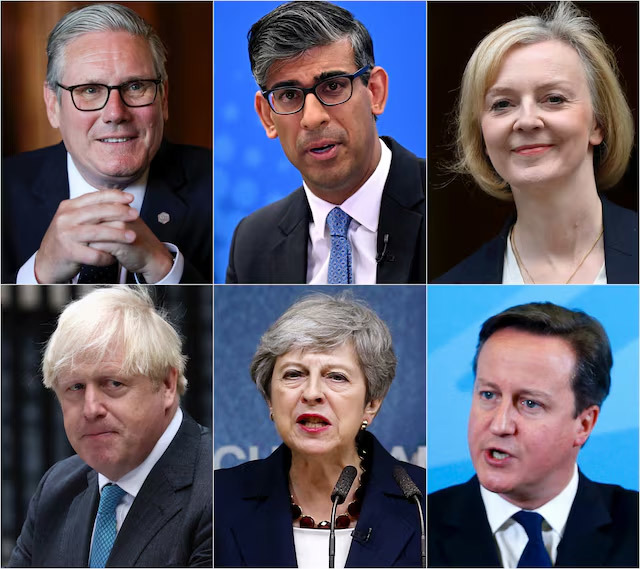
Six UK Prime Ministers have resigned in the last decade. Archival photo.
A Pillar of Stability Once Was
Britain was once seen as a cornerstone of political and economic stability. Leaders like Margaret Thatcher and Tony Blair, who together served for 21 years, reshaped the face of modern Britain. However, Britain’s economic growth had heavily relied on its massive financial sector, and the global financial crisis dealt a heavy blow. The subsequent austerity policies in the public sector left the country ill-prepared to handle subsequent challenges.
The last Prime Minister to win a general election without support from other parties and serve a full term was Tony Blair, from 2001 to 2005. People once mocked Italy for its frequent changes in leadership, but now they might look at Italy’s current Prime Minister Giorgia Meloni with envy— she is poised to become the longest-serving head of government in the history of the Italian Republic, having been in power for nearly four years.
In 2016, Britain voted to leave the EU, completely breaking its long-standing foreign policy model. This move also rekindled the Scottish “independence movement,” as Scottish voters had previously voted to remain in the EU. Although many commentators attribute Britain’s instability to the “Brexit” referendum that is coming up to its 10th anniversary this week, Jill Rutter, a former UK treasury official and senior fellow at the Institute for Government (IfG), believes the root of the problem started with the financial crisis.
“People generally feel that there is no sign of improvement in their own lives or their children’s lives,” she said. “Moreover, every government since seems powerless to change this situation.”
In addition, fiscal measures taken to cope with the pandemic and the Russia-Ukraine conflict pushed the national debt level to nearly 100% of GDP. Although Japan, Italy, the US, and France have higher debt-to-GDP ratios than the UK, Britain’s borrowing costs are higher. This is partly due to stubborn inflation and external concerns about its reliance on foreign investors to cover fiscal deficits.
This constraint on spending has severely affected people’s living standards. Data from supermarket giant Asda and the Centre for Economics and Business Research (CEBR) in 2025 shows that although the average real disposable income in the UK has increased, for the lowest 40% of earners, purchasing power is lower than in 2021.
Divided by “Brexit”
Politico Europe reported on June 23 that among the 103 Labour MPs who publicly demanded Starmer’s resignation in recent weeks, 63 were newly elected in 2024. Most of them had little or no parliamentary experience before 2016, a period of relative stability when Britain had only eight Prime Ministers in nearly 50 years. Therefore, 2016 became a “watershed,” and the shadow of the Brexit referendum still lingers over Britain today.
The report says that for Labour MPs, they cannot ignore the growing, volatile anger of voters, and the debate over “Brexit” has shaped voters’ positions. Although the European issue is no longer a particularly prominent topic for most voters, recent research shows that the division between the pro-Brexit and anti-Brexit camps (located on the right and left wings respectively) continues to affect election results.
The US Los Angeles Times also pointed out on June 22 that ten years after the Brexit referendum, Britain remains severely divided. Leaving the EU triggered the biggest economic and social changes since World War II, but the promised revitalization plans have largely failed to materialize.
Trade barriers with Europe, stalled trade agreements with the US, and continued slowing economic growth have made the UK’s economy smaller than it would have been had it remained in the EU. This has fueled anger over immigration and led to a decline in living standards.
Furthermore, since “Brexit,” the UK’s political landscape has become increasingly fragmented. The two dominant parties, the Conservative and Labour parties, have seen their support rates continue to fall. The Conservatives, after 14 years in power, went down in 2024. During their tenure, most of the time was spent in fierce debates over Britain’s relationship with Europe.
Today, millions of voters are being drawn to Nigel Farage, who leads the right-wing populist Reform UK party. Farage has been more proactive in supporting Brexit than any other politician, and for over a year, his party has led in almost all opinion polls.
However, more and more people in the UK believe that “Brexit” failed, and this is where British society is currently divided. According to two Ipsos polls, 52% of the British public hope the UK rejoins the EU, while 33% are opposed. The poll also found that 48% believe the progress of Brexit is worse than expected, while only 9% think it is better. Additionally, Ipsos survey shows that 48% support an immediate referendum on whether to remain in the EU, while 27% are opposed.
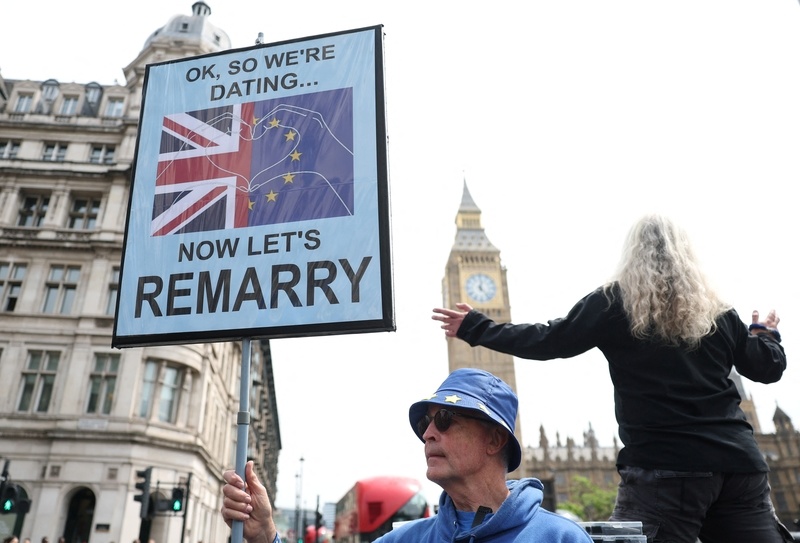
On May 21, 2025, pro-EU demonstrators gathered in London to protest. IC Photo
Why Is Nothing Working?
Sam Freedman, a former UK government advisor, points out in his recent book Failed State: Why Nothing Works and How We Fix It that power in the UK is too centralized, and key national functional departments are too small to handle various challenges.
Roger Gale, a senior MP who entered parliament in 1983 and is one of the longest-serving members in the UK, believes with Jill Rutter of the Institute for Government that Britain’s political culture is deteriorating. All-day rolling TV channels and social media force politicians to make quick decisions.
Gale, a Conservative MP, told Reuters that the government needs to slow down. “There is too much legislation, much of it is bad, and the drafting quality is poor,” he said. “We need a more mature and steady government.”
Reuters points out that Starmer has been criticised for taking office without a clear plan to deal with various challenges, ranging from soaring electricity bills to stimulating investment, improving medical services, and increasing defense spending.
The US Washington Post published an editorial on June 22 with a rather ironic title: Is this US盟国 (ally) difficult to govern? The article mentioned that Prime Minister Starmer’s resignation was less due to the scandal of appointing Peter Mandelson, who has close ties to Epstein, and more because he was unable to get the country out of economic stagnation. In fact, before the Mandelson incident erupted last September, Starmer was already one of the leaders with the lowest approval ratings in Western countries.
After winning the largest victory in parliamentary elections in modern British history, Starmer failed to fulfill his campaign promises. For example, Labour’s 2024 campaign manifesto promised not to increase National Insurance contributions (a type of employment tax paid by employers and employees). However, less than three months later, he broke his word.
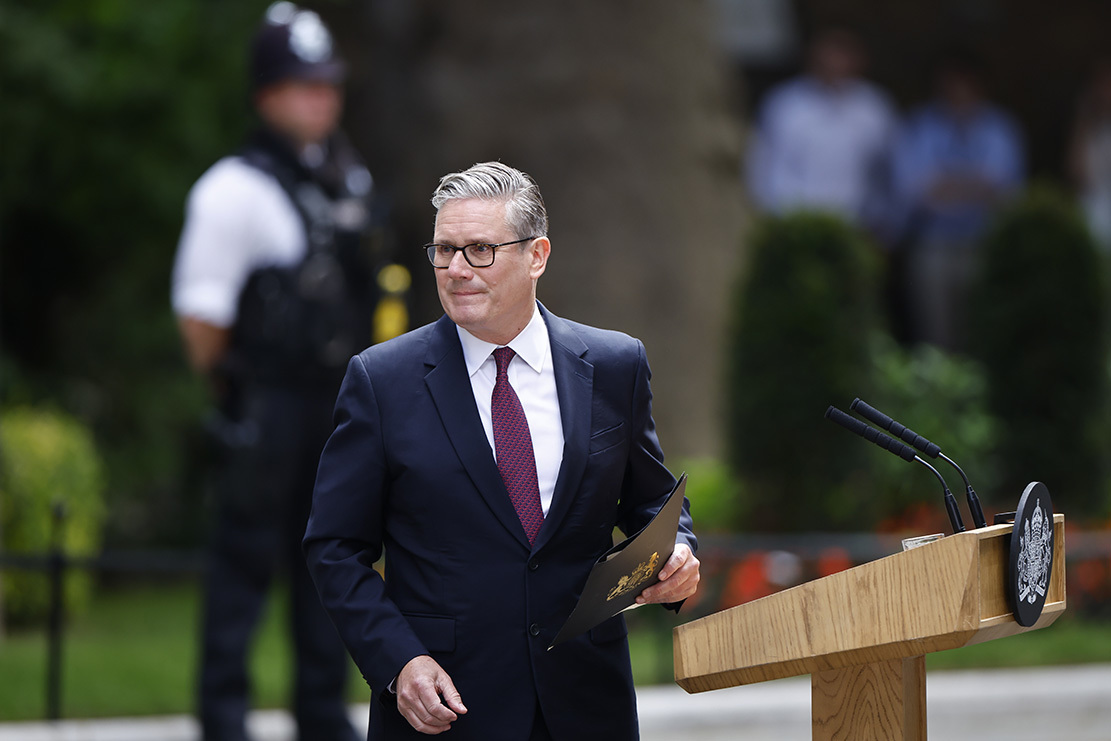
On June 22, UK Prime Minister Keir Starmer announced his resignation. IC Photo
As Starmer’s rival, Burnham, who previously served as the Mayor ofGreater Manchester, may assume the roles of Labour Party leader and Prime Minister within a few short weeks. At that time, he will need to form a cabinet and draw up a clear vision for the country.
The 56-year-old Burnham has also publicly stated that once the Labour Party starts a leadership contest, he will definitely run. Polls show that if Labour members vote to elect a new party leader, his chances of winning are great. Burnham has always advocated for the nationalization of key public services and has criticised the flaws of neoliberal economic policies. The Washington Post also noted that Burnham seems more enthusiastic about government intervention in the economy than Starmer.
However, Reuters analysis suggests that, like Starmer, Burnham may find that his room for policy action is quite limited if he succeeds: on the one hand, constrained by bond market investors who反对 (oppose) any additional borrowing; on the other hand, facing angry voters who believe the country’s operation is broken.
Britain is already the G7 member with the highest borrowing costs. Economists at Citibank believe that if Burnham becomes Prime Minister, “he will inherit a precarious fiscal situation with almost no policy tools to achieve meaningful change.”
Rishi Sunak, the former Conservative Prime Minister who lost to Starmer in the 2024 general election, stated that Burnham needs a plan. Writing in the Sunday Times, he wrote: “Without a plan, he will become another sleepless Prime Minister, anxious about why policies are not working.”