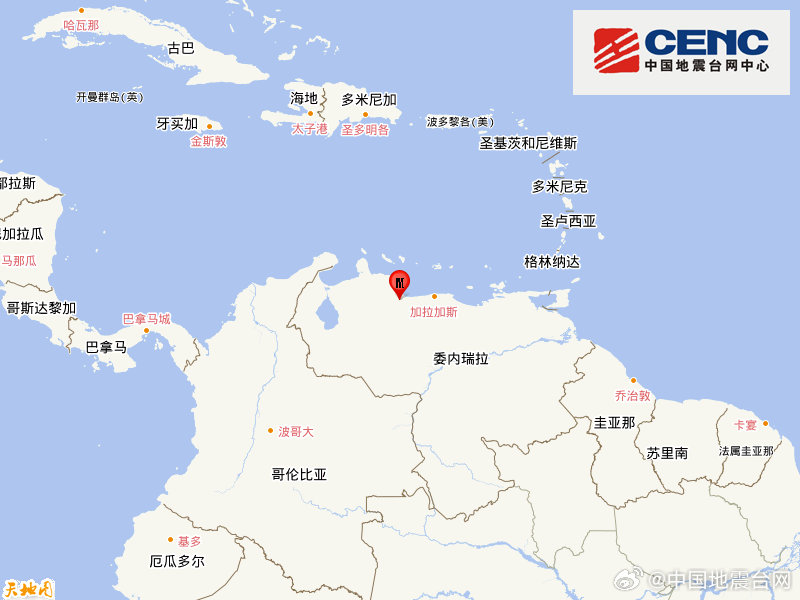
Official reports from Venezuela confirm that a series of powerful earthquakes has claimed at least 164 lives, leaving 971 others injured and triggering 30 aftershocks.
Just around 6:00 PM local time on June 24, 2026, the northern coastal region of Venezuela was struck by two major quakes, both measuring above 7.0 on the Richter scale, within a single minute. The epicenter was located near Morón in Carabobo state, roughly 160 kilometers from the capital, Caracas.
The Chinese Embassy in Venezuela has issued urgent reminders for Chinese citizens in the area to stay alert to local earthquake warnings and disaster updates. We advise maintaining calm, ensuring personal safety, and keeping communication devices charged and accessible. Residents in affected zones should immediately move away from the coastline and relocate to safe inland areas.
Venezuela holds the world’s largest proven oil reserves, estimated at around 303 billion barrels, accounting for 17% of global total reserves. Montalban, home to some of the country’s largest refineries, is located just about 28 kilometers from the epicenter. Rumors initially circulated that these facilities had shut down emergency operations.
However, sources close to the situation indicate that Venezuela’s three core refineries, which collectively handle 82% of the nation’s total refining capacity, are currently running normally. Given the aging infrastructure of Venezuela’s oil facilities, market watchers are now waiting for an official assessment from PDVSA, the state-owned oil company, before drawing final conclusions.
Amidst weak global demand and geopolitical tensions involving the U.S. and Iran, international oil prices didn’t panic-surge following the earthquake. Instead, prices dipped to lower levels, reflecting market stability despite the disaster.

Earlier this year, in January, the Trump administration lifted long-standing oil sanctions on Venezuela through executive action, allowing major players like Chevron to participate in trade. This move permitted Venezuelan heavy crude to flow directly to refineries along the U.S. Gulf Coast.
Following this policy shift, the United States became Venezuela’s primary export destination. U.S. Energy Secretary Wright had previously stated that during this administration, Venezuela’s daily oil exports could reach 2 million barrels. However, this earthquake may lead to a short-term reduction in crude exports to the U.S.
Recently, at a rally in Pennsylvania, former President Trump claimed that the military operation against Venezuela lasted only 48 minutes and was won decisively. He further asserted that exporting millions of barrels of oil had fully recouped military costs, boasting a return rate exceeding 28 times.
Chevron remains the only major U.S. energy giant maintaining large-scale operations in Venezuela. Its core business relies on five joint ventures with PDVSA, deeply involved in extracting heavy and extra-heavy oils. The company released a statement confirming that local operations remain normal and all employees are safe.
The northern region of Venezuela sits at the collision zone between the Caribbean and South American tectonic plates, hosting several active fault lines where crustal energy continuously accumulates. Seismic activity in the area is characterized by high frequency and periodic bursts. Historically, the 1967 Caracas earthquake, measuring between 6.5 and 6.7, resulted in hundreds of casualties.