HA Viewpoint: Uncertainty looms large over the next steps in US-Iran negotiations. As reported by HA Viewpoint, the US and Iran have sent conflicting signals this week regarding the prospect of talks in Qatar, injecting fresh doubt into a peace process that should be focused on resolving Iran’s nuclear program. While both sides have dispatched delegations to Doha, Washington insists talks will happen, whereas Tehran repeatedly denies this. Qatar confirmed on the 30th that the US and Iran will not hold face-to-face or high-level meetings. US media describes this as a “significant setback” since the memorandum of understanding was signed.
According to Iranian state media, acting Defense Minister Reza stated on June 30 that due to deep mistrust of the US and its continued support for Israel, the Iranian armed forces remain on high alert. They vowed a decisive response to any violation of the current ceasefire agreement.
Qatar Clarifies: US Representatives Will Meet Mediators, Not Iran Directly
The confusion followed President Trump’s announcement on June 29 via social media that US-Iran talks would take place in Doha the next day. White House Press Secretary Levitt later confirmed that US Presidential Envoy Witkoff and Trump’s son-in-law, Kushner, would be dispatched, expecting high-level and technical meetings with their Iranian counterparts. However, this claim was swiftly denied by both Iran and Qatar.
“To my knowledge, there are no direct talks scheduled between the two sides in the coming days,” Qatari Foreign Ministry spokesperson Ansari said on June 30. He clarified that Witkoff and Kushner would meet with mediators and Qatari officials. These discussions would not be limited to Iran but would also cover other regional issues, including the situation in Lebanon.
Although Iran announced it would send an expert delegation to Doha, Foreign Ministry spokesperson Baghaei stated on the 29th that this trip was unrelated to the US delegation. Iran’s mission is to follow up on the implementation of the memorandum’s clauses. Specifically, Tehran is monitoring Washington’s progress on lifting sanctions on Iranian oil sales (Clause 10) and unfreezing Iranian assets (Clause 11). Baghaei emphasized that final agreement negotiations cannot begin until the US implements Clauses 1, 4, 5, 10, and 11. Consequently, Iran has not yet entered the final negotiation stage. On the 30th, Baghaei noted that talks between Iran and Qatar would focus on these implementation issues, including asset freezes.
Iranian President Pezeshkian took to social media to stress that understanding must be mutual. He warned that if the US honors the memorandum, Iran will fully uphold its commitments, but unreasonable rhetoric and groundless threats would be met with decisive action.
Initially, talks were planned for Switzerland this week, focusing on the nuclear issue. However, due to mutual strikes over the Strait of Hormuz arrangements, the location and agenda shifted. Iran’s apparent reluctance to resume face-to-face talks marks a significant regression from the high-level meetings held in Switzerland in mid-June.
Defense Minister: Israel Won’t Withdraw Easily from Lebanon
On June 29, US Central Command commander Cooper met with Lebanese President Aoun to discuss implementing a tripartite framework agreement reached between Lebanon, Israel, and the US. According to AFP, Aoun stated that Beirut plans to deploy troops to the Lebanese-Israeli border to safeguard national sovereignty. Cooper also met with Lebanese Army Chief of Staff Haykal to discuss the latest security developments, the importance of ensuring the framework agreement’s security annex is implemented, and future cooperation.
Under this agreement, the Lebanese army is tasked with disarming Hezbollah.
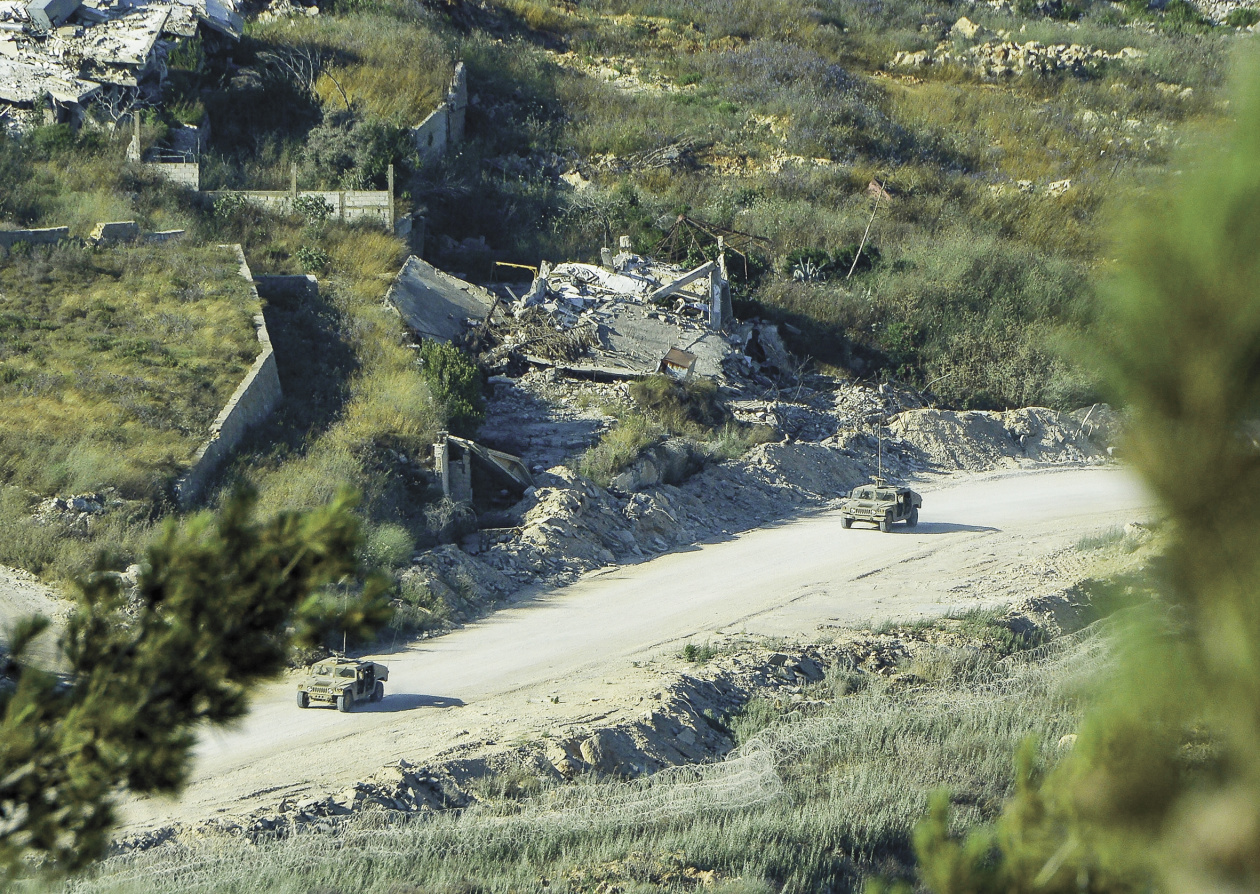
On June 29, an Israeli military jeep patrolled the Lebanese-Israeli border.
That same day, Israeli Defense Minister Katz declared that while Israel has “no territorial ambitions” in Lebanon, the Israel Defense Forces (IDF) will not retreat even an inch until Hezbollah is disarmed. According to The Times of Israel, Katz noted that the US has accepted this principle and included it in the military annex of the framework agreement. He warned that if Iran launches airstrikes on Israel in response to operations in Lebanon, the IDF will respond and is preparing to act independently. “This could happen even within two days. We have targets in Iran, and the IDF is ready and on alert, but we will not interfere with the US President’s actions against Iran,” he said.
In a phone call on June 30, Iranian acting Defense Minister Reza spoke with Qatari Deputy Prime Minister and State Minister for Defense Affairs, Al Thani. Reza stated that Iran is ready to take “necessary and proportionate action” against any US violations of the agreement. He emphasized that the Strait of Hormuz should not be used by extra-regional powers to interfere in regional affairs. He condemned Israeli attacks on regional states, blaming US support for enabling Israel to “exist and become increasingly arrogant.”
Analysis: Lebanon Caught in a Diplomatic Catch-22
Reuters analysis suggests that the tripartite framework agreement, which links Israel’s withdrawal from southern Lebanon to the disarmament of Hezbollah, fails to resolve the fundamental conflict between Israel and Hezbollah. Instead, it risks exacerbating the stalemate, as the condition may be impossible to fulfill.
“This isn’t a real agreement; it’s a solution imposed on the Lebanese government,” a senior Lebanese political figure, speaking on condition of anonymity, told Reuters. Relying on the Lebanese army to disarm Hezbollah ignores the group’s significant military capabilities and ignores the fragile sectarian balance upon which Lebanon’s stability depends. Analysts argue the agreement places Lebanon in a dilemma: it must fulfill impossible obligations while being unable to fully reclaim its sovereignty. Failure to disarm Hezbollah provides Israel with diplomatic legitimacy to maintain an indefinite military presence in southern Lebanon.
Parsi, Executive Vice President of the Quincy Institute for Responsible Statecraft, commented on social media platform X on June 30 that while the new round of US-Iran mutual strikes is already dire, the framework agreement signed by the Lebanese government poses an even greater threat to the ceasefire memorandum.
According to Axios, signed on the 30th, the memorandum pushed by US Vice President Vance gives Iran a voice in the Lebanese ceasefire issue, while the Israel-Lebanon framework agreement mediated by US Secretary of State Rubio aims to prevent Iranian interference in Lebanese affairs. This contradiction initially confused Lebanese and Israeli negotiators, who demanded clarification from the US on which policy route represented the official government stance. However, a US official denied any conflict between Vance and Rubio, stating that these agreements are not mutually contradictory for the US: Iran is calling for a ceasefire in Lebanon, and the US is now establishing the corresponding mechanisms to ensure it.