On June 29, the US Supreme Court handed down a landmark 6-to-3 decision, ruling that President Trump has the authority to remove Rebecca Slaughter, a commissioner of the Federal Trade Commission (FTC). Trump took to social media to declare it a “major victory,” claiming the ruling “greatly” expands the President’s power to dismiss officials in federal agencies. Media analysts suggest this decision effectively strips away some legal protections for the heads of independent federal bodies, fundamentally “rewriting” the boundaries of the President’s power as the nation’s top executive.
According to reports from major outlets like the Associated Press and The New York Times, this significant ruling stems from a recent “dismissal dispute” within the US government. In March 2025, Trump removed Slaughter from her position via email, stating that her tenure as an FTC commissioner was “incompatible with the policy priorities of this administration.” Slaughter immediately sued the Trump administration, arguing the move was illegal and seeking reinstatement. The legal battle, marked by twists and turns over the past year, eventually reached the Supreme Court.
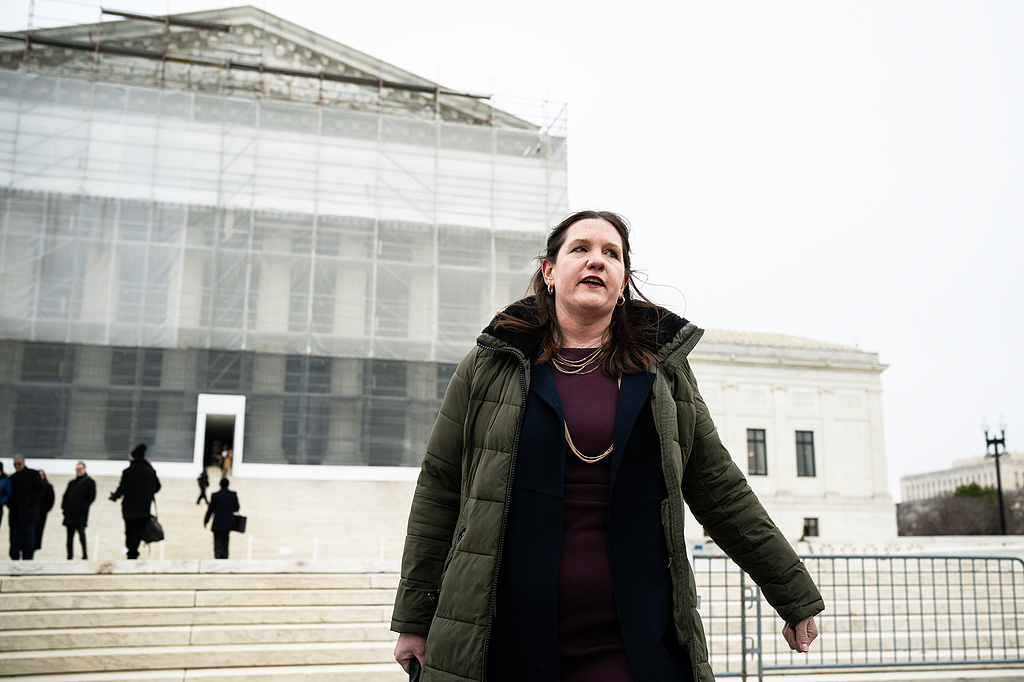
On December 8, 2025, former FTC Commissioner Rebecca Slaughter was seen leaving the US Supreme Court in Washington, D.C.
At the heart of Slaughter’s lawsuit was a pivotal 1935 Supreme Court precedent: Humphrey’s Executor v. United States. In 1933, President Franklin D. Roosevelt dismissed FTC Commissioner William Humphrey due to policy disagreements. Humphrey refused to leave. Tragically, Humphrey died of a stroke in 1934, and his estate executor, Samuel R. Ruffin, inherited his cause and sued the US government, ultimately winning the case. The Court ruled at the time that the President’s power to dismiss leaders of certain independent federal agencies should be limited by Congress.
It is important to understand the structure of the US federal government. It includes executive departments directly answerable to the President, such as the State Department, the Treasury, and the former War Department. However, it also includes more than 20 independent federal agencies, such as the FTC, the Federal Communications Commission (FCC), the Securities and Exchange Commission (SEC), and the Consumer Product Safety Commission (CPSC). Unlike direct executive departments, these agencies possess “quasi-legislative” or “quasi-judicial” characteristics. Major decisions are often made through committee voting, making them less partisan and more neutral. When the FTC was established in 1914, Congress intentionally designed it to be an agency “free from control by the President and the executive branch.” Empowered by the 1935 ruling, these agencies have long enjoyed certain “explicit or implicit protections against dismissal.”
On June 29, the Supreme Court ruled in favor of the White House in the Slaughter case. Chief Justice John Roberts, writing for the majority, stated that the FTC’s dismissal rules violate the constitutional principle of separation of powers. He argued that the agency exercises “significant executive power,” such as issuing legally binding regulations, conducting investigations and enforcement actions, resolving disputes, and recovering damages. These responsibilities, Roberts noted, fall squarely under the President’s jurisdiction. “Subordinate officers who exercise executive power on behalf of the President may be removed by the President at will,” he wrote. He added, “Whatever remains of the Humphrey’s Executor decision, we overturn it today.”
However, many media outlets have characterized the decision as a “party-line vote” driven by ideology among the six conservative justices. The Hill reported that on the day of the ruling, Justice Sonia Sotomayor read her dissent aloud from the bench—a rare gesture reserved for expressing “strong opposition” in the Supreme Court. She argued, “The result of this decision is that the President has acquired enormous power… This power is neither granted by the citizens nor by Congress and the Constitution. The majority of the Supreme Court has reshaped our government.” She criticized the move, stating that the Court not only overturned precedent but also distorted history, and failed to even maintain the “façade of judicial humility.”
While Reuters notes it remains unclear how the ruling will impact other independent federal agencies, the decision in the Slaughter case may fundamentally alter the constitutional foundation of modern US administrative agencies, potentially triggering a wave of future litigation. However, National Public Radio (NPR) points out that the Supreme Court’s ruling still leaves some room for interpretation. Even conservative justices acknowledged that not all independent agencies involve executive power—for instance, the Federal Reserve Board.