

“Spain is beyond hope, and we don’t want to trade with them anymore.” That’s what the US President reportedly declared at the NATO summit in Ankara on the 8th. He threatened to cut all trade ties with Spain following a heated argument over defense spending and the US-Iran conflict. New grievances piling on top of old ones, like the Greenland issue, are deepening the cracks between the US and Europe, making this NATO summit incredibly tense. International media comment that the summit kicked off with the US President’s complaints, completely shattering any sense of unity the meeting was supposed to project.
A major US news network reported on the 8th that hopes for a “more moderate tone” from the US President at this year’s summit have been dashed. Upon arriving in Turkey on the 7th, he was already voicing deep disappointment with NATO. Throughout the schedule, he expressed dissatisfaction with Europe’s stance on the Iran conflict and defense spending.
Spain became the primary target of attack for flatly refusing to increase military spending and denying the US use of its military bases in the Iran conflict. A Spanish newspaper reported that the US President issued a blunt and aggressive threat to Spain on the 8th. He called Spain a “terrible ally,” adding that the country was “beyond hope.” At a press conference, he even “directly ordered an immediate halt to all trade” with the country. Spanish media note that this fierce outburst happened even before a scheduled meeting with the Spanish Prime Minister, making it a clear and deliberate provocation.
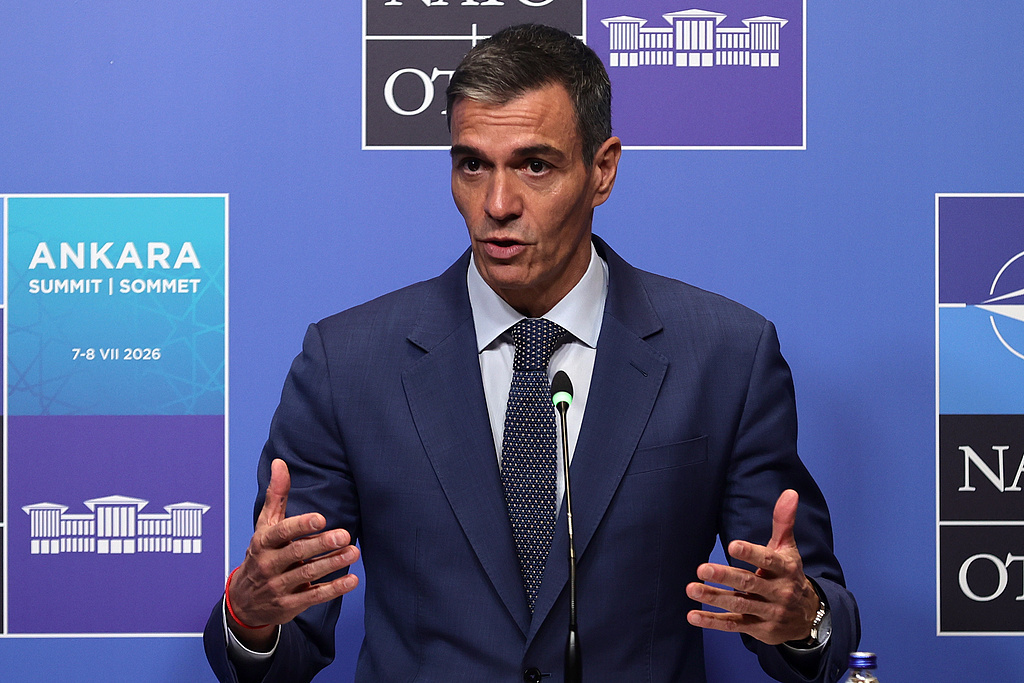
July 8, Ankara, Turkey. Spanish Prime Minister Sanchez speaks at a press conference during the NATO summit. (Image source: Getty Images)
The US President also criticized the UK and Italy, for largely the same reasons as Spain—both countries were unwilling to contribute militarily to the US-Iran conflict.
He claimed the allies “have not been good to us,” saying, “Before I even asked, they said they wouldn’t go, even though we’ve poured trillions of dollars into NATO.” But he also reiterated that he neither needs nor wants their help.
Europe fired back in response. News agency AFP reported that, according to Spanish government sources, Spain’s reaction to the threat was “calm and collected.” A source said, “Our country has excellent social, cultural, and economic relations with the US, and we have no intention of changing that.” A spokesperson noted that the US actually enjoys a trade surplus with Spain, meaning the US benefits more from the bilateral trade relationship. Plus, as an EU member, Spain “cannot” be singled out with trade measures.
In another report from AFP, a European Commission spokesperson stated on Wednesday that the EU will “always ensure” the interests of its member states are “fully protected.”
Regarding the US interest in Greenland, Denmark’s Prime Minister Frederiksen stated on the 8th that Denmark’s position is crystal clear: Greenland is “not for sale.” She also said Denmark is prepared to defend “every inch of NATO territory,” including the Arctic island, if attacked. An EU spokesperson supported Denmark, saying the future of Greenland should be decided jointly by the people of Greenland and Denmark.
During the NATO summit, the back-and-forth attacks between the US and Iran, along with the US President’s focus on his own agenda, overshadowed one of the summit’s original main themes: showcasing Europe’s improved defense capabilities.
At last year’s NATO summit, following a demand from the US, allies agreed to spend 3.5% of their GDP on traditional defense annually, starting no later than 2035. This Tuesday, NATO stated that core defense spending by European nations and Canada increased by 11% in 2026.
Also, NATO leaders unveiled billions of dollars in military procurement orders in Turkey on the 7th, covering counter-drone capabilities and drone purchases. These plans include Denmark, Finland, Germany, and Norway buying Northrop Grumman’s MQ-4C Triton drones, and 11 NATO member states purchasing Saab’s GlobalEye airborne early warning aircraft. The UK also planned to announce a procurement initiative at the summit, investing over $50 billion with 12 European countries, including France and Germany, to develop long-range precision weapons to strengthen NATO’s defenses.
Reuters reported that by announcing these massive arms deals, NATO leaders are trying hard to send a message that they are heeding the US call to increase spending to defend Europe.
However, the worry for Europe came true: the US showed no satisfaction and kept belittling NATO. Bloomberg reported that NATO is considering canceling next year’s annual summit, partly to avoid direct confrontation with the US President and to keep the spotlight off the host, Albania, which has one of the lowest defense spending levels in the alliance. Reuters noted that NATO had hoped to show unity after a tough year, but issues like the Iran conflict have once again exposed the cracks in the alliance that has underpinned Western security since World War II.