

President Donald Trump has officially notified Congress that hostilities with Iran have reignited. In a letter dated July 10, Trump stated that U.S. forces carried out “defensive strikes” against targets inside Iran on July 7.
This message has further inflamed the ongoing rift between Congress and the White House. Despite both chambers previously voting to require the president to either end the war or seek approval before continuing, the White House insists Trump, as commander-in-chief, is acting within his constitutional authority.
On June 23, the Senate passed a resolution limiting the president’s war powers, demanding Trump end military actions against Iran and obtain congressional authorization for any future operations. The House had already approved a similar measure.
Still, the motion is largely symbolic and doesn’t legally bind the commander-in-chief’s authority.
The Combined Maritime Information Center, overseen by the U.S. Navy, announced that American forces will begin a maritime blockade of all Iranian ports and coastal areas starting at 20:00 GMT on July 14 (4:00 a.m. Beijing time on July 15).
The blockade applies to all vessels, regardless of flag. It covers Iran’s entire coastline, including its ports and oil terminals. Neutral ships transiting through the Strait of Hormuz to or from non-Iranian destinations won’t be blocked, and humanitarian aid will be allowed passage after inspection.
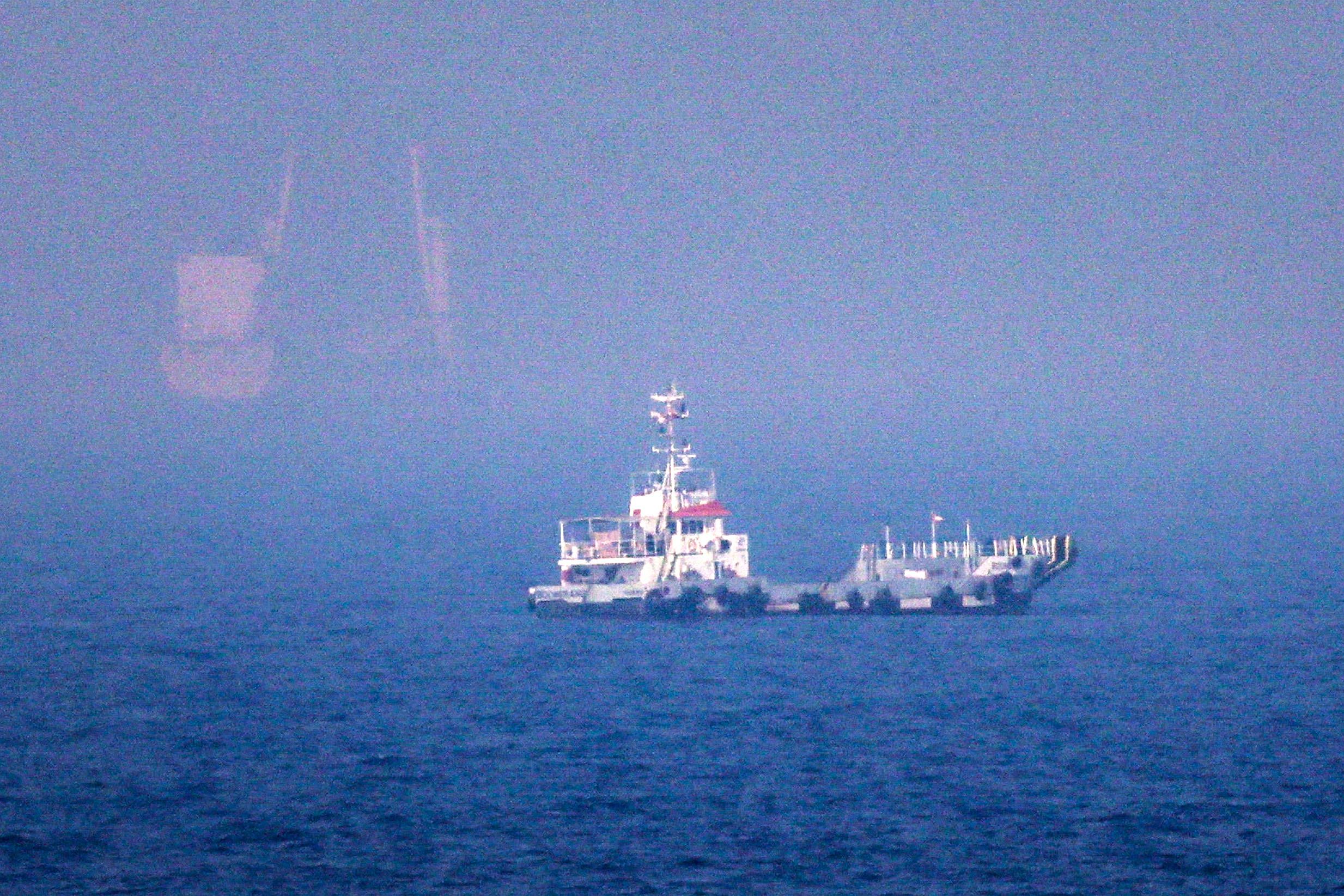
Later that day, U.S. Central Command advised all mariners in the Gulf of Oman and near the Strait of Hormuz to monitor “Navigational Warnings” broadcasts and stay in contact with U.S. naval forces via bridge-to-bridge channel 16.
On the same day, Central Command stated that, under Trump’s direction, U.S. forces launched a third consecutive night of airstrikes against Iran starting at 4:45 p.m. Eastern Time. The operations aim to further weaken Iran’s military capabilities and its ability to threaten innocent civilians and commercial shipping in the Strait of Hormuz.
Earlier, Trump told a radio host that the U.S. would “hit Iran hard tonight and tomorrow.” He also claimed the recent memorandum of understanding with Iran was just a test, one that Iran “failed.”
In the early hours of July 14, Iran’s military issued a statement saying that, in response to recent U.S. provocations and aggression, Iranian forces had launched suicide drones hours earlier, targeting U.S. communication systems, fuel storage facilities, Patriot missile defenses, control towers, and ammunition depots in Kuwait.
Additionally, as a response to U.S. missile strikes on Iranian military sites, the Iranian Navy fired cruise missiles at American warships.
Iran’s military stated that its defensive strikes would be adjusted based on the enemy’s actions and would continue with full force.
U.S. military bases in the Middle East are mainly in Qatar, Bahrain, Kuwait, the UAE, and Saudi Arabia, key among them Al Udeid Air Base and the Fifth Fleet headquarters. Early on July 14, local time, Bahrain’s Interior Ministry reported air raid sirens sounding again.
The recent flare-up stems from attacks on commercial vessels from third-party nations transiting the Strait of Hormuz.
After the U.S.-Iran MOU on June 17, two main shipping lanes emerged in the Strait: a northern lane controlled by Iran and a southern one near Oman, where the U.S. Navy offered assistance. Despite Iran repeatedly urging ships to use the northern route, the U.S. Navy continued recommending the other.
Last week, several commercial ships from Saudi Arabia, Qatar, and other nations reported drone attacks while passing through the Omani side of the Strait. Two vessels were hit and severely damaged. Saudi Arabia and Qatar condemned these Iranian strikes against civilian-operated ships in international waters, calling them unjustified, dangerous, and a clear violation of the ceasefire.
Cross-referencing multiple authoritative reports, it’s clear the U.S.-Iran MOU didn’t require ships to follow Iran’s designated routes or reporting procedures, which became a direct trigger for the escalating conflict.
On July 13, Trump confirmed on social media that the U.S. would reinstate a naval blockade of Iran and impose a 20% fee on all cargo passing through the Strait of Hormuz. Deployment and related procedures will start immediately.
Trump stated, “We are restarting the ‘Iran Blockade,’ so named because it only blocks Iranian ships or their clients from accessing the Strait. All other nations can use it fairly and openly.” He added, “From now on, America is the guardian of the Strait of Hormuz.”
Trump also said the U.S. would charge several wealthy Middle Eastern nations—specifically Saudi Arabia, the UAE, Qatar, Bahrain, and Kuwait—for security, claiming America is protecting them and Israel.
After Monday’s U.S. stock market close, crude oil remained elevated. Brent crude rose over 10% from Friday’s close, and WTI crude futures settled at $78.14 per barrel, up $6.73, a gain of 9.42%.