

According to a report from July 15, the US military launched two more rounds of airstrikes against Iran that same day, hitting coastal defense systems and missile facilities near the Strait of Hormuz, while continuing a maritime blockade on Iranian ports. Facing mounting pressure, Iran warned the situation had entered an “existential battle with the US” and threatened to further disrupt regional energy transport.
The US airstrikes targeted the coastal defense system on Greater Tunb Island near the Strait of Hormuz, as well as cruise missile storage and launch facilities.
The US Central Command said the move was aimed at weakening Iran’s military ability to threaten international shipping through the Strait of Hormuz, adding that the operation was carried out under the direction of President Trump.
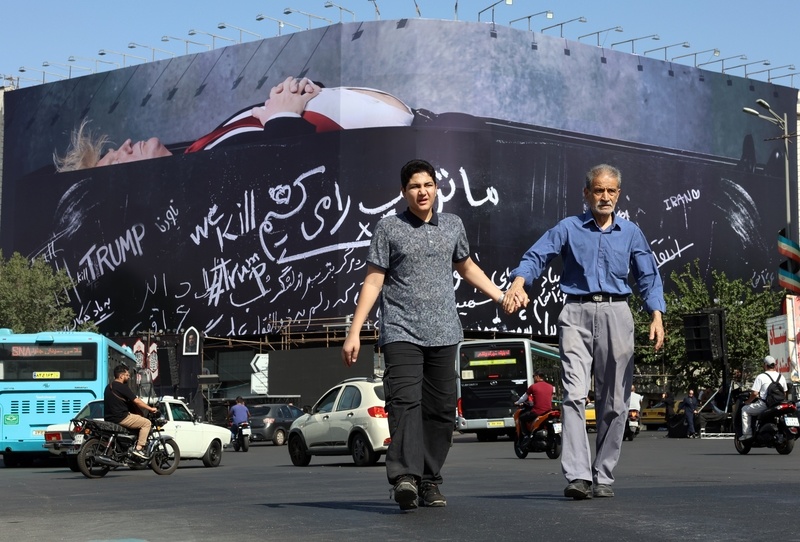
In Tehran on July 15, an anti-US billboard depicts President Trump lying in a coffin.
Three US officials told Reuters that the strikes were not just about reopening the Strait of Hormuz but also about weakening Iran’s military strength in advance of potentially more complex operations in the future.
At the same time, the US continued its maritime blockade of Iranian ports. The US military said an unloaded oil tanker, ignoring warnings while heading to Iran’s Kharg Island, was hit by a Hellfire missile on its smokestack and lost propulsion. Since reinstating the blockade, US forces have forced two ships to change course and disabled another.
“We are in an existential battle with the US,” said Iran’s Parliament Speaker and chief negotiator Mohammad Bagher Ghalibaf in a statement after the latest US airstrikes. He emphasized that Iran never welcomed war nor would seek it, but must always be ready to fight to protect national security and interests.
He also noted that Iran should continue utilizing diplomacy and negotiations to safeguard and strengthen its national interests.
Iranian media reported that the US also struck areas including Ahvaz, Bandar Abbas, and Konarak. Iran’s state TV said an area near a hospital housing a children’s cancer center in Ahvaz was also hit, prompting an evacuation. No casualties have been reported so far.
In response, Iran’s Islamic Revolutionary Guard Corps announced strikes on US military targets in Bahrain, Kuwait, and Jordan. Kuwait said it intercepted four missiles and 21 drones that day, with no casualties or property damage.
Trump continued to send tough signals, saying “we will defeat Iran soon,” while also suggesting Iran “really wants a deal,” and that the US would decide “whether to make a deal or end it all.”
The report describes this as the latest escalation since a fragile ceasefire collapsed. While analysts generally believe neither the US nor Iran wants a full-scale war, the confrontation over navigation in the Strait of Hormuz and regional military operations continues, with no signs of easing tensions in the Middle East anytime soon.