

Just one week before its scheduled opening, the Gordie Howe International Bridge—linking Michigan, USA, with Ontario, Canada—is already at the heart of a fresh political fight over toll revenue. Canada’s Prime Minister Mark Carney made it crystal clear on July 16: his country won’t share a single dollar in bridge tolls with the U.S. until it has fully recouped its initial construction costs. This came after American officials claimed a new agreement on the bridge’s earnings had been reached, fueling questions in Canada about whether their government had caved in. What was supposed to be a symbol of cooperation and a vital corridor for the North American auto supply chain has now become a political battleground—a real barometer of how rocky U.S.-Canada relations have gotten.
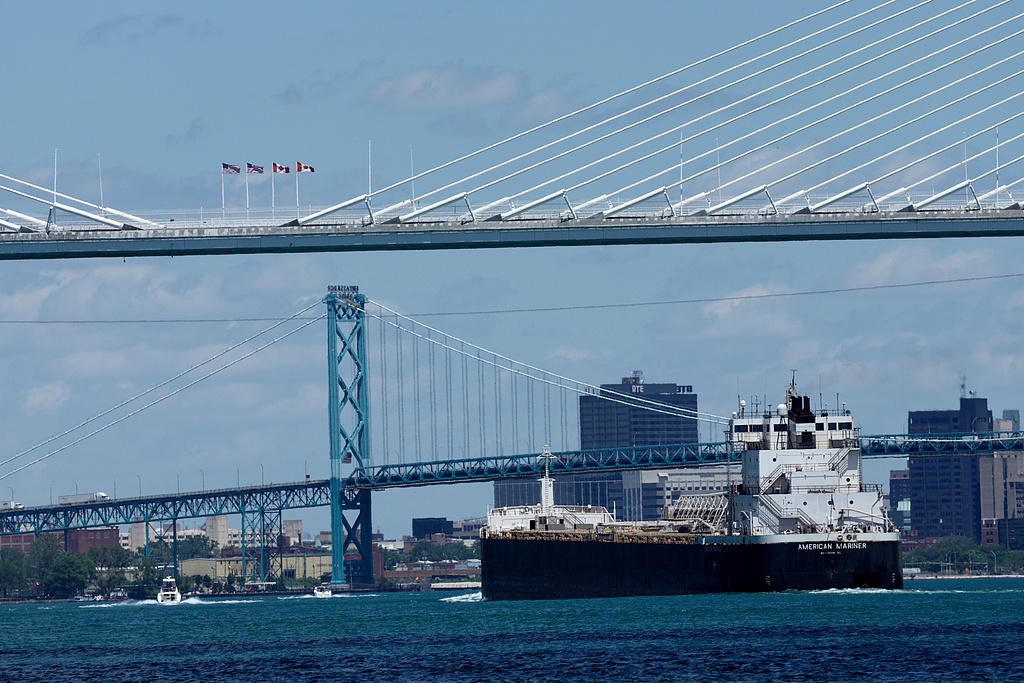
The Gordie Howe International Bridge near Detroit, Michigan (top), and the Ambassador Bridge.
From “Canada Pays” to a U.S. “Bridge Heist”
Spanning the Detroit River, the bridge is named after the late Canadian hockey legend Gordie Howe. According to reports, construction kicked off in 2018, with the Canadian federal government footing the entire bill—64 billion Canadian dollars (around 46 billion U.S. dollars). The plan was to recover that cost through future tolls. Under the original deal with Michigan, Canada gets to keep all toll revenue until construction costs are covered, while Michigan gets a nominal half-ownership without paying a dime.
But this bridge, built on a “Canada pays, both share” model, has already seen repeated delays. Back in February, former U.S. President Donald Trump threatened to block its opening, demanding Canada hand over at least half the ownership to the U.S. Then in June, just before the ribbon-cutting, the opening was postponed again.
Trump took to social media on July 10, claiming the bridge would open by the end of July. He said he couldn’t accept the old deal and had secured a “much better deal” for the U.S. That statement sparked a firestorm in Canada, with the opposition Conservatives demanding Carney reveal the details of any new agreement.
Carney pushed back hard on July 16, repeating that Canada won’t share toll revenue until it recoups its entire upfront investment. He added that any future profit-sharing would only happen after deducting financing costs and debt repayments—meaning Canada gets first dibs on the cash.
The Bridge That Holds North America’s Auto Supply Chain Together
The Gordie Howe Bridge is seen as a critical piece of infrastructure for trade and supply chain security between the two countries. Once open, it’s expected to become the busiest land border crossing on the U.S.-Canada frontier. It connects Detroit, the heart of America’s auto industry, with Ontario’s manufacturing core—two regions that are the lifeblood of the North American automotive supply chain. Tons of car parts and finished vehicles cross the border daily. Right now, most commercial traffic relies on the aging Ambassador Bridge, which is plagued by chronic gridlock. Trucks often sit in long lines, causing huge delays and costs for businesses. The new bridge promises to relieve that pressure and provide a more stable route for the auto industry.
Canada and the U.S. share a deeply integrated auto supply chain. Canada’s car industry depends heavily on the American market. In a typical year, about 80% of Canadian auto parts and vehicle sales go to the U.S. Many popular American brands—like Chevrolet, Chrysler, and Dodge—are assembled in Canada. According to the Canadian Vehicle Manufacturers’ Association, Canada assembled over 1.5 million vehicles in 2023, with the vast majority shipped south of the border.
An article in Canadian magazine Policy noted that Michigan’s governor, Gretchen Whitmer, along with members of Congress, manufacturers, unions, and logistics companies, all understand that delaying the bridge hurts American workers and businesses just as much as it hurts Canadians. But Trump, it said, is still forcing a crisis, squeezing out extra concessions from an existing deal and then declaring victory.
Punishing Canada for Wildfire Smoke?
Observers see this bridge dispute as just one piece of a much larger puzzle: the ongoing U.S.-Canada trade friction. The failure to renew the USMCA (the North American trade agreement) by the July 1 deadline, combined with simmering tariff issues, has only deepened tensions.
A July 13 piece in Policy magazine argued that the Gordie Howe International Bridge should have been the simplest project in the U.S.-Canada relationship. Now, like the USMCA standoff, it reflects a growing erosion of trust between the two nations.
The article warned that Trump’s approach “doesn’t just target Canada—it also hurts America’s own interests.” For nearly 250 years, a key source of U.S. global influence has been the belief that America respects contracts, upholds the rule of law, maintains open markets, and keeps its promises, no matter who’s in power. That reliability is one of its most important strategic assets. “If agreements become short-term tactics rather than long-term commitments,” it said, “the U.S. won’t just lose the trust of allies and partners; it will also undermine the very foundations its own prosperity is built on.”
The article concluded with a warning for Canada: in dealing with the Trump administration, Ottawa needs to keep talking—but also stay in a defensive posture, like playing hockey. “Elbows up,” it said, ready to defend its own interests at any moment.
On top of all this, another conflict is brewing. Multiple media outlets report that smoke from prolonged Canadian wildfires has drifted south, even shrouding Washington, D.C. Trump has said he’s “holding Canada responsible” for not properly managing its forests and is considering imposing tariffs on Canada over the air quality impact.
Ontario Premier Doug Ford fired back, saying the U.S. shouldn’t blame Canada for the wildfire smoke. He reminded everyone that Canada has often helped the U.S. during disasters, and that accusations from the U.S. government and some lawmakers are simply unacceptable.