

We’ve been getting some amazing news lately in the hunt for another planet that could support life beyond Earth. Just recently, an exoplanet named GJ3378b was confirmed to be sitting right in the habitable zone of a red dwarf star only 25 light-years away, making it a promising candidate for hosting life. And if that wasn’t exciting enough, scientists have also found another rocky planet that seems to have managed to keep its atmosphere—and we all know that’s a key ingredient for life as we understand it.
A new study published in the journal Science on July 16 reveals that a planet named LHS 1140 b, about 48 light-years from us, orbits a small, cool red dwarf star. This exoplanet is about 5.6 times the mass of Earth, so we call it a “super-Earth”—a kind of rocky planet that’s bigger than Earth but smaller than gas giants like Neptune. What’s really groundbreaking is that this is the first time scientists have detected an atmosphere around a rocky planet orbiting within another star’s habitable zone, the region where temperatures are just right for liquid water to exist on the surface. For decades, we’ve found thousands of exoplanets, plenty of them rocky, but figuring out if they have atmospheres has been incredibly tough. In this new research, the team didn’t look for the atmosphere directly; instead, they found indirect evidence: helium leaking from the atmosphere into space. “Twenty years ago, we were still wondering if other Earth-like planets even existed,” said Robin Wordsworth, a professor of Earth and planetary sciences at Harvard University. “Then we learned they’re actually pretty common, and we found some in habitable zones. The next big question was whether any of them had managed to hold onto their atmospheres. Now we know at least one has.”
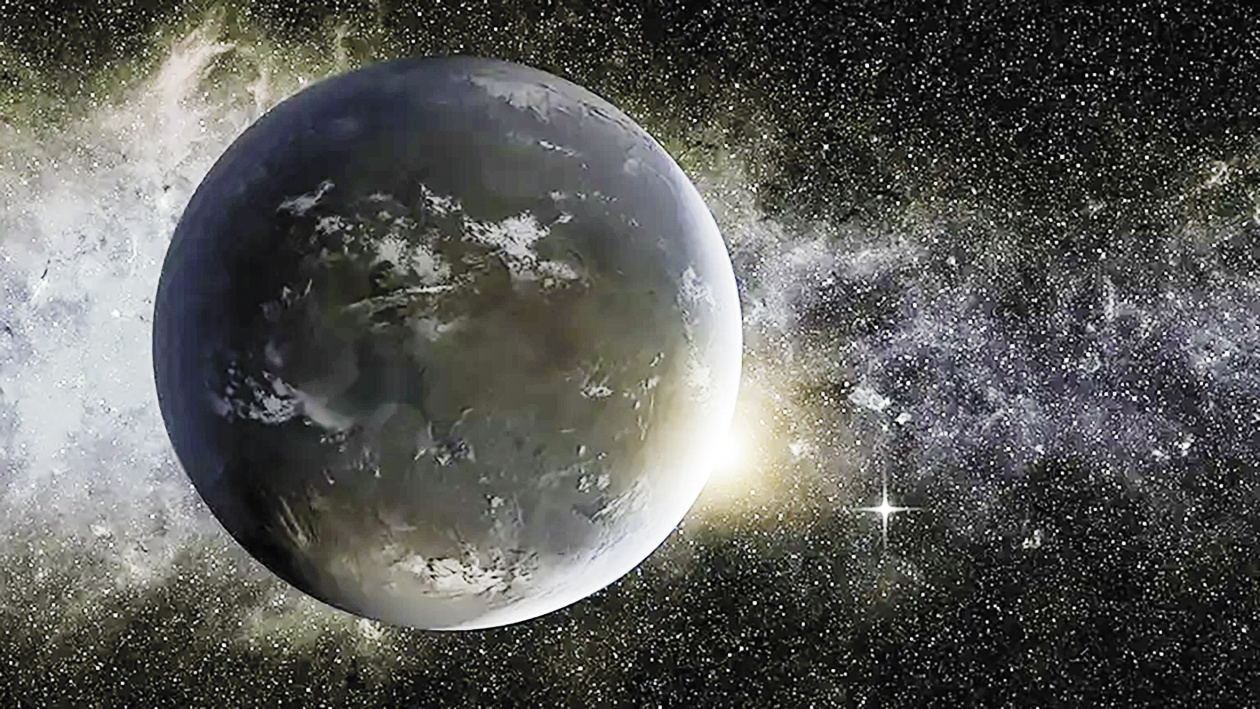
The planet LHS 1140 b is believed to have an atmosphere.
At the same time, the news about a “super-Earth just 25 light-years away” has been all over social media. Originally, the planet GJ3378b was thought to be about 5.26 times Earth’s mass, classed as a mini-Neptune gas planet. But the latest, more precise measurements show it’s actually only 2.3 times Earth’s mass, making it a rocky “super-Earth” just 25 light-years away. It orbits a red dwarf star and sits right in the habitable zone. However, since red dwarfs often blast out strong stellar winds and radiation, we still don’t know if this rocky planet has an atmosphere.
With observation tools getting better and better, astronomers are spotting “super-Earths” faster than ever, and thousands have been discovered in recent years. According to public reports, during China’s “15th Five-Year Plan” period, the National Space Science Center of the Chinese Academy of Sciences will roll out space science missions like the “Hongmeng Plan” and exo-Earth surveys, aiming for new breakthroughs in the search for Earth-like exoplanets.