

Late on the 21st, Ukrainian President Zelensky announced on social media that he was replacing the Commander-in-Chief of the Armed Forces, Syrskyi, with the Commander of the Joint Forces, Drapaty. This marks the second high-level military dismissal within a week, following the removal of Defense Minister Fedorov on the 16th. After Fedorov was let go, Ukraine experienced its longest-running nationwide protests since the start of the Russia-Ukraine conflict. Fedorov publicly accused Syrskyi of pushing Zelensky to fire him, claiming Syrskyi was “dividing the country.” This high-stakes internal feud is seen by Western media as one of the most urgent political crises facing Zelensky. The UK’s The Times reported that multiple Ukrainian politicians are backing Fedorov to form his own party and run for president once elections resume. Amidst the peak of the conflict, Bloomberg cited Ukrainian lawmaker Fedienko, who warned, “This is a path toward national collapse.”
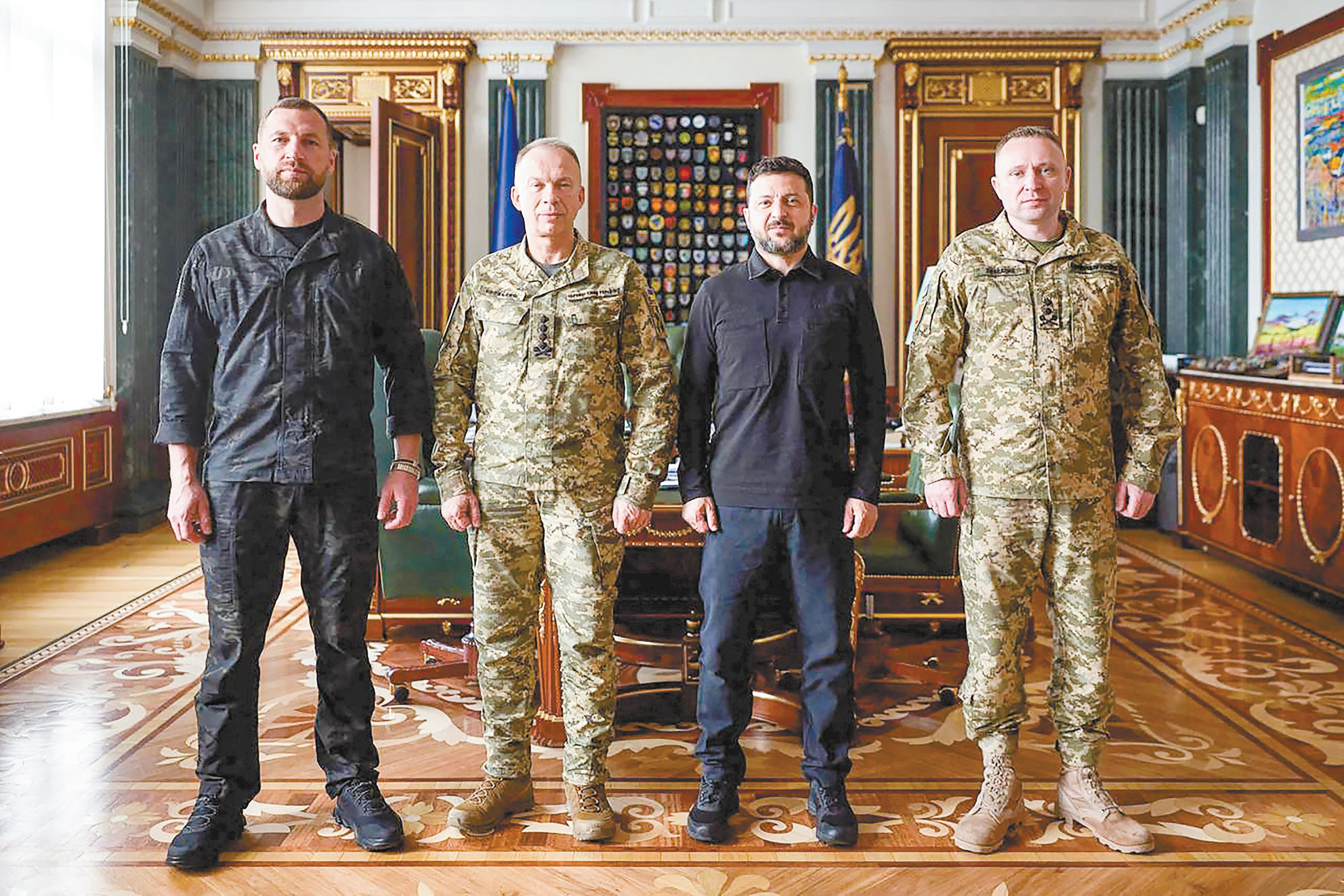
Zelensky (third from left) with Hmara (first from left), Syrskyi (second from left), and Drapaty (first from right) in a photo taken on the 22nd.
Another Shake-up at the Top of the Military
According to Ukrainska Pravda on the 22nd, late on the 21st, Zelensky announced on social media that he had appointed Joint Forces Commander Drapaty as the new Commander-in-Chief of the Armed Forces, replacing Syrskyi. Zelensky stated that he had discussions with Drapaty, Acting Defense Minister Hmara, and Deputy Head of the Presidential Office Palisa about adjusting the General Staff personnel. All final decisions are expected to be confirmed on the 22nd.
Ukraine’s National News Agency reported that on the 21st, Zelensky emphasized the need to continue long-range strike plans. He stressed that maintaining operational continuity while ensuring a smooth handover within the military is crucial. He also mentioned offering the recently dismissed Defense Minister Fedorov a “valuable leadership position in the government” to strengthen the country’s military technology development. At the same time, he praised Acting Defense Minister Hmara as highly professional and the person the government needs.
Bloomberg reported on the 22nd that Zelensky made the decision to dismiss Syrskyi following days of nationwide protests. Syrskyi has been accused of being the “mastermind” behind pushing Zelensky to fire the former defense minister, Fedorov.
However, according to Politico Europe on the 21st, Fedorov has refused any government position other than the defense portfolio. It remains unclear whether he will accept Zelensky’s latest offer to return to the government.
Is the West Involved in Ukraine’s Internal Strife?
“Zelensky Dismisses Top General at a Critical Moment in the War,” reported The New York Times on the 22nd. The paper noted that Zelensky’s decision to replace Syrskyi was a concession to days of nationwide protests. After firing Fedorov, Ukraine saw continuous large-scale street protests across the country.
AFP described these protests as the longest-lasting nationwide demonstrations since the Russia-Ukraine conflict began. This high-level personnel turmoil has become one of the most urgent political crises for Zelensky.
Syrskyi took over as Commander-in-Chief of the Ukrainian Armed Forces in 2024. According to reports, the 60-year-old Syrskyi studied at military academies during the Soviet era and served in the Soviet army. He favors traditional tactics like centralized command, positional defense, and reliance on infantry and heavy armor. In contrast, the 35-year-old Fedorov is a “tech guy” with no military background. After becoming defense minister in January, he promoted drone swarm tactics and advocated for deep strikes on Russian energy and logistics facilities. The two have severe disagreements over combat strategies, which has influenced the direction of Ukraine’s defense procurement.
After being dismissed, Fedorov stated at a public press conference that Syrskyi had issued an ultimatum to Zelensky, forcing Zelensky to fire him. Fedorov accused Syrskyi of “dividing the country.” He also claimed he had made many enemies by trying to root out rampant corruption in defense procurement. Syrskyi denied these allegations.
The UK’s The Times reported that Zelensky’s decision to fire Fedorov during a chaotic government reshuffle might have created a “powerful political opponent.” The report cited multiple anonymous Ukrainian lawmakers and politicians who said Zelensky removed Fedorov because his approval ratings were rising, and he had strong political ambitions. There has been talk in Kyiv that Fedorov might consider running for president if elections resume—a major threat to Zelensky. The report noted that several Ukrainian lawmakers have urged Fedorov to form his own party. A recent poll in Kyiv showed Fedorov’s net approval rating is two percentage points higher than Zelensky’s.
Berlin-based BNE International News reported that the current street protests are similar to last year’s demonstrations triggered by Zelensky’s attempt to limit the powers of the Western-backed National Anti-Corruption Bureau (NABU) and the Special Anti-Corruption Prosecutor’s Office (SAPO). The report suggested that Fedorov’s dismissal has sparked behind-the-scenes pressure from some EU countries, who see him as a key anti-corruption figure in Kyiv. Fedorov is famous for fighting corruption, while many of Zelensky’s close advisors and friends have been found to be involved in corruption, the report said.
Russia: This Won’t Change the Frontline Situation
“Ukraine’s Cracks,” titled The New York Times on the 22nd, noted that despite heavy Russian bombardment, Ukraine has recently reported several “good news” on the battlefield: it has launched attacks on Moscow and destroyed Russian infrastructure like oil refineries. On the diplomatic front, Ukraine has secured billions of euros in EU aid and received praise from Trump. However, this political infighting has torn apart the unity so crucial for Ukraine, plunging the country into political turmoil at a critical moment. “The biggest enemy is internal division,” said Ukrainian scholar Volodymyr. “History tells us this could be fatal.”
On the 22nd, Russian Presidential Press Secretary Peskov stated at a press conference that the Ukrainian authorities are facing serious internal problems. “All this turmoil will shake the Kyiv regime from within, that’s obvious,” he said. Peskov also noted that appointing a new Commander-in-Chief is unlikely to change the situation on the front lines, as “Russian forces are actively conducting offensive operations.” Regarding peace talks, Peskov said President Putin has already laid out conditions for halting hostilities, which remain valid. “Transitioning to serious negotiations depends primarily on Kyiv’s actions.”