Looking across the strait at North Africa, Spain holds two enclaves—Melilla and Ceuta—which share land borders with Morocco yet remain part of the European Union.
Back in June 2022, Melilla witnessed a horrific incident where thousands of African migrants attempted to storm the border fence, resulting in heavy casualties and marking one of the most controversial migration tragedies in Europe’s external border history. Now, four years later, late July saw over 70,000 irregular migrants flood into Ceuta, claiming 88 lives—not just triggering a humanitarian emergency, but rapidly escalating into a full-blown European political storm.
Earlier that month, Spain’s Supreme Court had just ruled that irregular migrants entering the enclaves overland would be immediately returned, while those arriving by sea could not be deported without proper legal review and had to go through the full judicial process. That legal nuance, however, got twisted on social media into a dangerously seductive slogan: “Just swim to Ceuta, and you can stay.” Morocco’s Interior Ministry mostly blamed the incident on disinformation circulating online, incitement by trafficking networks, and widespread misunderstanding of Spanish law.
But stepping back, the real questions this crisis raises go far beyond any single event.
Why does Europe’s massive investment in border control—even pushing migration management deep into North Africa—still fail to stop these tragedies from repeating? After outsourcing border enforcement to North African countries, is Europe becoming dangerously dependent on, even hostage to, its own “gatekeepers”? And why are migrant deaths, clashes, and political divisions persisting even as overall irregular entries into Europe decline?
Over the past decade-plus, Europe has kept raising its border walls higher and pushing its frontier further outward. Yet the migrant waves haven’t vanished—they’ve just found new routes, new locations, and more perilous means.
From Morocco to Spain, from North Africa to Europe, from border security to internal politics, Europe is confronting an increasingly unavoidable dilemma: it’s trying to wall off the migration problem, but slowly realizing the real issue isn’t just about keeping people out—it’s whether Europe is losing control over its own migration policy altogether.
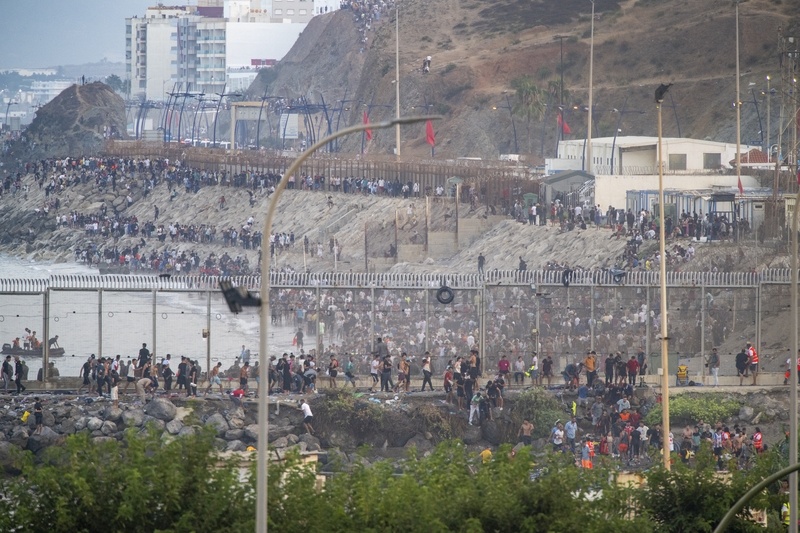
July 30, 2026: Large numbers of irregular migrants enter Spain’s North African enclave of Ceuta by sea from Morocco. IC Photo
Europe’s ‘Gatekeepers’: Once Borders Are Handed to Morocco, Who Holds the Keys?
What makes Ceuta and Melilla unique is that they aren’t your typical European border points. Located on the African continent yet belonging to Spain, they are the EU’s only land territory in Africa.
From Europe’s perspective, they’re vital gateways into the bloc. Geographically, though, they’re completely encircled by Morocco.
This peculiarity has long posed a dilemma for Spain: Europe wants to control its southern border, but that border happens to sit in Africa.
Since 2010, waves of refugees from Africa, the Middle East, and South Asia have reached Europe via the Mediterranean and the Balkans, peaking dramatically in 2015.
Over the past decade or so, the EU has gradually forged a new migration governance model—one that relies less on internal European border checks and more on pushing the front line southward, partnering with North African states like Morocco, Tunisia, and Mauritania to stop migrants before they ever reach European shores.
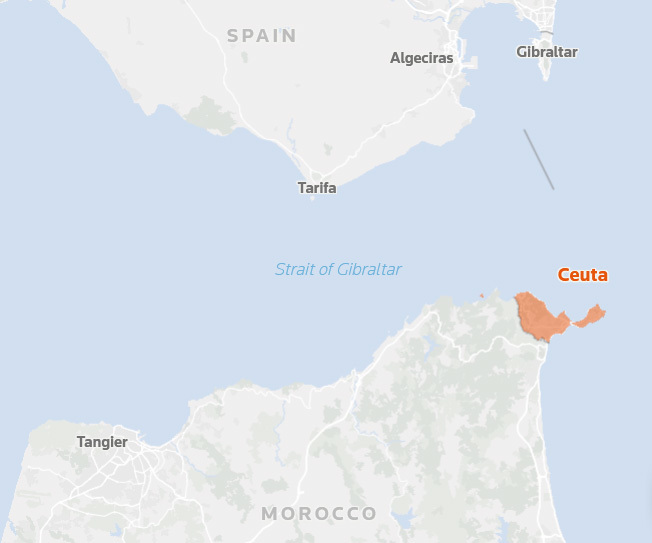
Ceuta, Spain’s enclave in North Africa. File photo.
European media outlets like the Financial Times have long tracked this trend, noting that the EU is increasingly relying on third countries for what’s called “border externalization.”
In an August 2 commentary, Ben Hall, a senior editor at the Financial Times, pointed out that this model has indeed reduced migrant numbers entering Europe to some extent. But simultaneously, a new problem has emerged: when Europe needs North African nations to secure its borders, those nations gain significant leverage over Europe.
Ceuta saw a similar crisis back in 2021.
At that time, during a diplomatic spat between Spain and Morocco over the disputed Western Sahara region (then under Moroccan control), thousands of irregular migrants breached Ceuta’s border controls. Afterwards, Spain shifted its stance to support Morocco’s proposal for regional autonomy under Moroccan sovereignty.
During this latest Ceuta crisis, Madrid has been careful not to blame Rabat, even as Spain and its European allies traded accusations. The article notes that in the short term, Spain needs Morocco’s cooperation to receive migrants from Ceuta; in the long term, it needs Moroccan collaboration on migration control and security.
“This reminds us that EU migration control depends on cooperation with neighbors. But given reports of a lack of regular border personnel on the Moroccan side, Madrid has every reason to believe Rabat allowed the influx to pressure Spain. Why? Because Morocco has done it before.”
Clearly, Hall is openly suspicious of Morocco.
Of course, without direct evidence, one can’t simply assert Morocco “orchestrated” this Ceuta crisis. But the reality is becoming increasingly obvious: after outsourcing border management to North Africa, Europe must accept that its border security hinges largely on the choices of those North African states.
On July 31, a commentary from the German Marshall Fund of the United States also argued that Europe’s overreaction to migration and its obsession with outsourcing migration control to third countries has handed those countries an easy-to-use lever of pressure. Ultimately, irregular migrants themselves become political tools—and face deadly risks as a result.
Has Europe Actually Controlled Migration? No—It Just Changed Route
If you look only at the numbers, Europe seems to be making progress. In recent years, irregular entries into the EU have generally trended downward.
EU data shows notable declines in arrivals on several major migration routes. Yet Spain’s El País, citing data from the European Border and Coast Guard Agency (Frontex) in January, pointed out that the risk hasn’t disappeared.
Frontex data indicates roughly 178,000 irregular migrants entered the EU in 2025—a 26% drop year-on-year and the lowest level since 2021. However, while irregular entries fell sharply across all routes, the Western Mediterranean route—from Algeria to Spain’s coast—actually saw a 14% increase in crossings.
The International Organization for Migration (IOM) estimates around 1,878 people died at sea last year. If both figures are reliable, that’s one death for every 100 arrivals.
So the real issue is that migratory pressure hasn’t disappeared—it’s just changed direction.
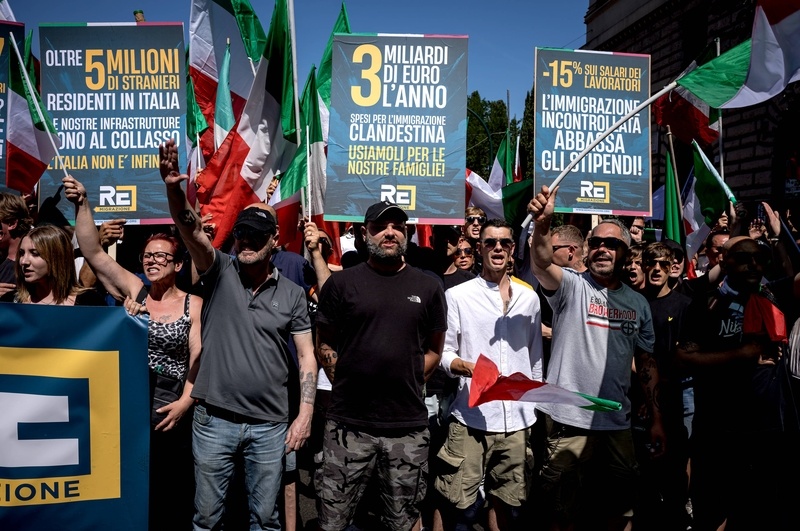
June 13, 2026, Rome, Italy: A national demonstration organized by the Committee for Migrant Repatriation and Recovery, calling for the passage and implementation of a migrant repatriation law. IC Photo
Europe’s past migration policies have increasingly emphasized preventing people from reaching Europe—through fortified border infrastructure, expanded maritime interdiction, cooperation with third countries to block departures, and faster deportation procedures.
While these measures have reduced some arrivals, they haven’t addressed the root causes driving human movement. In recent years, war, poverty, employment pressures, and political instability persist, and the IOM has long noted that such instability fuels migration—and that simply hardening border controls can’t eliminate these deeper drivers.
So, as Spain’s El Día noted on August 2, migration waves aren’t a temporary phenomenon. History shows that sealing one entry point doesn’t resolve the crisis—it simply shifts migration flows to other routes. Block one path, and another emerges.
With tighter controls from Morocco’s side, some pressure may shift toward the Canary Islands; as the Western Mediterranean route becomes riskier, other maritime paths may reactivate; and as Europe strengthens its external borders, smuggling networks keep hunting for new openings.
More critically, the stricter the border controls, the more some migrants may resort to even more dangerous methods: swimming across straits, taking unseaworthy boats across the Atlantic, or relying on trafficking networks to find new routes…
Europe is solving the “entry management” problem but not the “migration pressure” problem. Fewer people are arriving, but the danger hasn’t lessened. If anything, deaths may be shifting to more hidden, harder-to-count places.
So here’s the paradox: it’s hard to say whether Europe has “failed successfully” or “succeeded disastrously.”
Migration Is Biting Back: From Border Crisis to Political Crisis
If Europe’s migration issue was once primarily a border management problem, it has now become a major fault line in European internal politics.
The reactions across Europe after the Ceuta crisis once again exposed deep divisions within the EU.
Spain wants more European solidarity, arguing that migration pressure shouldn’t fall on a few border states alone. But some countries are primarily focused on keeping such pressure from spreading to their own territories.
The Financial Times reported that after the tragedy, Italy’s right-wing Prime Minister Giorgia Meloni immediately called for suspending Spain’s Schengen membership. Denmark’s center-left PM Mette Frederiksen, also a migration hardliner, and several other EU leaders echoed Meloni’s call to varying degrees.
Spanish PM Pedro Sánchez, facing fierce criticism and warnings from fellow EU leaders, lashed back, condemning some member states’ reactions to the Ceuta crisis as “selfish, divisive, and unlawful.”
All of this shows migration is no longer just an issue between Europe and the outside world—it’s reshaping relations within the EU itself.
Over the past few years, migration has also become a major driver behind the rise of right-wing parties across Europe.
From France and Germany to the Netherlands and Italy, more and more political forces are making migration a central election issue.
For instance, Meloni’s Brothers of Italy, France’s National Rally led by Marine Le Pen, Germany’s AfD led by Alice Weidel—both right-wing firebrands—all champion reducing irregular migration and tightening border controls as core political platforms.

From left to right: Weidel, Le Pen, Meloni. File photo.
Migration waves are reshaping European politics.
And in a sense, Europe’s migration policy is trapped in a vicious cycle: to control migration, Europe keeps fortifying borders; to fortify borders, Europe grows more dependent on third countries; that dependence brings new diplomatic risks; and the persistently unresolved migration problem pushes European internal politics further to the right.
The tragedy that unfolded in Ceuta in late July 2026 wasn’t an isolated incident.
From Melilla to Ceuta, from the Mediterranean to the Atlantic, from North Africa to the heart of the continent—this is one continuous chain.
Europe wants to build a higher border wall to hold back the migrant tide, but in the end, it may discover that this wall is riddled with holes—and buried beneath it lie ever more human bones.
The loss of 72 lives may serve as yet another reminder to Europe that the wall it has spent over a decade constructing has left behind not just a boundary, but an unbroken series of death tolls that can’t be ignored.
How to stop these tragedies from repeating? European policymakers still have no answer…