South America’s two biggest economies have just plunged into their worst diplomatic slump in decades.
On August 5, Argentina’s Foreign Minister Pablo Quirno announced that Argentina’s ambassador to Brazil, Raimondi, would soon be returning home for leave. Just a day earlier, Brazil’s Foreign Minister had summoned Raimondi, declaring that the Brazilian government was downgrading bilateral diplomatic relations to charge d’affaires level and demanding his return to Argentina.
Argentina’s Foreign Ministry expressed regret over Brazil’s unilateral decision, saying it would not take reciprocal diplomatic countermeasures in an attempt to prevent the situation from spiraling further out of control. For now, chargés d’affaires appointed by both foreign ministers will handle day-to-day operations, while high-level visits and official cooperation have come to a full halt.
The direct trigger for this standoff? Argentine President Milei’s over-the-line remarks and behavior.
On July 25, Milei was invited to speak at the Brazilian Liberal Party’s national convention in São Paulo. Instead of playing nice, he publicly tore into Brazilian President Lula, calling him a “corrupt individual” and a “thief,” attacked Brazil’s Supreme Federal Court justices, and even campaigned for the son of former Brazilian President Bolsonaro. Brazilian officials promptly branded this as interference in internal affairs.
Both Bolsonaro and his son belong to the Brazilian Liberal Party. Back in September 2025, Brazil’s Supreme Federal Court ruled that Bolsonaro was guilty of plotting a coup, sentencing him to 27 years and 3 months in prison. He’s currently under restricted detention.
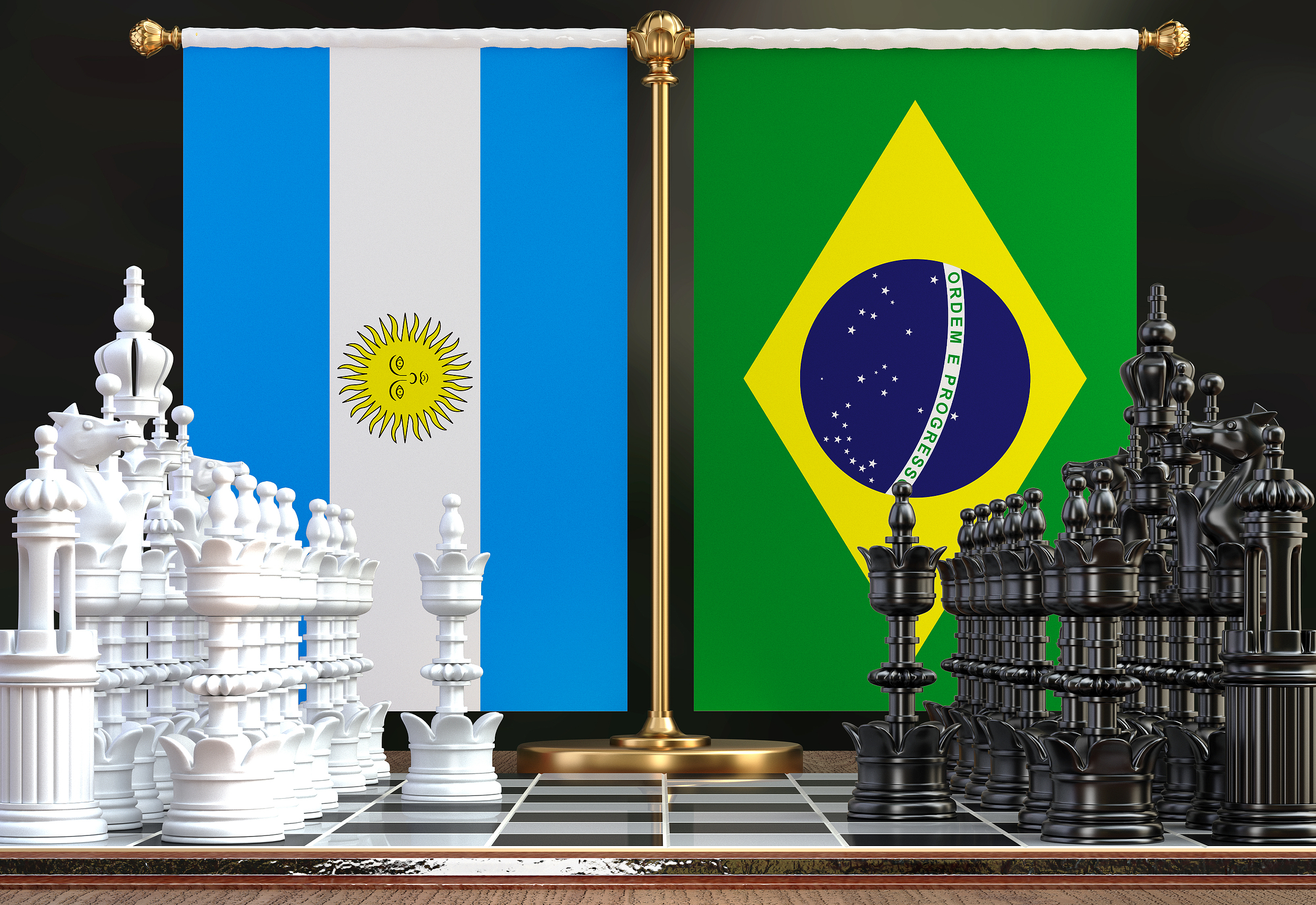
After Milei’s explosive comments, Brazil’s Foreign Ministry recalled its ambassador to Argentina on July 26 as a pressure move. But Milei kept firing off more provocative statements and never offered any meaningful response — which ultimately pushed things over the edge.
Milei, now 55, was an economics scholar before entering politics, deeply entrenched in his own extreme free-market ideology — so much so that people often call him “the madman.” He’s known for getting highly emotional during public speeches, and during his campaign, he even brandished a roaring chainsaw as a prop, completely ignoring the rulebook of traditional politicians.
Brazil and Argentina share a 1,261-kilometer border and were former colonies of Portugal and Spain respectively. These two European nations once engaged in a long tug-of-war over the La Plata River basin in South America, which fostered a lasting sense of rivalry between Brazil and Argentina — politically, economically, and culturally at the grassroots level.
Milei and Lula sit on opposite ends of the ideological spectrum: one is South America’s far-right firebrand, the other is the old-school leftist icon. Their worldviews are fundamentally irreconcilable.
Milei is President Trump’s most hardcore ally in South America, and both he and Bolsonaro have been respectively nicknamed “Argentina’s Trump” and “Brazil’s Trump” by outside observers.
Lula’s administration, meanwhile, insists on “South America handling its own affairs,” which directly clashes with the Trump administration’s “New Monroe Doctrine” strategy. Late last year, the White House released a National Security Strategy report with a theme emphasizing Western Hemisphere (meaning the Americas) first. U.S. media described that report as a revival of the “Monroe Doctrine” — the tool historically used by Washington to control Latin America.
Lula formally took office in 2023, and his current presidential term runs until the end of 2026. He’s already registered to run in Brazil’s October 2026 presidential election, seeking an unprecedented fourth term.
The Trump administration has repeatedly moved against Brazil during both of its terms. Right now, the White House has slapped tariffs of up to 37.5% on various Brazilian goods. Trump himself has also publicly defended Bolsonaro, calling Brazil’s trial of him “judicial oppression,” and has been trying to prop up pro-U.S. right-wing forces. Lula has fired back hard too: he refused to issue visas to U.S. Assistant Secretary of State Riley and others, and also rejected the nomination of the new U.S. ambassador to Brazil.
Driven by the Latin American debt crisis and regional integration trends, Brazil and Argentina jointly pushed forward tariff reductions and trade facilitation covering nearly all categories — from agricultural goods to manufactured products — building South America’s largest regional free trade network. Analysts point out that with political trust between the two countries now frozen at rock bottom, regional cooperation could well grind to a halt.
Even so, the economic bonds between these two neighbors are unlikely to be completely severed. Brazil is Argentina’s top trading partner, and its auto industry leans heavily on Argentina’s supply chain. Meanwhile, about 38% of Argentina’s manufactured goods and nearly 70% of its capital goods exports flow to Brazil.