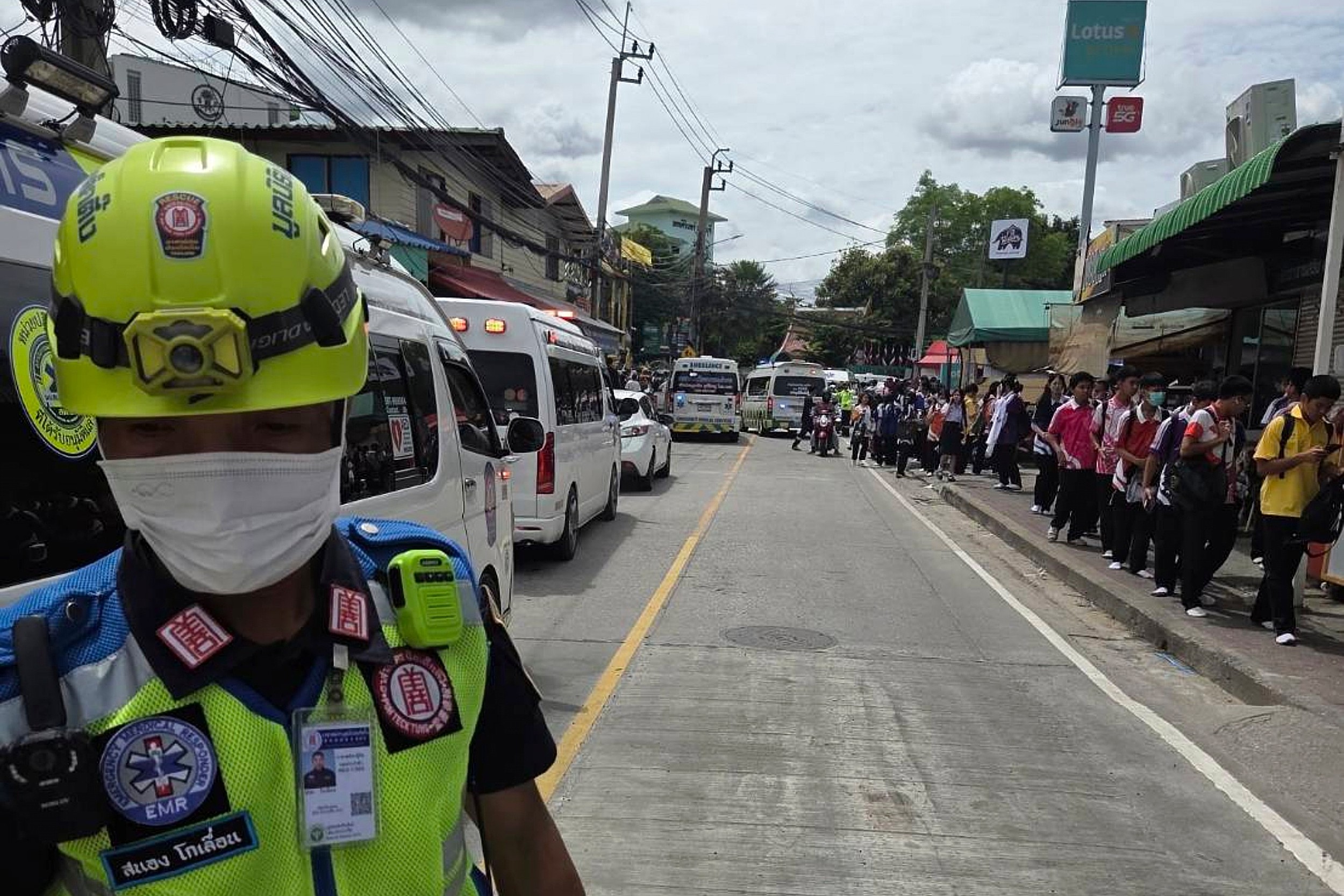
On August 7, a deadly shooting unfolded at Debsirin Nonthaburi, a secondary school in Thailand’s Nonthaburi province. Preliminary investigations identified the gunman as a 14-year-old junior high school student.
As of the time of this report, the incident has left 7 dead, including the shooter himself, with 15 others wounded, two critically. Among the deceased are 3 teachers and 3 students.
According to Thai police, the young gunman first shot and killed his own grandparents at home before heading to school to continue his rampage. Authorities confirmed he fired 26 rounds before turning the gun on himself, and his bag contained even more unused ammunition.
The school sits right next to a busy main road and enrolls roughly 3,100 students, with 147 teachers on staff. One student on campus recalled seeing the gunman in a purple tracksuit, firing dozens of shots across the school grounds.Police later found the gunman had died by suicide.
Thai media reports indicate the boy had been living with his grandparents. On the morning of the incident, he went to class as usual, then began shooting around 10 AM. The handgun used in the attack was legally registered to his grandfather. Investigators believe academic pressure may have been a driving factor; his grandmother, a former teacher, was known to be extremely strict about his studies.
That afternoon, Prime Minister Anutin expressed deep shock and grief over the tragedy. The government is now proposing a new gun control initiative to restrict public carrying of firearms. Relevant agencies must tighten oversight of gun ownership; no one—whether officials or ordinary citizens—should be allowed to carry weapons into public spaces except for official duties.
In this predominantly Buddhist nation—where over 90% of the population follows the faith—military culture runs equally deep. The country has experienced numerous coups, a military-dominated political landscape, and a conservative establishment that reveres military and law enforcement values. Firearms are often seen as symbols of wealth and privilege. Shootings to settle personal disputes frequently make headlines, particularly in rural areas.
Nonthaburi province sits just north of Bangkok, with daily commuting and ordinary life generally at an upper-middle standard, though localized risks like theft do exist. Last month, local police dismantled a shadowy capital operation hidden inside a hotel, seizing drugs, gambling equipment, and large sums of cash.
The Debsirin Nonthaburi tragedy marks the second school shooting in Thailand within six months to draw intense public scrutiny.
Back in February, a shooting at a school in Songkhla province in the south left a principal dead from blood loss and two students injured. The suspect, a 17-year-old local male, used a firearm stolen from police. He had previously been hospitalized for substance abuse and was released in December 2025.
In 2002, a monk hid an AK-47 under his robes and stormed the Parliament building, taking 30 hostages to plead his case. In 2022, a massacre at a childcare center in the northeast killed 36 people, 24 of them children.
According to data from the Switzerland-based Small Arms Survey (SAS) in 2017, Thailand has over 10.3 million civilian firearms—roughly 15 guns for every 100 people. That puts the country at 13th globally, and the highest-ranked nation in ASEAN. Among those10.3 million civilian firearms, roughly 4 million are unregistered illegal weapons.
Separate figures from the University of Washington show Thailand ranks second in Southeast Asia for gun homicides, trailing only the Philippines.
In reality, Thailand’s gun laws are fairly strict on paper. Illegal possession can draw up to 10 years in prison and fines of up to 20,000 baht. Firearms can only be purchased from a limited number of licensed dealers, who themselves face annual quotas on how many guns and rounds they can sell.
Yet Thailand also has a thriving black market for guns. Underground trading posts along the Thai-Myanmar and Thai-Cambodia borders funnel weapons from conflict zones in neighboring countries into the country. Meanwhile, some officials, military personnel, and police exploit their positions to buy guns at low prices and resell them for profit.