

According to the office of Iran’s Supreme Leader on the 10th, the country’s top authority issued several appointment decrees, officially naming six individuals to senior posts within the Armed Forces General Staff, the Islamic Revolutionary Guard Corps (IRGC), and the Basij militia.
US media reports note that several of the newly appointed commanders have previously been subjected to American or European sanctions.
The appointments are as follows:
IRGC Brigadier General Ali Abdollahi has been named Chief of the General Staff of the Armed Forces;
Army Brigadier General Kioumars Heidari has been appointed Deputy Chief of the General Staff of the Armed Forces;
IRGC Brigadier General Ahmad Vahidi, who has been promoted to Major General, will serve as the Commander-in-Chief of the IRGC;
IRGC Major General Mostafa Izadi has been appointed Deputy Commander-in-Chief of the IRGC;
IRGC Navy Brigadier General Ali Azmaei has been named Commander of the IRGC Navy;
Hossein Taieb has been appointed as the head of the Basij militia, also known as the “Mobilization of the Oppressed” organization.
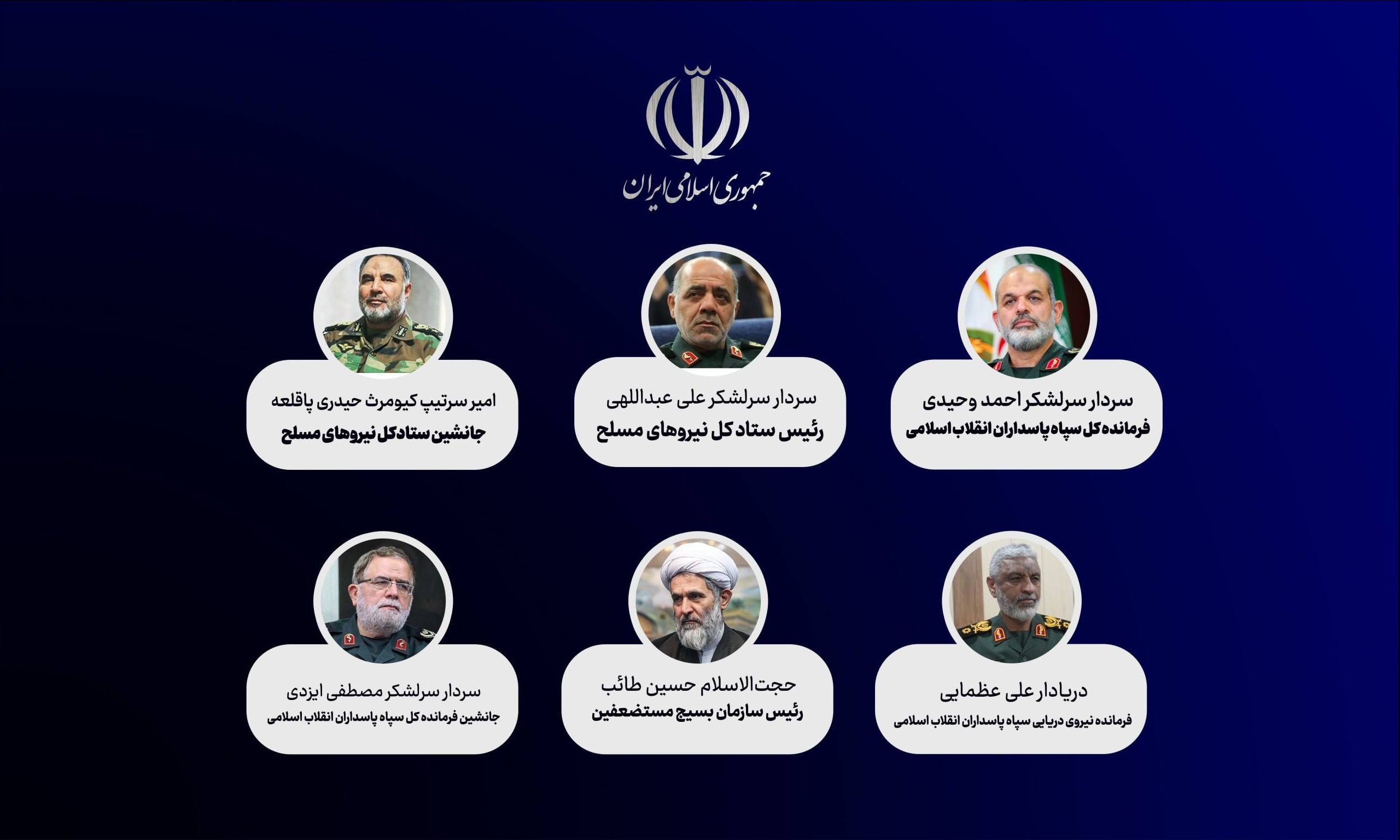
Iran’s Supreme Leader reshuffles six top military commanders. (Photo via Iranian media)
In its latest report on the 11th, Fox News suggested these appointments represent a consolidation and reorganization of the wartime military command structure, coming in the wake of airstrikes attributed to the US and Israel that resulted in the deaths of several senior Iranian commanders.
The report cites analysis from Omar Mohammed of George Washington University, who argues the timing and wording of the decrees indicate Tehran is gearing up for a “long-term confrontation,” rather than seeking a rapprochement with Washington.
Mohammed observed: “Strategically, it’s telling that these appointments were announced in English on X, right as Iranian and Omani negotiators are finalizing the proposed shipping route coordinates in the Strait of Hormuz. This is deliberate sequencing. Tehran is establishing its command structure as a fait accompli before signing any agreements.”
He further pointed out that the decrees’ language, which blames “the Zionist-American enemy” for the deaths of former commanders, formally characterizes the US as a co-belligerent in official state documents. “A country that is de-escalating would be dismantling its wartime command arrangements, but Iran is institutionalizing them. These decrees describe a leadership that is preparing for a long fight, not one seeking reconciliation,” Mohammed added.
The report also mentions that the Supreme Leader’s decrees instruct Vahidi to maintain readiness for “powerful offensive operations against the enemy,” and direct Abdollahi to complete the integration of the Armed Forces General Staff with the “Prophet Khatam” wartime joint command center.