

Israeli Prime Minister Benjamin Netanyahu stated on the 9th that Israel rejects the Gaza peace plan proposed by the so-called “peace committee” initiated by the United States, and asserted that the Israeli military will not withdraw from the Gaza Strip until Hamas is truly disarmed. International media widely view this as a rare public display of disagreement between Netanyahu and former US President Donald Trump. Some Spanish media outlets noted that Netanyahu’s statement marks a further hardening of Israel’s Gaza policy, limiting the potential for short-term diplomatic progress. Al Jazeera pointed out that with the Middle East currently facing multi-front conflicts, this stance could create additional obstacles to efforts aimed at de-escalating regional tensions.
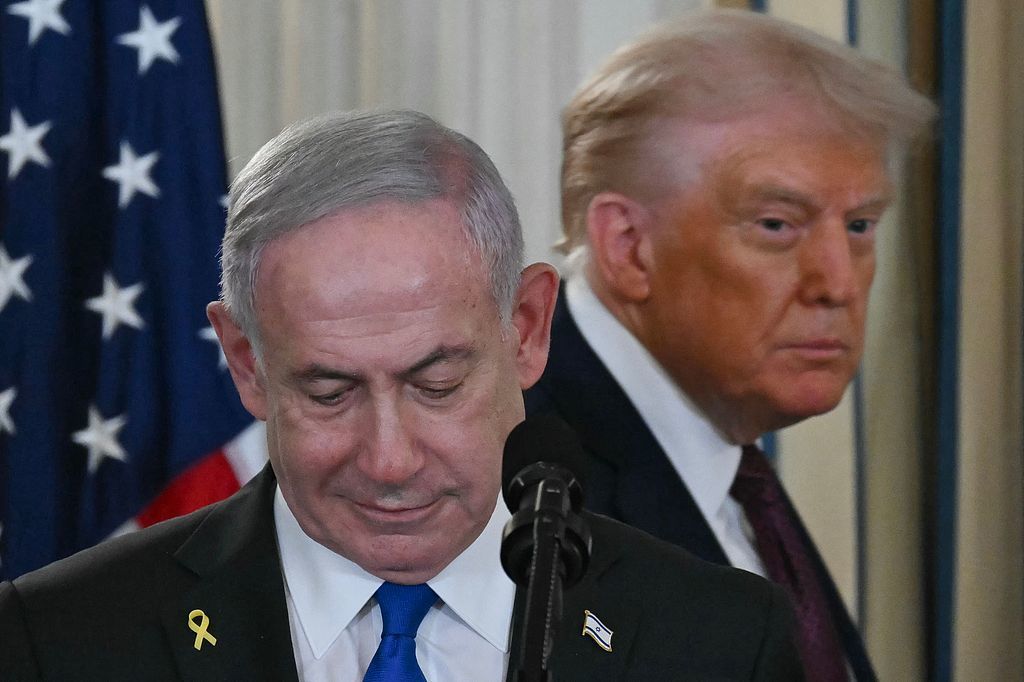
Trump and Netanyahu (file photo)
IDF Learned the News Just That Day
Speaking at a cabinet meeting on the 9th, Netanyahu said, “Israel rejects this peace plan containing 15 points.” He reiterated, “Our military will never withdraw from Gaza until Hamas is completely disarmed. We are discussing this with the Americans. They have various ideas, some we can accept, and some we cannot.” Netanyahu also emphasized that as long as he remains Prime Minister, he will not accept the establishment of a Palestinian state in the Gaza Strip or the West Bank.
On July 30th, Trump announced that the “peace committee” had reached a “historic agreement” on the comprehensive disarmament of Hamas and other armed groups in Gaza. The following day, the committee released a 15-point peace plan. Under this plan, Hamas would gradually surrender its weapons, while Israeli forces would withdraw from Gaza in phases.
Hamas Political Bureau member Bassem Naim stated on the 9th that Hamas remains committed to implementing the roadmap set by the “peace committee.” He urged the mediators and the American guarantors to pressure Netanyahu and his government to adhere to the roadmap and not obstruct the process for domestic political and electoral reasons.
Shortly after Netanyahu announced his rejection of the committee’s plan, Israel’s Channel 12 reported that he had personally approved a pilot withdrawal of IDF troops from three small areas near Rafah in southern Gaza. However, within the past 24 hours, Netanyahu apparently changed his mind. The IDF and security agencies reportedly only learned of Netanyahu’s reversal from media reports that same day.
Why the Public Confrontation with Trump?
“Netanyahu’s rejection deals a blow to Trump’s aspiration to be seen as a peace broker in international conflicts,” noted The Guardian. With the US midterm elections approaching in November, the White House is eager to hold peace talks on Iran and is also trying to bring peace to Lebanon and Gaza. However, the reality is that Israel occupies parts of Lebanon and has been accused by America’s Gulf allies of ethnic cleansing in Gaza.
“Why is Netanyahu so openly confronting Trump?” CNN questioned. The reason might not be surprising: the Israeli election. With less than 12 weeks until the vote, polls show Netanyahu’s prospects aren’t looking good. If he wants to continue governing, he needs the support of his far-right allies. These allies have criticized the roadmap aimed at advancing a Gaza ceasefire and have demanded the reversal of a previous cabinet decision to deploy an international stability force in Gaza. The Guardian suggests that to solidify his image as Israel’s “defender” at home, Netanyahu seems willing to publicly test his relationship with Trump.
The US side, however, doesn’t appear worried about Netanyahu’s stance. A senior American official told Israel’s Channel 12: “We understand his political needs (during the election period). As long as he continues to do what we ask—especially regarding controlling airstrikes in Gaza—we won’t have a problem.”
“Cold Comfort”
According to The New York Times, the relationship between Netanyahu and Trump has always been unpredictable. The two jointly launched military action against Iran in late February this year, but have since diverged on how to end the war and on the future scope of Israeli military operations in Gaza and Lebanon.
Wang Jin, director of the Center for International Strategic Studies at Northwest University, commented on the 10th that while there are differences between the US and Israel over the conditions for ending the Gaza conflict, the pace of Israeli withdrawal, and Hamas’s future status, this doesn’t mean a fundamental shift in the US-Israeli strategic relationship. He believes the “15-point plan” is more likely to be implemented in stages with ongoing negotiations rather than a one-time, comprehensive execution, so short-term setbacks or stalemates aren’t unexpected.
Zhu Yongbiao, a professor at Lanzhou University’s Institute for Central Asian Studies, told reporters that the US-led “15-point plan” is more of a political vision than an immediately executable ceasefire agreement. The more likely reality is a situation where the peace plan exists on paper, but the conflict on the ground in Gaza continues.
According to Reuters on the 9th, citing Gaza’s health ministry, over 1,250 people have been killed in Israeli strikes since the ceasefire agreement in October 2025. After the IDF occupied two-thirds of the Gaza Strip, nearly all of the more than 2 million residents are confined to a small coastal area controlled by Hamas, with most living in temporary tents or damaged buildings. CNN noted that while a US official from the “peace committee” tried to emphasize Israel’s recent military restraint in Gaza, for the 2 million residents there, it’s “cold comfort.” They remain completely excluded from the dialogue and have almost no say in determining their own fate.