

[By HA Viewpoint]
In August 2026, a leaked draft of an internal US State Department letter pushed Kazakhstan into the spotlight of the US-China artificial intelligence rivalry.
The document, addressed to 35 countries, delivered a blunt warning: joining the US-led “Pax Silica” initiative isn’t just a membership — it’s a commitment. It argued that “joining everything means joining nothing,” and that nations cannot simultaneously participate in competing frameworks that conflict with Washington’s vision. Kazakhstan, notably, is currently the only known country holding dual membership in both Pax Silica and the China-led World AI Cooperation Organization (WAICO).
This raises a deeper question: in an era where great-power tech competition is hardening into “institutional blocs,” does the “multi-vector diplomacy” long favored by middle powers still have room to maneuver? The fact that the letter hasn’t been officially sent yet also gives Astana some breathing room.
Li Lifan, director of the SCO Research Center at the Shanghai Academy of Social Sciences, told HA Viewpoint that Kazakhstan’s multi-vector diplomacy hasn’t hit its limit in the age of AI competition. Facing Washington’s “pick-one” pressure, Astana will adopt a “domain-layered” strategy. If US pressure escalates, Kazakhstan is more likely to lean economically toward China while hedging its bets on technology, using “non-participation in containing China’s tech” as a bargaining chip to buy time — rather than making a wholesale pivot to one side.
Li noted that US pressure could create early signs of “technological bloc-formation” in Central Asia, but it won’t lead to a full rupture. New tensions may emerge within the Shanghai Cooperation Organization, as Central Asian states don’t want the SCO to become an anti-US alliance, preferring to keep it as a platform for economic and security coordination.
Why Kazakhstan?
WAICO, launched in Shanghai in July 2026 with 29 founding members, emphasizes “open-weight” technology and a Global South orientation, pledging AI training for developing countries. China’s embassy in Washington has made clear its opposition to politicizing trade and technology issues, stating that “such actions would only stifle global AI progress and serve no one’s interests.”
The newly leaked draft letter effectively exposed Washington’s implicit exclusivity in the AI domain. Pax Silica has attracted around 24 countries, including US allies like Japan, Australia, and South Korea. Reuters noted that Washington aims to cut off China’s access to critical resources by pushing countries to choose sides. AI is viewed as a strategic asset that could be weaponized for military or economic dominance, and the US is determined not to concede any advantage in this field.
George Chen, a lecturer in politics and public administration at the University of Hong Kong, wrote in a recent newsletter that Pax Silica and WAICO are becoming the two core frameworks in the US-China battle for AI influence. Kazakhstan’s centrality highlights the dilemma facing middle powers. Dual membership was originally a “balancing act” that helped Astana serve as a bridge. But Washington’s latest “AI ultimatum” may force Kazakhstan to pick a side, undermining that bridging role.
His article cautioned: the pressure to align exclusively with one bloc is intensifying, and Kazakhstan’s predicament carries both demonstrative and cautionary significance.
Kazakhstan is Central Asia’s largest country and holds critical mineral reserves that the US considers vital — tungsten, copper, and rare earths are directly tied to semiconductor and advanced manufacturing supply chains. One of Pax Silica’s core goals, unveiled in late 2025, is to build a China-free AI supply chain: from mineral extraction to chip manufacturing to frontier models. In June, Washington prominently announced Kazakhstan as the first Central Asian member of Pax Silica, precisely because of the strategic value of its resource endowments.
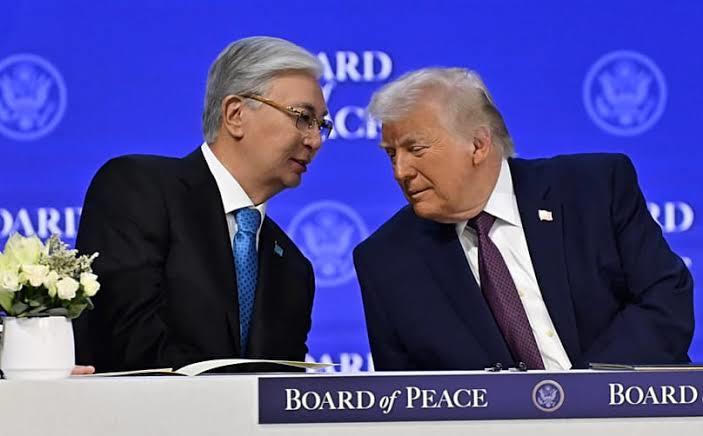
During the World Economic Forum on January 22, Trump launched the signing ceremony for the “Peace Council” charter. Kazakh President Kassym-Jomart Tokayev attended and signed as a founding member. Photo: Kazakh Presidential Press Office
However, Kazakhstan’s economic ties with China run far deeper than with the US. In 2025, bilateral trade approached $49 billion, making China its largest trading partner and export market. Cumulative Chinese investment exceeds $30 billion, with more than 8,500 Chinese companies operating in Kazakhstan. The China-Kazakhstan oil pipeline and the Central Asia-China gas pipeline are critical routes that reduce its dependence on Russian transit. As recently as July 2026, during Tokayev’s visit to Shanghai for the World AI Conference, the two sides signed cooperation agreements worth over $15 billion, covering Huawei strategic partnerships and digital infrastructure projects.
More crucially, Kazakhstan is aggressively advancing its “Data Center Valley” and regional AI hub ambitions. It needs both high-end computing power and cutting-edge technology from US firms like Nvidia, as well as China’s cost-effective open-weight models, infrastructure investment, and vast market access. Wanting both is a rational choice; being told to choose only one creates a structural dilemma.
This dilemma is symbolically captured in Astana’s skyline: the Kazakhstan-Russia business center, a pagoda-shaped hotel funded by Chinese oil investment, and the US-branded Ritz-Carlton stand side by side, coexisting without conflict. But the bloc-ification of the AI era is eroding that physical coexistence.
Cold Calculation of Interests: Who Hurts More?
Simplified to the extreme — whose loss hurts Kazakhstan more? The answer isn’t ambiguous. Giving up China would carry a heavier, more rigid, and harder-to-reverse cost.
Kazakh-China trade volume is nearly ten times that of Kazakh-US trade. Among Kazakhstan’s mineral exports, China accounts for about 27%, while the US takes only about 5%. On energy routes, the China-Kazakhstan oil pipeline is a vital alternative that bypasses Russia. More importantly, Chinese investment has created deep “embeddedness” — from infrastructure to digital communications, from mineral development to manufacturing. Interrupting these projects wouldn’t just be an economic loss; it would mean stalled employment, fiscal strain, and a halt to regional development momentum. Geographic proximity also means that political cooling quickly translates into slower border crossings, higher logistics costs, and tighter market access. These layers of “hard constraints” leave Kazakhstan almost no buffer if it were to distance itself from China.
Giving up the US would carry a more concentrated, more “quality-oriented” cost, but with a narrower impact. The losses would be high-end chip supply, advanced AI technology cooperation, Western capital inflows, and the indispensable strategic balancing lever in the China-US-Russia triangle. If cooperation with US firms like Nvidia were blocked, Kazakhstan’s plans to build a regional AI hub would be severely set back, and high-value-added mineral projects like tungsten could slow down.
The deeper impact: losing the US would significantly shrink Kazakhstan’s maneuvering space between Russia and China. However, these effects are more visible in long-term industrial upgrading and diplomatic flexibility — the short-term blow to the economic fundamentals would be far smaller than distancing from China.
So, purely from an interest-ranking perspective, Kazakhstan’s priority of “preserving China, courting the US” is clear. But that doesn’t mean it will happily “pick a side.”
Li Lifan predicts that if US pressure keeps escalating, Kazakhstan is more likely to tilt economically toward China while maintaining diversified balances in the security domain. The US also has energy investment stock in Kazakhstan and provides unique resources like financial systems, technical standards, and high-end equipment. But these resources are far smaller in volume and coverage compared to the comprehensive nesting of the Kazakh-China economy. In other words, the US offers more of a “icing on the cake” high-end element, while China provides the “fuel in snowy weather” foundational architecture — even though high-end tech is harder to substitute, damage to the foundational layer carries far greater systemic risk.
“After weighing the options, Kazakhstan will lean toward protecting its Chinese economic lifeline while maintaining selective engagement with the US and the West in security and technology to preserve its multi-balance diplomatic space.”
Specifically, if Washington keeps pressing, Kazakhstan is more likely to use “non-participation in containing China’s tech” as its bottom-line stance while actively seeking US exemptions or transition arrangements. It won’t adopt an openly anti-US posture to avoid fully antagonizing Washington, but it certainly won’t sacrifice its economic lifeline with China to win American approval.
Li believes that unless the US imposes extreme sanctions on Kazakhstan — such as cutting off SWIFT access, freezing US-backed projects, or imposing secondary sanctions on its critical mineral exports — the probability of Kazakhstan tilting entirely toward the US is low. From Astana’s perspective, losing the application layer is a setback, but losing the infrastructure layer means systemic risk.
Multi-Vector Diplomacy Hasn’t Hit Its Limit
Kazakhstan’s foreign policy tradition is “multi-vector” — maintaining relations with Russia, China, the US, and the EU simultaneously to avoid over-dependence on any single power. It’s essentially a flexible combination of diverse issues and the core strategic thread of maintaining middle-power status. Tokayev himself has repeatedly emphasized that autonomy isn’t about choosing sides but about diversified strategic partnerships. This logic continues in the AI domain: signing Pax Silica on one hand, joining WAICO on the other.
Li Lifan argues that Kazakhstan’s accession to Pax Silica is more of a political gesture, while joining WAICO is driven by technological needs. In Astana’s view, the US-China AI competition isn’t a simple “either-or” proposition. AI isn’t a single product but a composite ecosystem of computing power, data, models, and standards. Once deeply integrated into one ecosystem, switching costs become prohibitively high. Therefore, Kazakhstan’s core approach to navigating US-China AI competition is to emphasize technology security and structural diversification — not passive alignment.
Regarding Washington’s demand that Kazakhstan “can’t have both,” Astana sees this as essentially an attempt to forcibly link AI cooperation with security and finance to compress its diplomatic ambiguity. But Kazakhstan’s investment in AI goes back years — it has established a national AI computing center, and its development approach has always been to draw on the strengths of all parties, staying inclusive rather than “undermining one side for another.” Kazakh experts have repeatedly noted that neither the US nor China has a complete AI ecosystem on its own — both need external markets. China needs Central Asia as a node for the Digital Silk Road, and the US equally needs Central Asia to avoid being fully absorbed into China’s orbit.
Li judges that Kazakhstan’s limited size means it isn’t the main battleground of US-China AI competition, leaving it considerable room to maneuver. Going forward, Kazakhstan can adopt a “domain-layered” strategy: deepening cooperation with Chinese firms in basic computing power, digital infrastructure, 5G, and cloud services; maintaining multiple points of contact with the US on high-end chip acquisition and AI governance standards alignment; and leveraging data sovereignty and localization requirements as important hedging tools.
Based on this analysis, Li believes Kazakhstan’s multi-vector diplomacy hasn’t reached its limit — it can still maneuver deftly between great powers. A typical example: Kazakhstan actively supports China-favored open-source AI within Chinese or SCO frameworks, while when Rubio visits Kazakhstan or attends G20-related events in September, it will work to preserve US face. This “dual-track operation” precisely demonstrates that Kazakhstan’s multi-vector diplomacy still has ample elasticity.
In practical terms, Astana’s most likely path is:
First, prioritize delay and ambiguity. Don’t publicly withdraw from either side; respond with rhetoric like “technical cooperation and governance frameworks can be separated,” “national interests come first,” and “cooperation is non-exclusive.” Meanwhile, control the visibility of sensitive actions at the operational level to lower Washington’s perception of “dual affiliation.” The US letter is still a draft with no clear deadline.
Second, if pressure intensifies, make asymmetric tilts. Protect substantive economic and energy cooperation with China first — this is the “bottom card that can’t be lost” — while trying to “technologize” and “projectize” cooperation with the US: keeping concrete projects like chips, data centers, and high-end mineral development while downplaying formal framework commitments.
Third, use the competition between the two sides to drive up leverage. Continue using critical minerals and AI infrastructure positioning as bargaining chips, demanding more localization processing, technology transfers, and long-term investment commitments from both China and the US. For resource-rich countries, this is a rare window of opportunity — but windows don’t stay open forever.
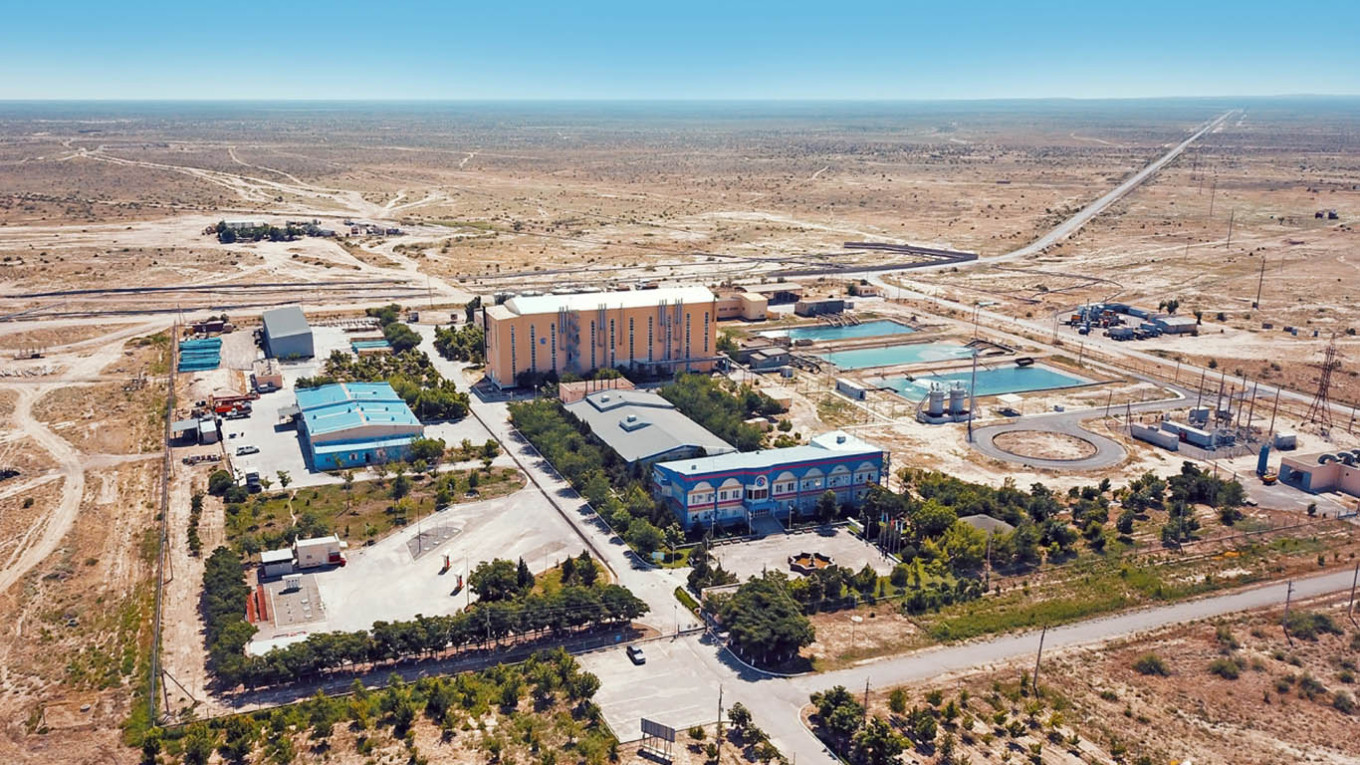
Uranium processing facility in southern Kazakhstan. Photo: Kazatomprom
The Middle Ground Is Narrowing — What Does It Mean for the SCO?
Kazakhstan’s predicament isn’t unique. Over the past decade-plus, many middle powers have grown accustomed to hedging between the US and China — economically leaning on China, security and tech-wise relying on the US or the West. But when AI supply chains are given security attributes, and minerals, chips, and models are required to be shared only among “trusted partners,” the gray zone begins to shrink. Pax Silica’s attempt to upgrade from a non-binding initiative to an exclusive commitment is a manifestation of this trend.
Li Lifan told HA Viewpoint that Washington’s pressure will trigger early signs of “technological bloc formation” in Central Asia, but it won’t cause a complete rupture. Central Asian states generally don’t want to become the front line of a new Cold War and will try to preserve living space between great powers.
Specifically, Kazakhstan and Uzbekistan, as the region’s two stronger states, will take proactive hedging measures to maintain flexibility between two technological systems. Other smaller Central Asian nations are more inclined to stay quiet, observe from the sidelines, and avoid becoming focal points of great-power competition.
For internal cooperation within the Shanghai Cooperation Organization, Li believes external pressure could actually transform into internal cohesion. China will leverage the SCO framework to push pragmatic cooperation on the Digital Silk Road, AI collaboration, local currency settlement, and cross-border data flows to counter US exclusivity pressure. Meanwhile, Russia will also strengthen its ties with Central Asian states through security议题. Against the backdrop of intensifying US-China rivalry, Sino-Russian coordination in Central Asia may further deepen.
But Li also cautions that new tensions will emerge within the SCO — Central Asian states don’t want the organization to evolve into an “anti-US bloc,” preferring to keep it positioned as an economic and security coordination platform rather than a geopolitical confrontation tool. Additionally, Russia’s stance on AI technical standards, data governance, and digital sovereignty deserves attention. Central Asian states may exploit the divergences between China, Russia, and the US-West to preserve their own policy space and diplomatic flexibility. The middle ground in this “three-way game” is precisely the structural foundation that allows countries like Kazakhstan to continue their multi-vector diplomacy.
In the medium-to-long term, the trajectory depends on several key variables: the actual enforcement intensity and punishment mechanisms of Pax Silica; China’s sustained appeal in open-weight models and resource cooperation; and the pace at which Kazakhstan improves its own AI application capabilities and mineral processing capacity. After all, the stronger one’s “bargaining power,” the less pressure there is to be coerced into picking sides.
Whether Kazakhstan can continue to chart its own path in the cracks is both a test of its diplomatic wisdom and an important window into whether the global technological order will descend into complete fragmentation — or retain some room for compatibility. For all middle powers pursuing independent foreign policies, Astana’s choice, or its refusal to choose, will become a reference point revisited again and again.