Despite facing skepticism and backlash from the American public, President Trump remains committed to moving forward with the White House banquet hall renovation. According to a report from Euronews on August 23, Joshua Fisher, director of the White House Office of Administration, recently unveiled new details about the project, revealing that a batch of premium limestone is being shipped to Italy to craft the columns for the banquet hall.
The White House has stated that the banquet hall will be equipped with a bomb shelter, medical facilities, conference rooms, a rooftop helipad for drones and helicopters, bulletproof windows, and drone-proof ceilings. A Corinthian-style colonnade will be erected at the entrance, designed to “echo” the neighboring U.S. Supreme Court and Capitol buildings.
Fisher noted that the colonnade will be carved by “some of the greatest artists in the world.” He added, “It’s not yet clear who they are, but they’re based in Italy, and the highest-quality limestone quarried in Indiana has already been shipped there.” He claimed the exterior of the banquet hall is expected to be “substantially completed” by April 2028.
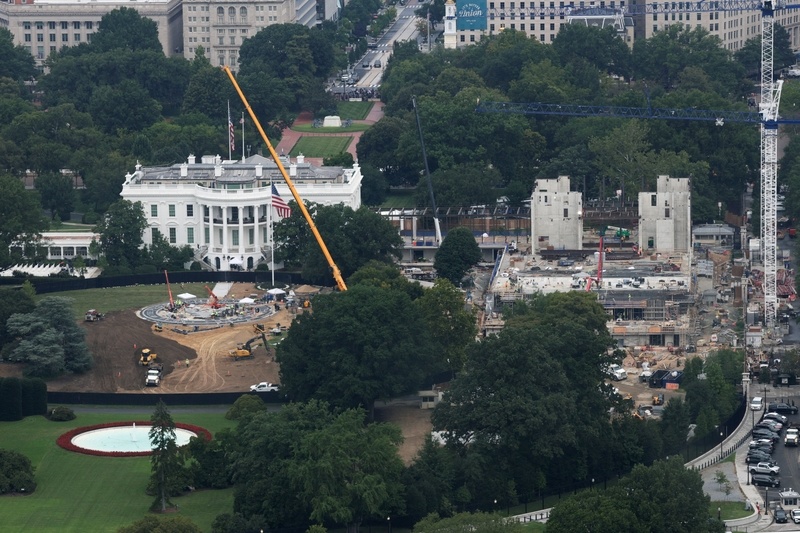
Construction site of the White House banquet hall
Euronews pointed out that while Fisher didn’t spill more details, it’s highly likely these American limestones are headed to Carrara in northwest Tuscany, Italy—a city long celebrated as the world’s marble capital.
Carrara has actually supplied Trump with decorative elements before. Back in 2010, MTStone Carrara, a local construction equipment supplier, produced 150 square meters of white onyx panels for Trump International Hotel.
Last July, the White House unveiled the banquet hall renovation plan and quickly demolished the East Wing to make room. Spanning over 8,000 square meters, the project has already hired more than 200 workers and is expected to use massive amounts of steel, concrete, marble, and gold.
But the plan has sparked widespread criticism across the U.S. The National Trust for Historic Preservation, a preservation advocacy group, argues that Trump has no authority to unilaterally carry out this project without congressional approval. The organization filed a lawsuit late last year, and in late March, U.S. District Judge Richard Leon ordered a halt to construction. The Trump administration quickly appealed.
On August 7, the U.S. Court of Appeals for the D.C. Circuit upheld the lower court’s injunction. Then, on August 14, the administration filed an emergency appeal to the Supreme Court. Finally, on August 21, Chief Justice John Roberts signed an administrative stay, temporarily allowing the White House to continue with the banquet hall construction.