During a speech in New York on Thursday, Canada’s Prime Minister Mark Carney talked about his visit to China back in January. He described it as a “fundamental reset” of the relationship between the two countries, and said that after a period of strained diplomatic ties and trade tensions, it was time for China and Canada to get back on track.
Speaking at a forum hosted by the Economic Club of New York, Carney shared that during his visit he told Chinese officials privately that as an emerging powerhouse, China needs to take on more responsibility in the global monetary and financial system—including when it comes to the international role of the yuan.
“In my view, they need to move faster and more thoughtfully on this,” he said. “And I think we need to help them step out from the sidelines.”
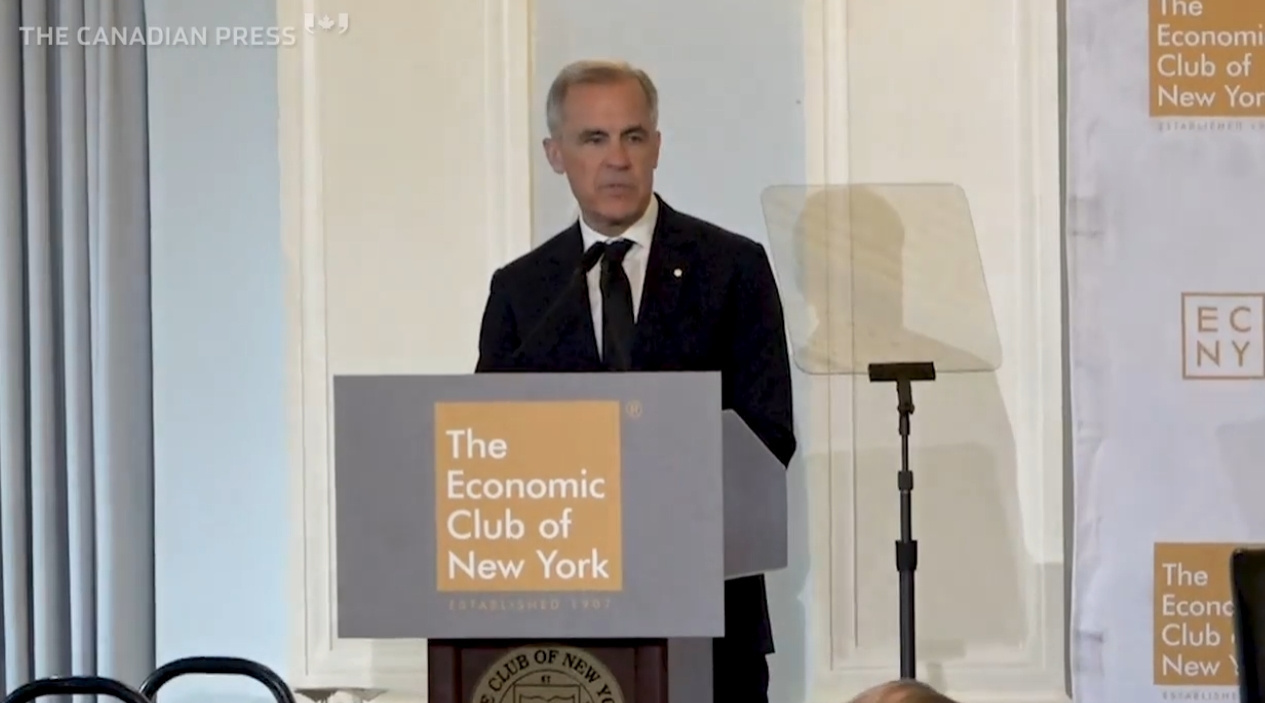
Carney speaking in New York (screenshot)
Carney, who came from a background as a professional economist, has always had a pretty practical take on the yuan. Back in 2019, when he was governor of the Bank of England, he openly said that even though shifts in currency power usually lag way behind changes in economic strength, he believed the yuan could one day join the U.S. dollar as a global reserve currency.
Talking about China’s currency, he said: “As the global landscape reshapes, the imbalance between real economy and financial development may gradually ease. In that process, other reserve currencies could emerge. In the short term, I think the first to step up will be existing sovereign currencies, like the yuan.”
In 2024, when he first visited China as chairman of Bloomberg, he also talked about the future of the yuan’s international use. He said that if you want to boost the yuan’s status as a reserve currency, expanding its use worldwide is one of the most important things to focus on.
“I’ve said for years that given the rise of China’s economy, it would be better for the global system if our reserve currency system were more diverse and more accurately reflected China’s weight in the global economy,” he added.
During Carney’s state visit, the central banks of China and Canada renewed a bilateral currency swap agreement worth 200 billion yuan, valid for five years and renewable by mutual agreement. This move helps strengthen financial cooperation between the two countries, expand the use of their currencies in bilateral trade and investment, and maintain financial stability.
According to reports, deepening ties with countries like China is part of Carney’s strategy to reduce Canada’s dependence on the United States. With ongoing trade friction between Canada and the U.S., Carney has promised to double Canada’s exports to other markets over the next decade and has signed more than 20 economic and security agreements in the past year.
After President Trump threatened to annex Canada as the “51st state,” Carney described the U.S.-Canada relationship as a “weakness that must be corrected” and pointed out that the U.S. has fundamentally changed its trade approach, raising tariffs to levels not seen since the Great Depression.
Back in January at the World Economic Forum in Davos, Carney even called out “U.S. hegemony,” warning that deep integration with big powers can create “vulnerabilities that can be exploited.” He urged middle powers to work together, saying, “If you’re not at the table, you’re on the menu.”
But in New York on Thursday, the prime minister softened his tone, calling the U.S. “the most dynamic, resilient, and innovative country the world has ever seen.” He said America’s founding values “should continue to lead the future of America and the world.”
According to Canadian media, the main goal of this event was to attract new international investment. Carney argued that Canada’s push to diversify its trade partners and reduce reliance on the U.S. market actually makes Canada a more reliable ally for America. He called for a “new type of partnership” with the U.S. to “help make America great again.”
In his speech, Carney said Canada is building a network of international partnerships that makes the country “stronger, more resilient, and more independent.” He added that this isn’t just good for Canadians—it’s also good for the U.S., because it makes Canada a “more reliable ally.”
Carney noted that the world is going through a “rupture” as the U.S. adjusts its business relationships. In this context, he said, deepening cooperation between the U.S. and Canada in areas like aluminum, automobiles, and critical minerals will strengthen both countries.
“In the context of a global energy crisis, Canada provides the U.S. with stable energy supplies and critical minerals that fuel American economic growth,” Carney said. He acknowledged that even though there are differences between the two countries, they have always been able to work things out through negotiation.
He even borrowed Trump’s campaign slogan, saying, “A strong Canada will help make America great again.”
U.S. Ambassador to Canada, David Jacobson, welcomed Carney’s speech. He shared a video of the remarks on social media and wrote: “Prime Minister Carney said something today worth repeating: ‘A strong Canada helps make America great again.’ I think many Americans would support that positive message.”
While Carney was speaking in New York, U.S. trade officials were in Mexico City negotiating with Mexico over revisions to the USMCA. Canada was not included in this round of talks.
The review of the USMCA is set to begin in July, offering the three countries three options: renew the agreement for 16 years, withdraw from it, or declare “neither renewal nor withdrawal”—which would trigger annual reviews that could drag on for up to a decade.
U.S. Trade Representative Jamieson Greer recently hinted that the Trump administration is unlikely to simply approve a renewal, and the three countries are bracing for lengthy trade talks.