Ukraine’s President Volodymyr Zelenskyy has sent a personal letter to President Donald Trump and the U.S. Congress, urgently requesting faster delivery of anti-ballistic missiles to tackle a severe shortage of air defense weapons. This move comes just as Russia is ramping up massive airstrikes across Ukraine and openly threatening new long-range attacks on Kyiv, including what Moscow calls “decision-making centers.” It’s a clear sign of the mounting pressure on Ukraine’s air defense systems.
According to the Kyiv Independent, Ukrainian officials worry that their limited Patriot interceptor missiles and other Western-supplied air defense gear might not hold up under the relentless bombardment. The letter also highlights Kyiv’s growing frustration with the “Ukraine Priority Requirements List” (PURL) mechanism, a joint U.S.-NATO initiative that lets allies fund American-made weapons for Ukraine. Zelenskyy wrote that the current delivery speed under PURL can’t keep up with the threats Ukraine faces. He begged Washington to stay engaged and help secure Patriot Advanced Capability-3 missiles and other systems to fend off Russian missile strikes.
Ukraine relies almost entirely on Western allies for missile defense, but the Middle East conflict has worsened the shortage of interceptor missiles. On May 28, Swedish Prime Minister Ulf Kristersson met Zelenskyy in Uppsala and announced a donation of 16 older-model Gripen fighter jets, plus support for selling 20 newer Gripen E/F jets to Kyiv. Just two days earlier, at a summit in Kyiv with European representatives, Zelenskyy urged Europe to ramp up air defense support, calling it a “top priority” for all European leaders.
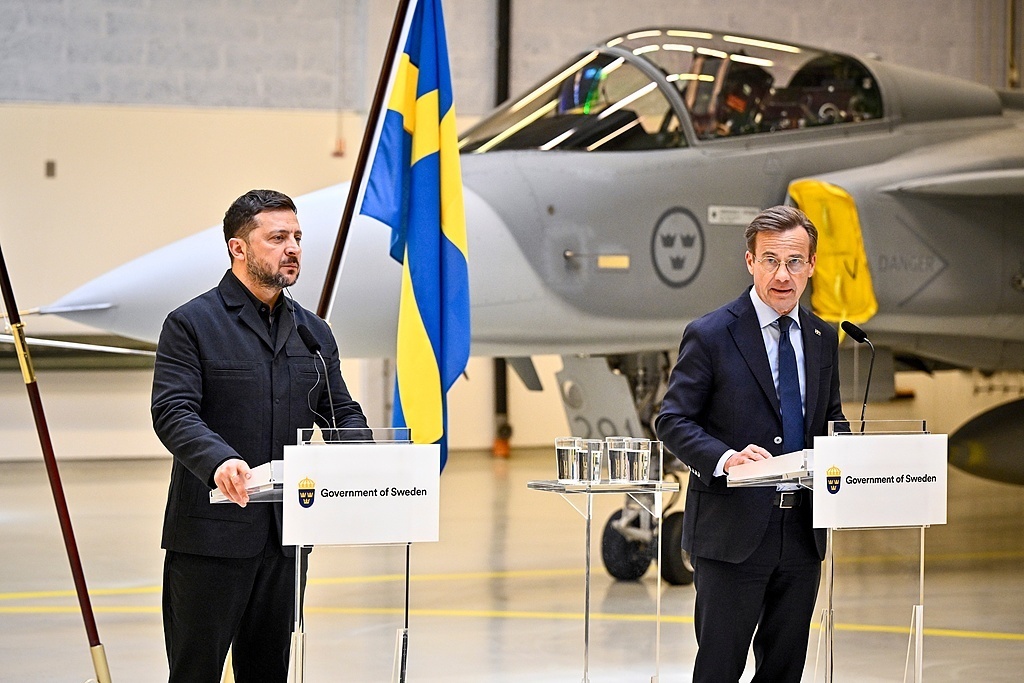
Swedish PM Kristersson (right) and Ukraine’s President Zelenskyy hold a joint press conference on May 28.
While Ukraine scrambles to boost its air defense, Lt. Gen. Andriy Biletsky, commander of Ukraine’s Third Army, told Reuters on May 27 that Ukrainian forces have a six-month window to seize battlefield momentum from Russia and gain leverage for peace talks. He predicted the next 6 to 9 months would be a “turning point.” If Ukraine can launch and sustain offensives in the coming months, it might gain an upper hand on the front line, forcing Russia to give up its ambitions for the last unoccupied part of Donetsk in eastern Ukraine. Reuters notes that control of Donetsk has been a sticking point in U.S.-backed peace negotiations, which are now stalled. Russia hasn’t responded to these claims yet.
As U.S. mediation stalls, the European Union is trying to restart direct dialogue with Russia. EU foreign ministers, meeting informally in Cyprus, said that for the EU, the mandate for talks matters more than the choice of negotiator. This sensitive topic topped the agenda at the meeting.
On May 28, EU foreign policy chief Kaja Kallas told reporters at the informal gathering in Cyprus that arguments over who should lead EU-Russia talks are a “trap the Russians want us to fall into.” She said, “Negotiations are always a team effort. You need some to play bad cop, some to play good cop, and a strategy for how to sit at the table. So the substance is far more important than the person.”
According to reports, Kallas had circulated a confidential document listing possible concessions and expectations from Russia as part of a deal. She recommended the EU adopt a “maximalist” stance in talks to counter Russia’s own maximalist demands.
Russia is deeply skeptical about the EU’s sincerity and effectiveness in resuming talks. Russia’s “Lenta” news site reported on May 28 that Kremlin spokesman Dmitry Peskov said the EU is only pretending to be willing to negotiate on resolving the Ukraine conflict, while actually pushing Kyiv to keep fighting.
Russia recently announced it would launch “systematic strikes” on Kyiv and called on all countries to withdraw their diplomatic personnel from the city. The EU bluntly refused. Kallas said on May 28, “All European embassies stayed. Only the United States left.” The U.S. embassy in Kyiv quickly dismissed that as “false.”
Russia’s “Eurasia Daily” website on May 28 called Europe’s response to the Russian warning “irresponsible” and potentially “criminal negligence.” It said keeping civilians inside a zone that’s been declared a target area amounts to deliberate provocation. Some Western military experts predict Kyiv could face new strikes this weekend, around May 30-31.