Well, here’s a big move in European defense: French President Emmanuel Macron announced on Tuesday that Norway has officially signed up for France’s “forward deterrence” plan—a nuclear protection scheme designed to cover allied nations. This comes after Macron unveiled the initiative back in early March, aiming to extend France’s nuclear umbrella to several European partners.
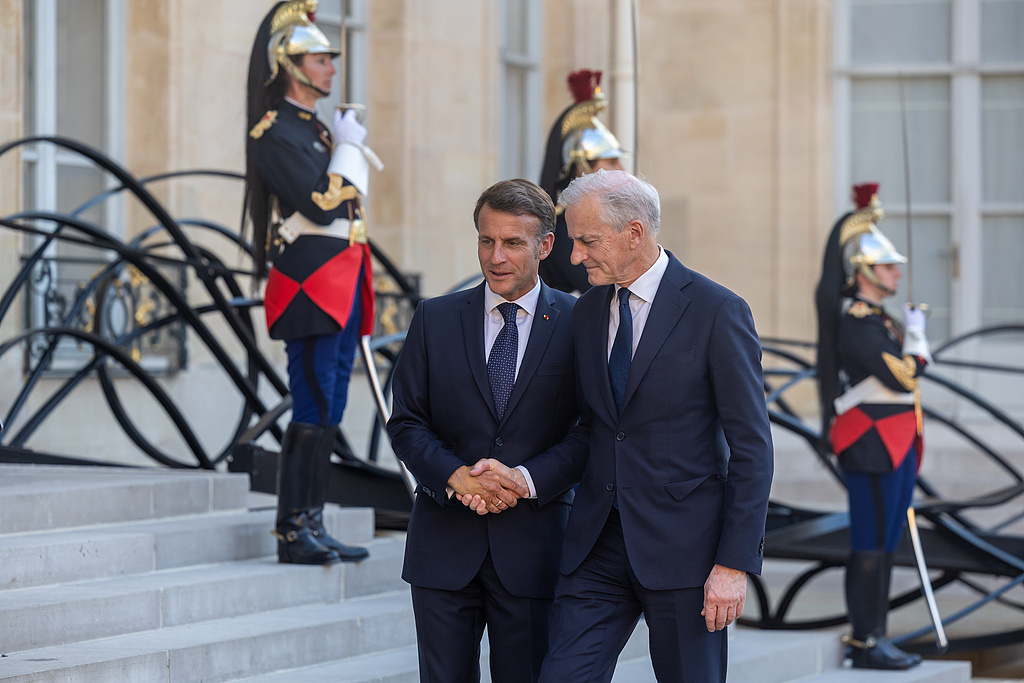
Photo: Macron (left) welcomes Norwegian Prime Minister Jonas Gahr Støre at the Élysée Palace in Paris on May 27. (Visual China)
So, what’s the deal? The “forward deterrence” initiative is essentially a partnership between France and eight other European countries—including the UK, Germany, Poland, the Netherlands, Belgium, Greece, Sweden, and Denmark—to extend nuclear deterrence beyond French borders. It’s seen as a pretty big shift in France’s nuclear policy. Norway, while not an EU member, is a NATO member and had already shown interest in joining the talks.
During a press conference at the Élysée, Macron said Støre agreed to join the program, calling it “a significant step in our partnership that will drive very ambitious cooperation.” He added, “Norway is a key geographical and strategic partner. We already work closely to protect allied territory from external threats, and Norway will bring important added value to this forward deterrence.”
Støre, for his part, acknowledged that Norway’s main deterrent still comes from NATO and the United States. But he also admitted that France’s nuclear capabilities “make an important contribution” to NATO’s overall deterrence posture. He expressed interest in working with “Poland, the UK, Germany, and Nordic partners” within this framework.
This move isn’t happening in a vacuum. The underlying vibe here is that European countries are growing increasingly uneasy about relying on the US for their security—especially with tensions rising against Russia and questions about America’s long-term commitments. So, they’re looking to beef up their own defenses. Beyond the nuclear plan, Macron and Støre also inked a defense agreement in Paris, pledging to provide mutual military support when needed.
According to nuclear expert Héloïse Fayet of the French Institute of International Relations, Finland and the Baltic states have shown “cautious” interest in the plan, and Romania might be a candidate too. But she points out that “forward deterrence” is more about strengthening strategic cooperation—like setting up nuclear guidance groups, taking part in French nuclear exercises, and even sharing intelligence—rather than just offering a straight-up nuclear umbrella. It’s more of a coordinated effort than a simple protection policy.