As talks between the US and Iran reach a critical point, President Trump is set to hold a full cabinet meeting on the 27th — but the location has changed at the last minute. Trump posted on social media on the 26th that due to expected bad weather the next day, the cabinet meeting originally planned at Camp David would be moved to the White House, and the trip to Camp David has been postponed. CNN noted this is Trump’s first cabinet meeting since March 26.
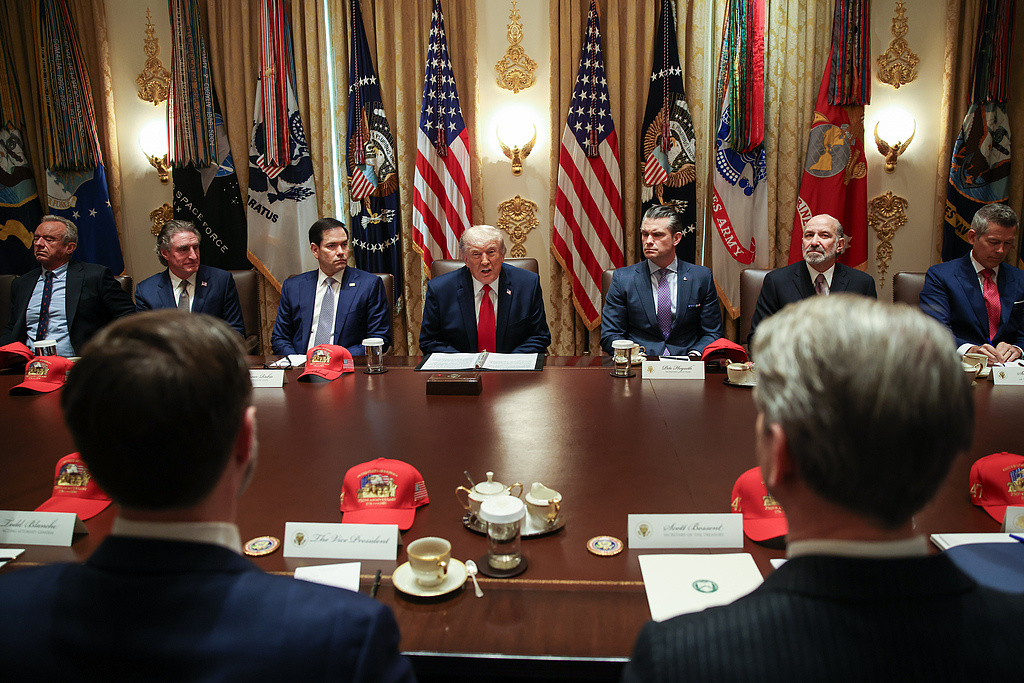
On May 27, in Washington, DC, US President Donald Trump speaks at a Cabinet meeting held at the White House.
According to the New York Post, a White House official said all cabinet members, including outgoing Director of National Intelligence Gabbard, will attend. The official said the meeting will discuss “recent achievements of this administration, including victories in the economy and small business, results from the ‘Fraud Elimination Task Force,’ and the latest developments in foreign policy.” Reports suggest the US-Iran deal could be the main topic of discussion.
On the 27th, the Associated Press reported that as he prepares for closed-door consultations with senior aides, Trump appeared confident, saying the US and Iran are close to a deal: reopening the Strait of Hormuz, and he offered a strong argument — Iran’s nuclear capabilities have been significantly weakened, enough to declare victory. The report suggests that given the current situation, Trump also faces risks: the war he chose to start may end in an unsatisfying outcome.
According to the Associated Press, the gradually taking shape deal puts off many key issues and has drawn sharp criticism — even from some Trump supporters. Critics argue that Iran’s hardline leaders, though frustrated in the conflict, may become even bolder. Some Republican allies question whether the terms are too favorable to Tehran. They oppose parts of the deal that have been made public, saying it looks very similar to the nuclear agreement former President Obama reached with Iran — the same one Trump withdrew from during his first term. Plus, with midterm elections approaching that will decide control of Congress, Republicans worry rising prices and fuel costs are hurting voter sentiment. The Wall Street Journal reported that while Iran seeks economic relief, it also wants to avoid letting the US president claim victory. Despite a small US airstrike on the 26th, Tehran’s goals still seem to be on the negotiating table. According to Iran’s state broadcaster, Iranian President Pezeshkian said in a call with Qatari leaders on Tuesday that Iran “is ready to end the war within a framework of mutual respect.”
Another key unresolved issue: whether the ceasefire agreement will cover Israel’s military operations against the Iran-backed Hezbollah in Lebanon. Iran insists any ceasefire with the US must include Lebanon. The reported ceasefire proposal calls for a halt to hostilities between the US and its allies on one side, and Iran and its proxies (such as Hezbollah) on the other, while preserving Israel’s right to self-defense against imminent threats. On the 26th, Israeli Prime Minister Netanyahu announced that the IDF is “deepening military operations in Lebanon.” Former IDF spokesman Jonathan Conricus said Israel expects Iran to quickly use sanctions relief funds to rebuild military strength and support proxies, including Hezbollah and Hamas in Gaza. “Our fight is not over because the Iranian regime hasn’t stopped,” Conricus said.
On the 26th, Lebanon’s Health Ministry and state news agency reported that Israeli airstrikes hit multiple areas in southern and eastern Lebanon, killing at least 31 people and wounding 40. Three airstrikes targeted areas near the Qaraoun Dam in the eastern Beqaa Valley. Lebanon’s Litani River Authority issued a statement saying the Qaraoun Dam is a crucial civilian infrastructure for Lebanon’s water security, energy supply, and agricultural irrigation. Any direct or indirect attack on the dam or its facilities could cause disastrous risks to downstream residents and infrastructure.
Hezbollah said on the same day that it fired drones and rockets at Israeli military vehicles and troop concentrations along the Lebanon-Israel border, in response to the IDF’s ground advances. Earlier, Israeli media reported that in response to Hezbollah’s drone threat, the IDF has begun crossing the so-called “yellow line” set by the April 17 ceasefire, launching ground operations deeper into Lebanese territory. Netanyahu said that evening that the IDF is occupying some “strategic locations.”
Israel and Lebanon agreed to a temporary 10-day ceasefire starting April 17, which has been extended multiple times. But since the ceasefire took effect, Israel has carried out attacks, claiming Hezbollah violated the truce, and has demolished and blown up so-called “Hezbollah military infrastructure” in occupied southern Lebanon.
In other news, the Israeli military said on the 27th that it killed the new military leader of Hamas, Mohammed Odeh, in an airstrike on the Gaza Strip. The IDF and Shin Bet said in a statement that after months of surveillance, they struck a facility in central Gaza City where Odeh was hiding, also hitting a nearby apartment. The statement said Odeh was “one of the planners” of the Hamas attack on Israel on October 7, 2023. He had recently replaced Izz al-Din Haddad, the former Hamas military leader who was assassinated by Israel. Odeh also served as head of Hamas intelligence. Hamas sources confirmed that Mohammed Odeh was killed in that strike.