The UK political scene is undergoing a major shake-up. On the morning of the 22nd, British Prime Minister Keir Starmer announced his resignation as Labour Party leader, with the nomination process for a new leader set to begin on the 9th of next month. Before Parliament reconvenes in September, Labour will elect a new leader, who will also take over as Prime Minister. As the internal competition officially kicks off, the successor is becoming clearer. Former Health Secretary Wes Streeting announced on the 22nd that he would support Andy Burnham for the next Labour leader, making it highly likely that the former Mayor of Greater Manchester—who just made a strong return to Parliament in the Macclesfield by-election—could move into 10 Downing Street as early as mid-July.
“I will resign as Labour leader,” Starmer said, stepping out of 10 Downing Street with his wife Victoria to deliver a resignation speech, ending his six-year tenure as Labour leader and two-year term as Prime Minister. He stated that he has “gladly accepted” the reality that he is not the best person to lead Labour into the next general election.
Starmer said he has asked the Labour National Executive Committee to set a timeline. According to his plan, UK media outlined key dates for selecting a new Labour leader: nominations open on July 9, close before the summer recess on July 16, and if there’s only one candidate, they become the new leader directly; if multiple candidates emerge, a leadership contest will be held. Before Parliament reconvenes on September 1, Labour will elect a new leader. Starmer will continue as Prime Minister until the leadership election is complete.
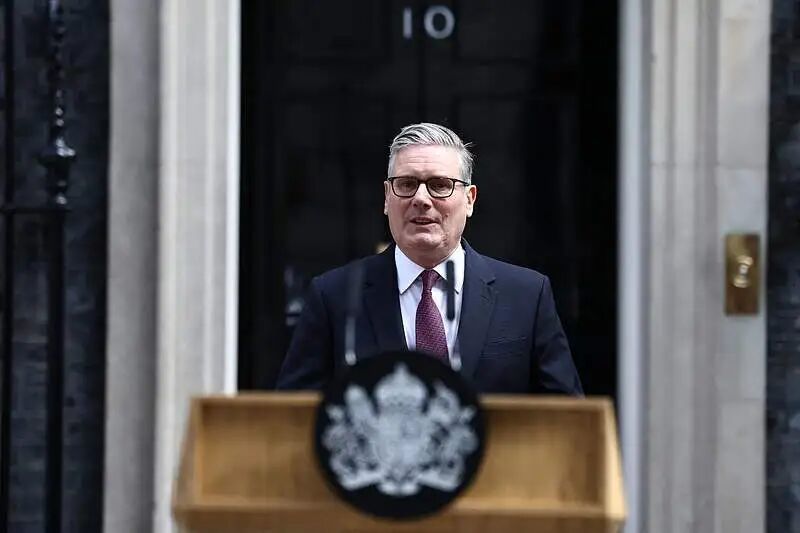
Starmer speaking outside 10 Downing Street on the 22nd (Photo: Getty Images)
Right now, Andy Burnham is the clear frontrunner to succeed Starmer as Labour leader, possibly the only candidate. According to reports from the BBC and The Daily Telegraph, Burnham traveled by train from Manchester to London on the morning of the 22nd, took his oath as an MP, and will discuss next steps with his team. If no other candidates step forward, Burnham could become Prime Minister as early as mid-next month.
After Starmer announced his resignation, Burnham expressed interest in running for Labour leader on social media. Former Health Secretary Wes Streeting, who was previously seen as a potential contender, announced on the 22nd that he supports Burnham. The BBC commented that this leadership contest might be “over before it even began.”
In a statement on the 22nd, Streeting revealed he had a long chat with Burnham in recent days and is confident that his ideas for national change have a place under Burnham’s leadership. Burnham’s allies told UK media that Streeting is “highly likely” to land a key role like Foreign Secretary in a future Burnham cabinet, but Streeting denied any such deal. “He didn’t offer me any position, and our conversation didn’t involve that,” Streeting said.
The BBC analyzed that with Streeting out of the leadership race, even die-hard fans who think Starmer should face off against Burnham now see it as unlikely. “The harsh political reality is that even Labour MPs with doubts about Burnham might now support him, hoping to land a position in his government.”
Reform UK leader Nigel Farage called for a general election on social media on the 22nd, saying he’s ready to “drive radical change.” “If Labour thinks they can just slot another career politician into 10 Downing Street, they’re badly mistaken,” he said.
Over the past decade, UK prime ministers have been a revolving door. This political upheaval comes just before the tenth anniversary of the Brexit referendum (June 23), with Starmer becoming the sixth UK prime minister to resign in the last ten years. The New York Times commented on the 22nd that, in a way, Starmer’s resignation is part of the new normal after Brexit. Citing analysts from Deutsche Bank, the report said that political instability since 2016 “highlights the immense challenges many incumbents in the Western world face today. Everyone comes in with high hopes, but then sluggish economic growth and harsh fiscal realities hit them hard. Unless economic growth picks up and debt burdens ease, this cycle of prime ministerial changes is likely to continue.”
The New York Times noted that Starmer’s resignation raises concerns about the future of UK foreign policy. Among his top successors, none have real experience handling foreign affairs in a volatile global landscape. Whoever takes over will have to deal with the ongoing Russia-Ukraine conflict, turmoil in the Middle East, and a US that is gradually stepping back from decades of commitments to Europe and NATO.