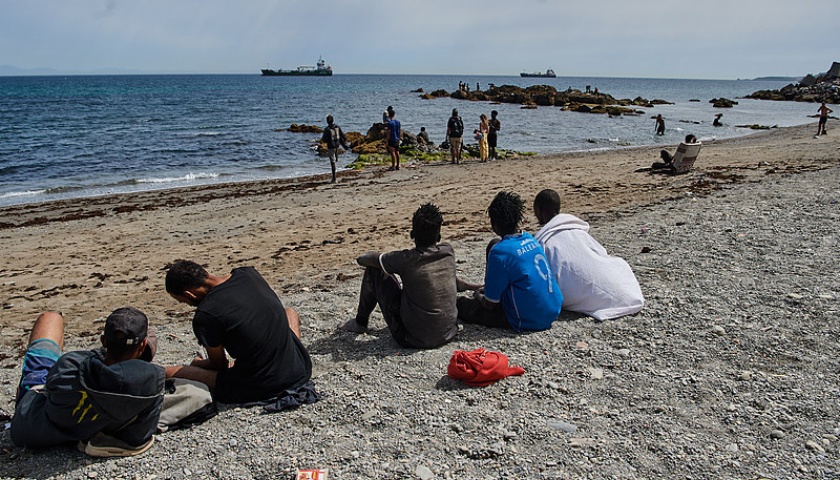
Illegal migrants attempting to cross from Morocco into Spain’s North African enclave of Ceuta have triggered the most severe border migration crisis Spain—and even Europe—has witnessed in years, with multiple deaths reported during the perilous crossings.
As of August 3, 2026, Spanish police confirmed that approximately 73,500 migrants have been returned to Morocco from the North African autonomous city of Ceuta. Social order is gradually being restored in Ceuta, and local shops are beginning to reopen their doors.
Police also reported that 88 illegal migrants have died trying to swim into Ceuta during this crisis. Just a day earlier, on August 2, Spain’s government delegate in Ceuta, Triano, had put the death toll at 72 from the mass illegal border crossings.
Ceuta and Melilla are two Spanish enclaves perched on Morocco’s northern Mediterranean coastline, long serving as gateway points for waves of illegal migrants seeking entry into Europe. Ceuta sits on the Mediterranean coast north of Morocco, guarding the eastern entrance to the Strait of Gibraltar, with a population of roughly 85,000. With at least 50,000 migrants flooding in recently, local order in Ceuta has spiraled into chaos—thousands of migrants are sleeping rough in the streets, residents are too afraid to step outside, and countless businesses have shuttered their doors to avoid looting and vandalism.
Video footage shows Spanish police dispersing illegal migrants in Ceuta, with some migrants boarding military vehicles to be transported by Spanish armed forces to the Moroccan border. Meanwhile, large crowds of Spanish citizens have gathered outside the Moroccan embassy in Madrid, protesting the influx of illegal migrants into Ceuta.
Spanish protester Arroyo told reporters: “In my view, this is an infringement on Spain’s sovereignty. Many call it an invasion, and honestly, that’s exactly what it is—a demographic invasion—and I’m absolutely outraged.”
Following the illegal border-crossing crisis in Ceuta, the mayor of Melilla—Spain’s other North African enclave—called on August 3 for a thorough assessment of the situation and demanded action. Imbroda stated, “Morocco must restore the 500-meter-wide neutral zone” to better protect the borders of both Ceuta and Melilla.
This wave of “migrant influx” has sparked alarm and vigilance across EU member states. Italian Prime Minister Meloni announced the suspension of the Schengen free-movement arrangement with Spain, reinstating border checks. French President Macron declared that Ceuta does not enjoy free movement rights to “other Schengen area zones” and ordered heightened border inspections along the France-Spain frontier. Finnish Interior Minister Rantanen accused Spain of failing to protect the Schengen area’s “external borders.” German Chancellor Merz urged the Spanish government to bring the situation under control swiftly and “safeguard the EU’s external borders.”
European Commission President von der Leyen called the chaos in Ceuta “unacceptable,” urging Spain to intensify efforts to dismantle smuggling networks and accelerate migrant repatriation. In response, Spanish Prime Minister Sánchez sent a letter to von der Leyen on August 1, criticizing certain EU members for their “selfish” and “divisive” reactions to the Ceuta migration crisis.
Amid mounting calls for action, the EU announced an emergency video conference of interior ministers from member states on August 4 to address the Ceuta crisis and coordinate a bloc-wide response.
Experts also warn that Spain’s right-wing political forces are seizing on the migration crisis to reshape the electoral landscape. Nicholas Lawley, a researcher at the UK-based Chatham House think tank, argues that Spain’s right wing is heavily exploiting this issue. “They’d love nothing more than to force Prime Minister Sánchez into fighting the next election on immigration rather than the economy. Right now, Spain’s economic performance is actually decent—the right’s goal is to turn migration into the top campaign issue.”
As for what triggered this latest wave of migrant crossings, opinions are divided and no definitive conclusion has been reached. Some speculate it may be linked to recent shifts in Spain’s immigration policies. In early July, Spain’s Supreme Court ruled that, given Ceuta and Melilla’s special border-management status as enclaves, migrants arriving by sea cannot be immediately deported. By contrast, those who breach border fences overland can be swiftly repatriated. News of this ruling spread like wildfire on social media, spawning a flurry of misinterpretations and possibly fueling the migrant surge. The Spanish government has pushed back against online misinformation, clarifying that illegal migrants arriving by sea, while not subject to immediate deportation, can still be repatriated through standard legal procedures.
Shelti, a senior researcher at Oxford University, notes: “Why did this erupt, and why now? That’s a question worth digging into. There’s no single trigger, no one cause—it’s a convergence of multiple factors. For young migrants, chronic unemployment and mounting economic and social frustration have been building for years. Social media has also become a channel for successful crossers to share playbooks—packed with practical guides on what to do after arriving in Spain, which documents to prioritize, how to register, how to enter—all the insider know-how you could need.”