

As America quietly marked its 250th birthday, the U.S. clean energy industry faced a pivotal moment. On July 4 last year, President Trump signed the “Big and Beautiful” tax and spending bill, and as of this July 4, new wind and solar projects not yet under construction no longer qualify for federal tax credits. These credits—worth about 30% of development costs—had been a major driver of U.S. clean energy growth. With that support gone and cash-rich data centers snapping up existing clean energy supplies, experts warn that American businesses are about to see a sharp spike in clean energy costs. The broader impact is already showing up in rising electricity prices and a less competitive clean energy sector.
“Once It’s Gone, It’s Gone”
For over three decades, tax subsidies fueled steady growth in U.S. wind and solar projects. According to Wood Mackenzie, an energy consultancy, solar capacity jumped from 141 gigawatts in 2022 to 279 gigawatts in 2025, making it the fastest-growing power source in the country.
But that growth is expected to slow dramatically. LevelTen Energy, a clean energy trading platform, told the Financial Times that the end of tax credits for new projects means the pool of eligible projects is fixed. “Once it’s gone, it’s gone,” they said.
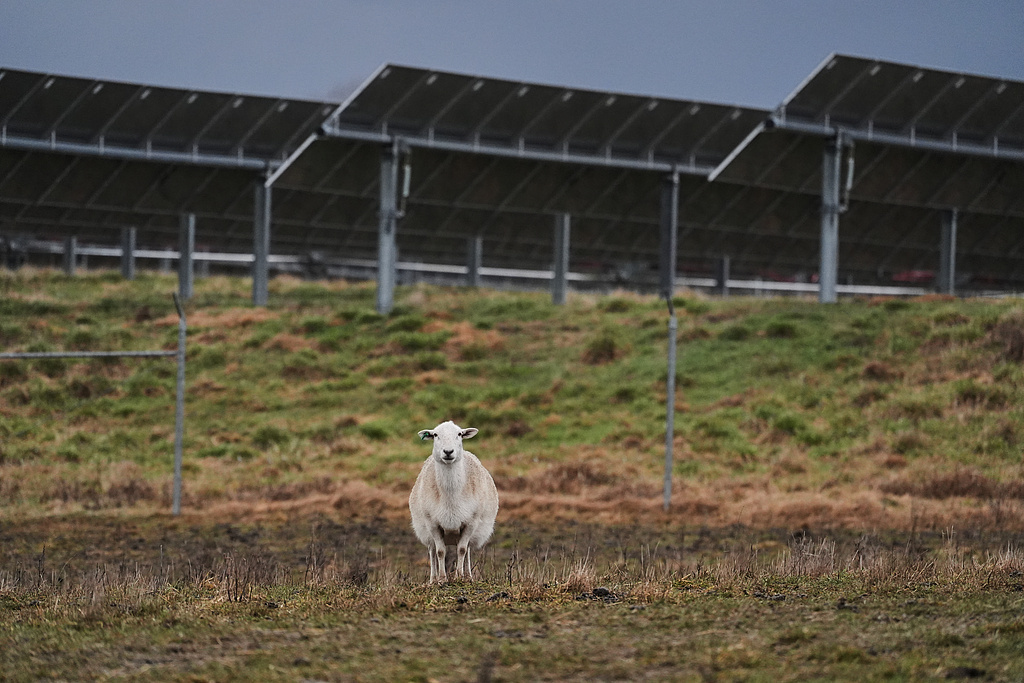
A sheep stands in front of solar panels in Kentucky.
The policy shift has triggered a rush to lock in subsidies. Reuters reports that U.S. solar developers have used “safe harbor” provisions to secure eligibility for over 200 gigawatts of projects before the July 4 deadline. Companies that didn’t sign power purchase agreements (PPAs) with those projects now face higher costs. PPAs give developers the certainty they need to finance and build new projects.
LevelTen Energy estimates that PPA prices for clean energy could rise by 40% to 120% after the subsidies end. In Texas, for instance, prices might jump from $55 per megawatt-hour to $121 per megawatt-hour. The root cause? A massive supply-demand imbalance.
While the Trump administration’s stance on clean energy has cooled some corporate enthusiasm for environmental issues, companies haven’t abandoned their climate goals entirely. They know some customers still care about reducing carbon footprints. Don Leavens, chief economist at the National Electrical Manufacturers Association, told the Financial Times: “Demand for clean energy PPAs will persist. International companies have to consider global trends, not just what’s happening in the U.S.”
On top of that, U.S. tech giants are locked in an AI arms race, and electrification of homes and transport is gaining steam. Big energy users like factories, retailers, and data centers are snapping up clean energy PPAs to meet sustainability targets. But some industrial buyers say data centers, hungry for power and willing to pay a premium, are pushing everyone else out of the market.
Industry insiders say this is changing how sellers evaluate potential buyers. Izzet Bensuan, CEO of Captona, an energy infrastructure investment firm, put it bluntly: “Sellers are thinking, ‘Why sell to a hospital or utility when I can get a higher price from a data center?'”
In 2025, U.S. corporate power purchase agreements hit a record 29.5 gigawatts, driven largely by big tech firms pivoting to stable sources like nuclear, hydro, and geothermal. But this growth is almost entirely fueled by tech giants. As project costs rise and policy uncertainty grows, smaller companies are backing off. The number of U.S. companies signing PPAs in 2025 plummeted by 51% year-over-year to just 33.
Nayel Brishi, a corporate energy analyst, noted: “U.S. corporate clean energy procurement is splitting into two speeds. Big tech is diving into larger projects and cutting-edge technologies, while small and medium businesses are struggling with a more complex power market.”
Beyond subsidies, U.S. clean energy costs are also weighed down by supply chain issues, labor costs, interest rates, and long grid-connection delays—all driving up development expenses.
U.S. Households Face $650 Billion in Extra Costs
Power shortages and rising electricity prices are already hitting everyday Americans hard, and the administration’s policies on wind and solar are adding more pressure. A new report from the clean energy think tank Energy Innovation, cited by CNN on July 7, argues that while the Trump administration frames its anti-clean-energy stance as a way to lower energy costs, restricting energy development during high-demand periods will actually make Americans pay more.
Energy Secretary Chris Wright dismissed wind and solar as “low value” in a statement on July 2 about the end of tax credits, saying “the wind doesn’t always blow, and the sun doesn’t always shine.” Trump promised during his campaign to cut electricity bills in half in his first year, but Energy Innovation found that the cumulative impact of the administration’s policies could cost U.S. households an extra $650 billion in energy expenses by 2040. On average, a single household could pay $460 more per year on energy by 2035, and $490 by 2040. Since last fall, electricity prices across the U.S. have jumped 7.4%, with a dozen states seeing double-digit year-over-year increases.
Robbie Orvis, senior director of modeling and analysis at Energy Innovation, warned that ending tax credits could trigger a “solar cliff”—a sharp drop in solar deployment. “This is the worst possible time to pull support, when data centers are driving a surge in energy demand,” he said. “It either makes building harder or more expensive.” The White House, however, disputes the report’s impartiality.
Beyond solar, the outlook for the entire clean energy sector is murky. Bloomberg’s forecast for new U.S. power generation capacity by 2035 is 42% lower than before the “Big and Beautiful” Act. On the manufacturing side, a joint tracking effort by MIT and the Rhodium Group shows that billions of dollars in projects involving batteries, electric vehicles, and industrial decarbonization equipment have been canceled.
The Clean Energy Manufacturing ‘Brake Pedal’
Behind the cost burden on households, deeper effects are eating away at U.S. industrial competitiveness. The Council on Foreign Relations website noted on July 7 that three factors—tax credit cuts, unclear rules on “foreign entities of concern,” and trade barriers—are acting as a “brake pedal” on U.S. clean energy manufacturing. The “Big and Beautiful” Act is shrinking the sector, threatening supply chains and competitiveness.
The group argues that the act eliminates and accelerates the phase-out of tax incentives for clean tech manufacturing, making it harder for U.S. companies to compete globally. It also scraps several demand-side deployment incentives, weakening long-term signals for clean tech manufacturing.
Data shows that U.S. clean tech manufacturing was on the rise over the past decade, especially after the 2021 bipartisan infrastructure law and the 2022 Inflation Reduction Act. But Trump’s re-election in 2024 seems to have marked a turning point. In the first quarter of 2026, clean tech manufacturing investment was down 34% from the same period in 2025, and new investment announcements fell by nearly 80% between early 2025 and 2026. This trend has continued since the “Big and Beautiful” Act took effect.
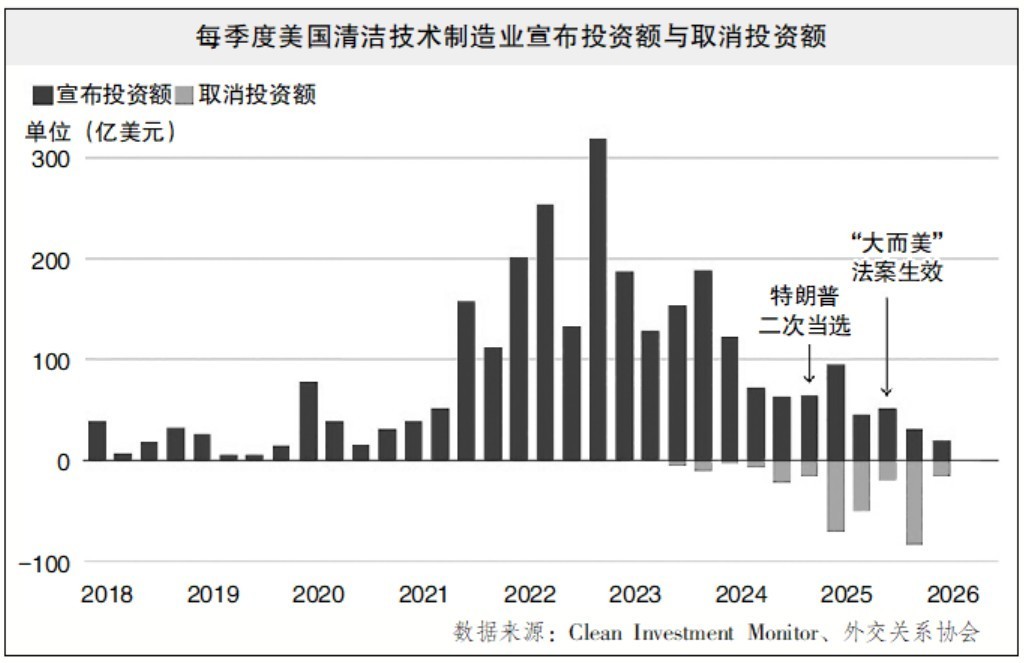
Cancellations of clean tech manufacturing projects spiked after Trump returned to the White House in January 2025, reaching a record $8 billion in the fourth quarter of 2025.
Other changes are also disrupting U.S. supply chains. For example, procurement restrictions have hit U.S. solar, battery, and EV manufacturers hard, as these supply chains rely heavily on Chinese components. According to the American Society of Civil Engineers, transformer prices in the U.S. have risen 60% to 80% since early 2020, while solar industry labor costs were up 15% in 2025.
Lin Boqiang, dean of the China Institute for Energy Policy at Xiamen University, told HA Viewpoint that subsidy cuts have clearly hurt the U.S. clean energy industry. Some early-stage projects have been halted or shelved, creating a ripple effect on future development. On the supply chain side, U.S. policies appear aimed at protecting domestic manufacturing, but short-term capacity is insufficient, likely driving up overall development costs. He noted that building a complete solar photovoltaic supply chain takes time—China spent 20 years on it, supported by other industries like steel. “Without government subsidies, the U.S. clean energy sector lacks competitiveness,” he said.
Despite the policy backtracking, Lin believes that if U.S. electricity demand becomes more urgent, wind and solar—even without subsidies—could be the fastest options to meet computing power needs, regardless of low-carbon goals. Reuters also notes that utility-scale solar and onshore wind remain the cheapest forms of electricity generation in the U.S. even without subsidies, and community and commercial solar installations are competitive with natural gas and nuclear.