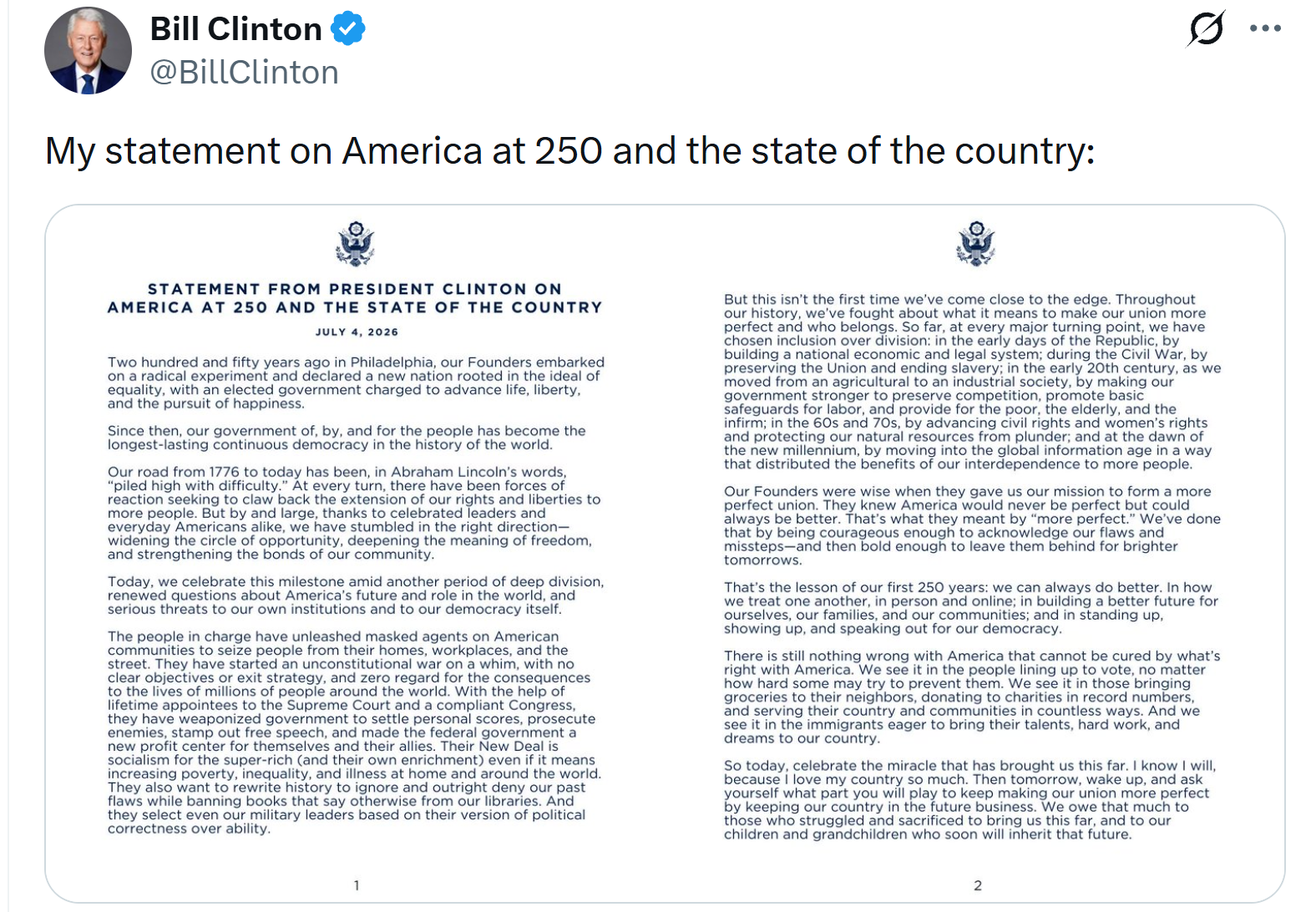
This year marks the 250th anniversary of American independence, with celebrations reaching a fever pitch on July 4th. But beyond the scorching heatwave and grander-than-usual fireworks, what truly caught everyone’s eye was the glaring political divide on display.
From Democrat-led states boycotting official events to activities dripping with partisan and campaign undertones, this celebration—meant to unite the nation through a shared history—instead became a stark mirror of America’s ongoing political warfare and social fragmentation.
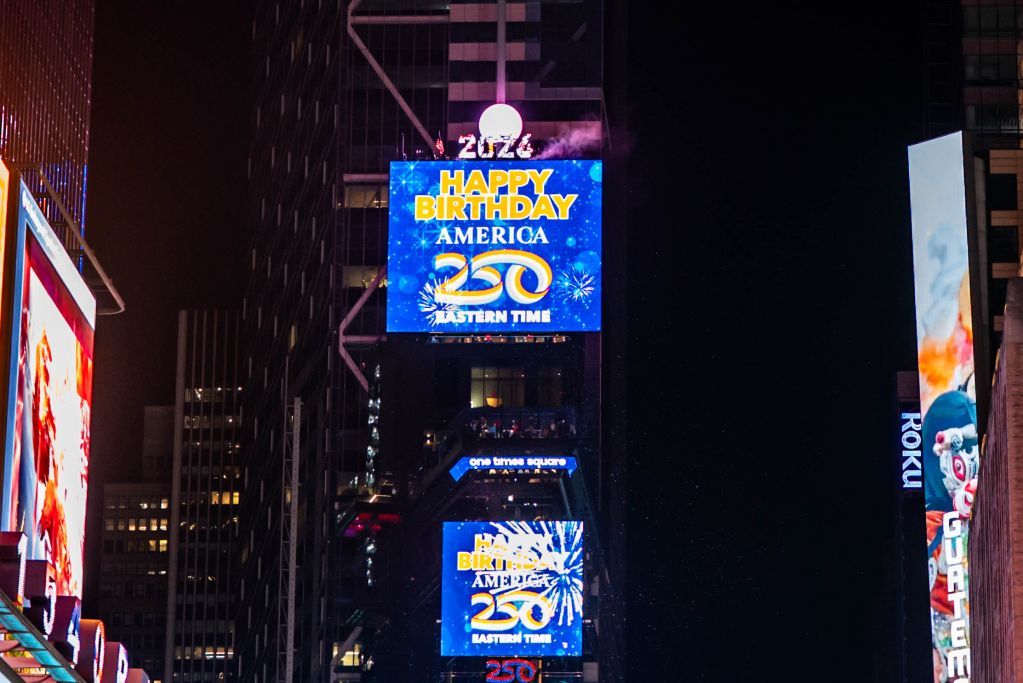
In the early hours of July 4th, a crystal ball drop ceremony lit up Times Square, marking the 250th anniversary. (Photo courtesy of contributors)
When a National Party Turns Partisan
This year’s festivities were long in the planning and took many forms, but one thing was consistent: a heavy partisan fingerprint.
President Trump delivered a speech at the Washington D.C. celebration on the evening of July 4th, touting his administration’s achievements and reiterating his push for stricter voting measures. Some media called it “a rally-style speech in disguise.”
In reality, the partisan bickering started well before a single firework went off. Ten years ago, Congress set up a bipartisan group called “America’s 250th Anniversary” to coordinate national and local events. But after Trump returned to the White House, his administration quickly scrapped that plan, declaring “Freedom 250″—an organization with strong ties to his camp—as the sole official planner. Democrats cried foul, accusing the White House of “politicizing a national celebration” and launching investigations into the group’s funding, historical narrative, and structure.
The partisan shadow even drove some to outright boycott. The “Great American State Fair,” a centerpiece event meant to run for two weeks, saw at least 11 states—mostly Democrat-run “blue states”—refuse to send official representatives. Walking through the fair, it was hard to miss the empty pavilions for Oregon and Washington, just lonely state banners and empty chairs. As The New York Times put it, these walkouts show the celebration has devolved into “a fragmented, partisan farce.”

On June 27th, people rode the Ferris wheel at the “Great American State Fair” in Washington, D.C. The fair runs from June 25th to July 10th. (Photo courtesy of contributors)
Several well-known musicians also pulled out of a concert on the National Mall. Rocker Bret Michaels said on social media that he originally agreed to perform, but the event had become so “divisive” he wanted no part of it.
Greg Cusack, an 80-something former Iowa state representative, told us this was supposed to be a pure, genuine national celebration and moment for historical reflection. Instead, he said, the overwhelming partisanship has made everything “downright ugly.”
Political Polarization: The New Normal
Many analysts think this whole messy celebration is just the latest symptom of America’s political polarization, where rigid party lines have become the daily reality.
According to the latest data from the Federal Register, President Trump has signed 268 executive orders since taking office in January 2025, bypassing Congress to push through sweeping policy changes—from tightening immigration controls and imposing broad tariffs to slashing federal agencies and reversing clean energy policies. To fight back against this “governing by executive order,” Democrat-led “blue states” have not only filed multiple lawsuits but have outright refused to follow White House directives. The two parties attack each other on nearly every policy issue, throwing national governance into chaos.
This nonstop partisan warfare inevitably spills over into everyday voters’ lives. For instance, a May poll from PBS found that nearly 90% of Democrats believe the Trump administration is responsible for rising gas prices, while only about 30% of Republicans agree.
The sense of national pride is also split down party lines. A recent Gallup poll shows 70% of Republicans feel “extremely proud” to be an American, compared to just 14% of Democrats.
These celebrations also became a platform for people to vent their frustrations with the government. In late June, hundreds gathered in Philadelphia—where the Declaration of Independence was signed—to protest the Trump administration’s perceived whitewashing of negative American history, like slavery, genocide, and the oppression of indigenous peoples. Philip Glee, a 65-year-old American writer, said Americans today have “wildly different” views of their own country, and these celebrations seem to amplify that division.
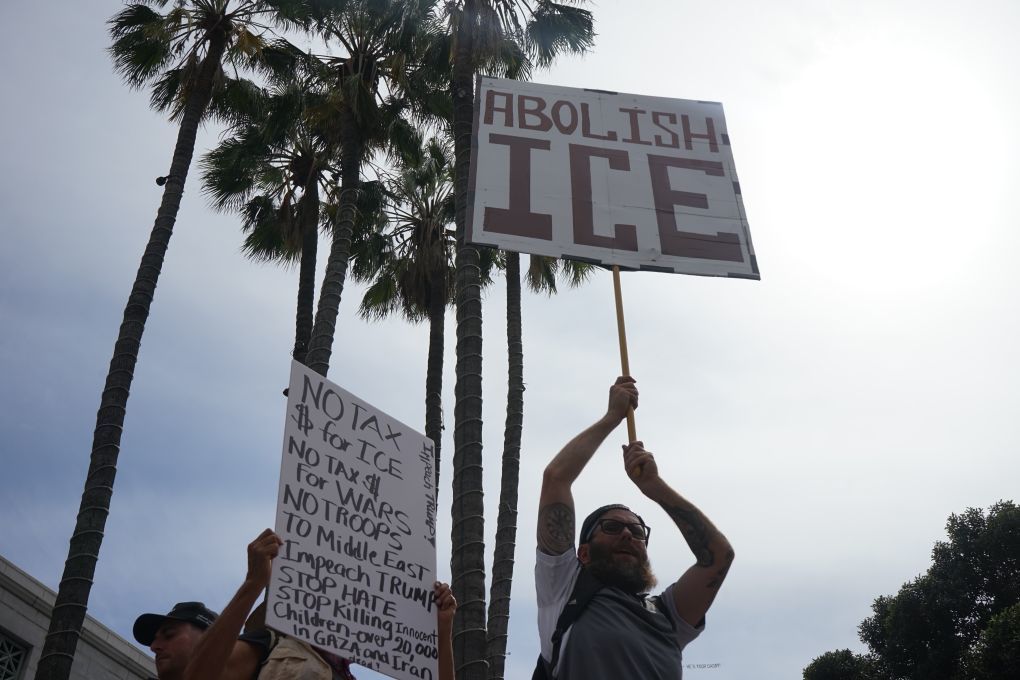
On March 28th, people in Los Angeles, California, protested against the Trump administration’s immigration enforcement and other policies. (Photo courtesy of contributors)
The Root Cause: A Broken System
America’s political polarization and social division have deep roots in its institutional design. Research from the Brookings Institution and other groups points out that under a two-party system with “winner-take-all” elections, both Republicans and Democrats are increasingly incentivized to sharpen their differences and oppose each other on values and policies to rally their base. This locks the political landscape into a zero-sum, us-versus-them binary, deepening polarization with every cycle.
Multiple polls show that partisan divisions are now at their worst in over half a century. Johanna Dunaway, a professor at the Maxwell School of Citizenship and Public Affairs, points out that today’s party warfare has gone beyond mere policy disagreements and now looks like “fighting for the sake of fighting.”
Driven by this logic of perpetual conflict, party interests have eclipsed the interests of the nation and its people. Issues like immigration, the economy, race, and the environment have become mere tools for “vote harvesting,” while real governance gets ignored. The price? America’s widening wealth gap and systemic injustices have become intractable, and social tensions keep piling up.
And it doesn’t stop there. To win, politicians don’t hesitate to exploit—or even manufacture—public divisions. More and more ordinary Americans find themselves on opposite sides of issues like gun control, abortion, and social security, leading to a rise in political violence. This social strife, in turn, becomes fresh ammunition for the two parties to attack each other, locking the nation into a vicious cycle. As Washington Post columnist David Ignatius put it, “Our political system is riddled with holes.”
Some American media outlets have noted that instead of a nationwide celebration, the 250th anniversary has brought a cloud of pessimism fueled by political polarization and social division. “America’s golden age has passed… the worst is yet to come,” one report lamented.