The Brazilian government announced on August 13 that it has initiated procedures under the country’s Economic Reciprocity Act to counter new tariff measures imposed by the US government on Brazilian products.
The act, passed by Brazil’s Congress in April 2025 and signed into law by President Lula, authorizes the Brazilian Foreign Trade Committee to adopt reciprocal countermeasures when unilateral actions by other countries harm Brazil’s international competitiveness.Brazil’s Ministry of Foreign Affairs has formally notified the US side of the initiation of the ordinary adaptation application analysis process under this act, while simultaneously commencing diplomatic consultations with US trade authorities.
To date, the US has implemented multiple rounds of stacked tariff measures against Brazilian goods exported to the US. First, on July 22, the US imposed a 25% tariff on approximately 4,100 Brazilian products under the pretext of “unfair trade practices.” Second, at the end of last month, the US continued to impose an additional 12.5% tariff on 46 economies, including Brazil, China, Japan, South Korea, and India, citing allegations of “forced labor.”
Both additional tariffs are legally grounded in Section 301 of the Trade Act of 1974. When stacked together, the total tariff rate on certain non-exempt Brazilian goods exported to the US could reach as high as 37.5%.
In a statement issued on July 27, Brazil’s Ministry of Foreign Affairs said that in response to the recent tariff measures imposed by the US government, Brazil once again invoked the WTO dispute settlement mechanism to request consultations with the US.
The most direct trigger for the US tariffs is a disagreement between the two countries over trade statistics methodology.The Trump administration has consistently claimed that the US runs a trade deficit with Brazil, while the Brazilian government counters that US official statistics improperly include service trade in the calculation.Data from Brazil’s Ministry of Finance shows that in 2024, Brazil imported a total of $42.41 billion from the US and exported $40.33 billion to the US.
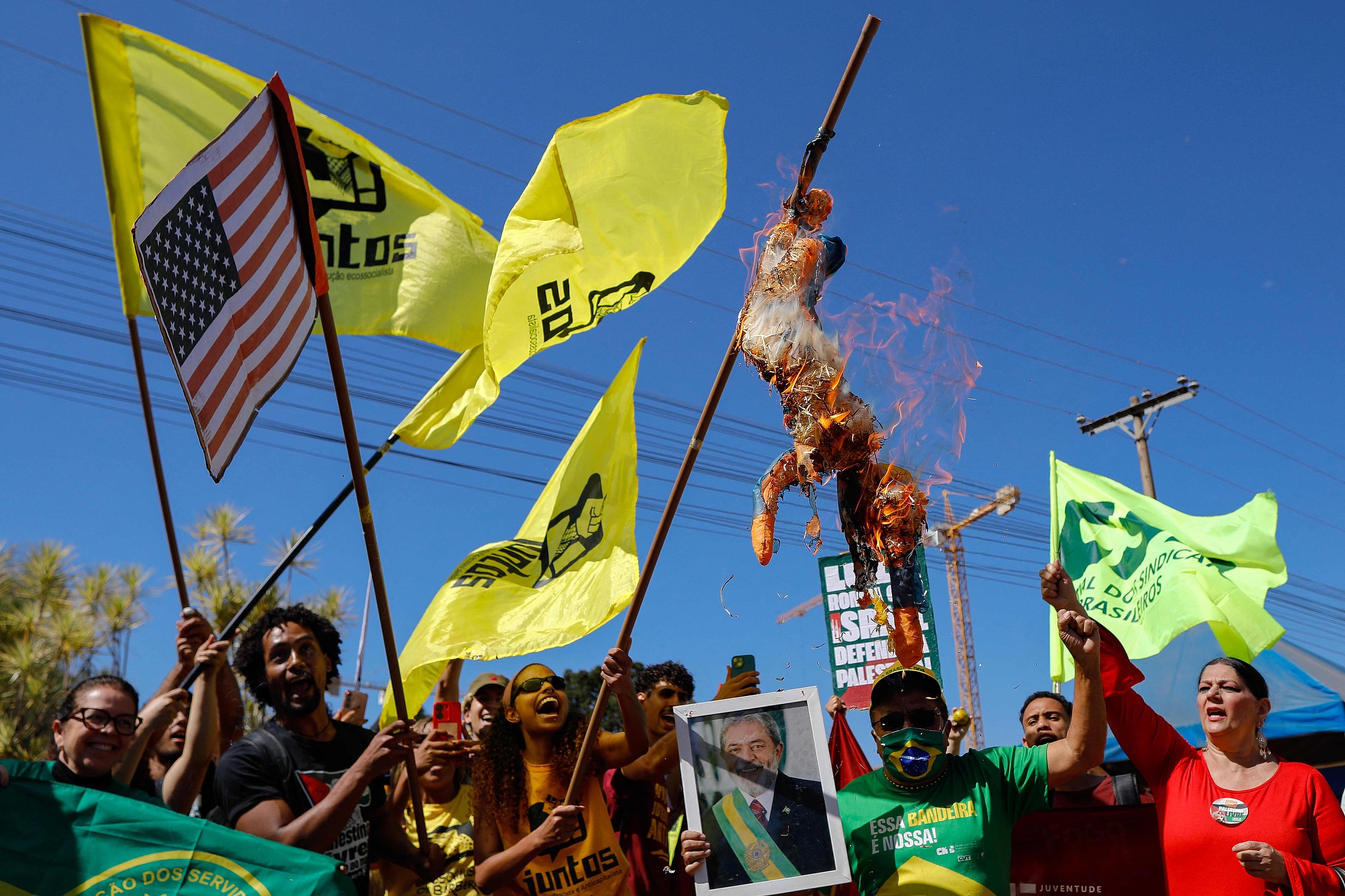
Beyond trade statistics, Trump also has political motivations specifically targeting Brazil. He has repeatedly publicly questioned the Lula government’s judicial investigation into former Brazilian president Bolsonaro, calling the proceedings against him — which involve allegations of plotting a coup and facing trial — “political persecution,” and threatening to impose tariffs if the investigation is not halted.
In July 2025, the US announced an additional 40% tariff on certain Brazilian goods, which, when stacked with the then-existing 10% global “reciprocal tariff,” brought total rates on some products to 50%. At that time, Brazil had already filed a consultation request with the WTO, initiating the dispute settlement process.
That mechanism, which took effect in 1995, is the core system for resolving trade disputes among WTO members and features mandatory compliance, among other characteristics.The mechanism comprises four stages: consultations, panel rulings, appellate review, and enforcement supervision.From the initiation of consultations to the formal adoption of a report, the entire process historically takes at least one year.
According to reports, the US steel tariffs of the early 2000s became a classic case of protectionism backfiring.Then-President George W. Bush announced tariffs of up to 30% on ten categories of imported steel products, after which the EU, China, and Japan successively initiated WTO dispute proceedings against the US. In the end, the WTO ruled that the US tariffs violated its commitments, forcing the Bush administration to revoke the policy ahead of schedule.
It’s worth noting that due to certain members obstructing the selection of judges, the WTO’s appellate body has been unable to function properly for years, which means Brazil may be unable to obtain a final, enforceable ruling due to procedural deadlock. In contrast, Brazil’s domestic law provides a unilateral, fast-acting countermeasure tool with a short process and rapid implementation, capable of creating deterrence well before any WTO ruling is issued.
Lula officially took office in 2023, and his current presidential term is set to end in late 2026. He has already registered to run in Brazil’s October 2026 presidential election, seeking a fourth term.
On the other hand, Section 301 of the US Trade Act of 1974 authorizes the US Trade Representative to investigate “unreasonable or unjustifiable trade practices” by other countries and recommend that the president impose unilateral sanctions. Compared to previous emergency authority justifications, the new measures have stronger legal compliance, significantly reducing the likelihood of being overturned directly by courts.
Overall, countries’ response strategies include filing complaints through WTO rules or implementing reciprocal tariffs for defense, while simultaneously accelerating supply chain diversification to reduce dependence on the US.
Analysts have previously told our publication that the impact of these Section 301 tariffs on the global economy is limited, as markets have already broadly priced them in. The US effective tariff rate remains below 10%, with minimal implications for its economy or inflation. Many countries are reluctant to adopt a confrontational stance due to their own economic vulnerabilities or strategic considerations.