

“In the current international situation, the EU cannot afford such selfish, polarized, and illegitimate reactions.” Spanish Prime Minister Sanchez wrote to the EU on August 1st, expressing his frustration over the reactions of several EU nations following the migrant surge in Ceuta, Spain’s North African enclave. Recently, Italian Prime Minister Meloni announced the suspension of the Schengen free-movement mechanism with Spain and reinstated border checks, Finland’s Interior Minister accused Spain of failing to protect the Schengen area’s “external borders,” and the French government also ordered tightened border control measures. US-based “Politico Europe” commented that the Ceuta incident is the latest sign of the “growing threats” facing the Schengen free-movement mechanism and that migration has become an explosive pan-European political issue. According to the UK’s Independent, after Spain and 22 other EU member states issued separate appeals, the rotating EU Council President, Irish Prime Minister Martin, announced an emergency meeting on the 4th to discuss the migrant crisis facing Ceuta.
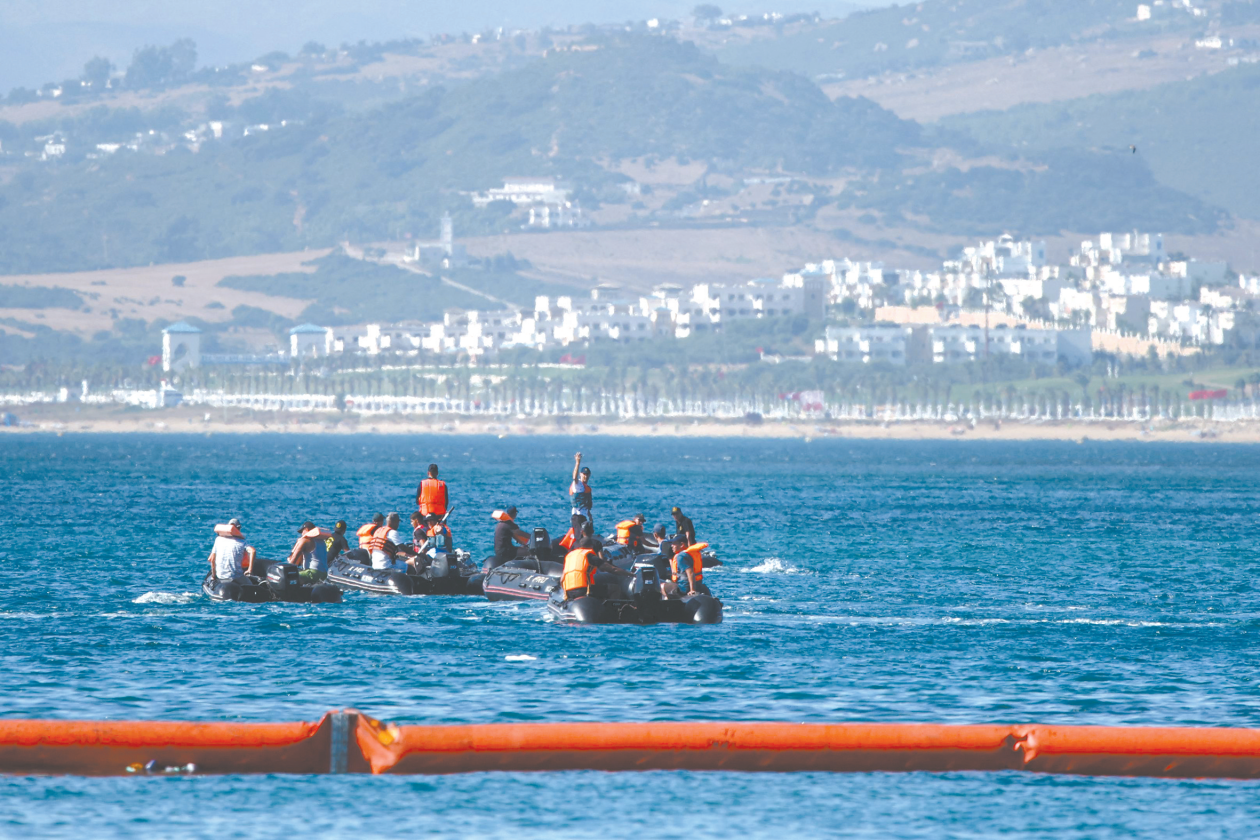
To prevent another mass illegal crossing in Ceuta, Spain has upgraded border controls and installed new maritime interdiction systems.
Spain Adds Maritime Interception Measures
Ceuta is located in northwest Africa, bordering Morocco, with an area of about 18.5 square kilometers. An “unprecedented migrant wave,” according to RFI’s website on the 2nd. Ceuta has only about 80,000 permanent residents, but within just two to three days, roughly 50,000 undocumented migrants entered from the Moroccan side. Many of them chose to swim or use makeshift flotation devices to reach Ceuta. According to Spain’s El País on the 2nd, data released that day by the Spanish government’s delegate in Ceuta, Pérez, showed the incident has resulted in at least 72 deaths.
According to Spanish national broadcaster RTVE, the Spanish government stated that as of August 1st, more than 48,000 undocumented migrants had returned to Morocco. To prevent another large-scale illegal border crossing, the Spanish government has further upgraded border control measures, including installing new maritime interception systems on the breakwater. The core of this system is a 500-meter-long inflatable floating barrier, extending about one meter underwater, with a central channel left for National Guard patrol boats. Meanwhile, Spain continues to strengthen border enforcement cooperation with Morocco. Morocco has stated it has arrested 70 individuals suspected of organizing and participating in violent activities related to this illegal crossing event.
According to CNN and the UK’s Independent, this migrant surge has sparked divisions within the EU. Italian PM Meloni announced the suspension of the Schengen free-movement mechanism with Spain, a move supported by Finland and Denmark. Danish PM Frederiksen urged the EU to “consider all options, including suspending Schengen cooperation.” Finnish Interior Minister Rantanen accused Spain of failing to protect the Schengen area’s “external border,” stating “this situation cannot continue.” French President Macron said Ceuta does not enjoy the right to free movement to “other areas of the Schengen zone” and ordered strengthened border checks between France and Spain.
Sanchez Hits Back Hard
“Ceuta crisis: 22 EU leaders unite against Spanish PM Sanchez’s migration policy.” Politico Europe reported on the 1st, noting that leaders from 22 EU member states, including Meloni and German Chancellor Merz, wrote to the EU expressing “grave concern” over threats to the “external borders” and specifically pointing to the Spanish government’s plan to grant legal status to hundreds of thousands of undocumented migrants as a “pull factor” exacerbating the crisis. Madrid has previously refuted such claims, stating that anyone entering Ceuta illegally does not qualify to benefit from that measure.
According to RTVE, these EU leaders also linked the Ceuta crisis to a ruling by Spain’s Supreme Court. In July, the Supreme Court ruled that, given the special border management system for the enclaves of Ceuta and Melilla, migrants arriving by sea cannot be immediately returned, while those who enter by land, such as climbing over border fences, can be immediately deported. Some analysts say this ruling was misinterpreted as “if you swim into Ceuta, you can stay in Spain and eventually get legal status,” and the claim spread rapidly on social media.
According to the Independent and Euronews on the 1st, Sanchez and senior Spanish officials criticized the reactions of some EU countries, stating that “solidarity and compassion are optional, but respect for European treaties is essential.” In a “bluntly worded” letter to the EU, Sanchez expressed “grave concern” over the reactions of some EU countries. He said most countries “expressed support and solidarity and offered assistance, but others chose to attack Spain and called for temporarily excluding Spain from the Schengen zone.” Sanchez also said the attitudes of some EU countries are driven by “prejudice, fake news, ignorance, or political interests,” which not only violate European law, humanitarian law, and the principle of EU solidarity but also harm Europe’s long-term interests.
Migration: An “Extremely Divisive Topic” Within Europe
The UK’s Times published an article on the 1st noting that, contrary to popular perception, the number of people illegally entering the EU is actually declining. A report released last month by Frontex showed that in the first half of this year, illegal crossings totaled 49,000, down 37% from the same period in 2025 and far below 2015 levels. However, in Europe, mass migration and its broader societal impact remain an extremely divisive topic.
The US New York Times said on the 2nd that the sudden influx of tens of thousands of migrants into Ceuta, with its chaos and scale, evokes similar scenes on the coasts of Greece and Italy 11 years ago. The 2015 refugee crisis deepened opposition to receiving migrants in many parts of Europe and fueled the rise of far-right movements. As in the past, Europe’s far-right camp now hopes to use the Ceuta incident to demonstrate the dangers of relatively lenient migration policies. The difference is that, to avoid political backlash, some European centrist leaders are also adopting tough policies and rhetoric on migration, abandoning the more open attitudes of 11 years ago. This trend makes the stance of Spain’s current left-wing government seem somewhat “out of step.”
There are also European leaders who support Sanchez. According to British media including the Independent, UK PM Burnham expressed willingness to help. European Council President and former Portuguese PM Costa praised Spain’s “firm response measures.”