

The security situation in the Democratic Republic of Congo (DRC) has spiraled into a dangerously complex crisis, where armed conflict, public health emergencies, and social instability are compounding one another, pushing the risk to foreign nationals to an extremely high level. The Chinese Embassy in the DRC has issued multiple security alerts between July and August 2026, with language that grew progressively more urgent.
As of August 10, the Ebola outbreak across five provinces—Ituri, Haut-Uele, North Kivu, South Kivu, and Tshopo—has resulted in 4,449 confirmed cases and 2,061 deaths.
On August 13, the Embassy reminded Chinese citizens in the DRC to closely monitor the evolving Ebola situation, strengthen their awareness of prevention, take personal responsibility for their health, and maintain strict personal hygiene. They were advised not to travel to epidemic zones such as Ituri Province, minimize unnecessary outings and cross-regional movement, avoid crowded places, steer clear of wild animals, and avoid physical contact with confirmed or suspected patients. Anyone feeling unwell should promptly seek examination and treatment at a proper hospital.
The Embassy also required Chinese citizens and Chinese-invested enterprises to further refine their epidemic prevention plans, enhance health monitoring for personnel, stockpile emergency supplies, reduce gatherings, and step up sanitation management at offices and residences. In areas where outbreaks occur, cooperation with local health authorities on isolation, testing, and epidemiological investigations is mandatory.
On August 12, WHO Director-General Tedros Adhanom Ghebreyesus warned that if the Ebola outbreak in the DRC maintains its current transmission rate, it could surpass the scale of the 2014–2016 West Africa epidemic, becoming the deadliest Ebola outbreak on record.
The WHO noted that inaccessible remote areas, armed conflict, insufficient medical resources, and misinformation are all compounding the difficulty of epidemic control. Dr. Abdourahmane Mahamoud, WHO’s Director of Emergency Preparedness and Response, stated that under a moderate scenario, the outbreak is expected to peak within the next six months; in a more severe scenario, it could persist for nine to twelve months.
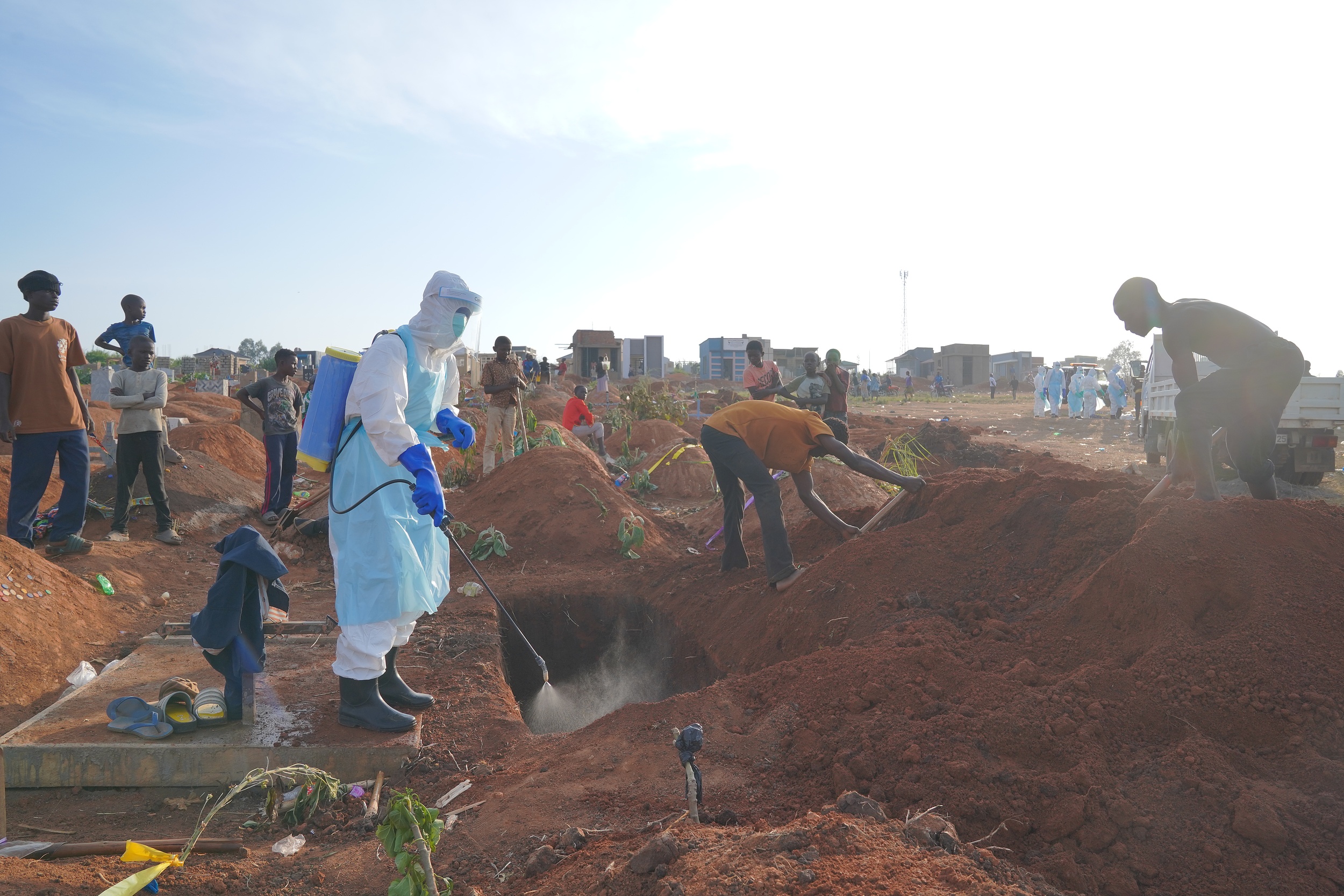
This current Bundibugyo strain outbreak was officially declared in May, yet genetic tracing has confirmed the virus was already spreading covertly as early as February. To date, no approved targeted vaccine or treatment exists.
On August 11, UN Under-Secretary-General for Humanitarian Affairs and Emergency Relief Coordinator Tom Fletcher stated that the Ebola outbreak in the DRC is accelerating, with cases roughly doubling every 20 days, and response efforts must be intensified and accelerated immediately.
The United Nations, together with the WHO and the International Organization for Migration, is assisting the DRC government in strengthening screening at key points of entry. Recently, over 1.4 million health screenings have been conducted nationwide, and community awareness campaigns have reached more than 1.4 million people across six provinces.
On the home front, a multi-layered defense system—from border screening to clinical early warning—has been established. Current assessments indicate that the overall threat to our country remains at a low-risk level.
The National Health Commission and the National Administration of Traditional Chinese Medicine released the Ebola Virus Disease Diagnosis and Treatment Plan (2026 Edition) on June 1. The plan states that the average case fatality rate for Ebola virus disease is approximately 50%, with some strains reaching as high as 90%. The disease is mainly prevalent in sub-Saharan Africa, and no indigenous or imported cases have been reported in our country.
Outbreaks tend to flare up in border regions plagued by conflict, poverty, and high population mobility, where complex geopolitical dynamics make it extremely difficult for prevention efforts to reach the grassroots. Since late last year, the rapidly deteriorating security situation in provinces like Ituri and surrounding areas has placed them at extremely high risk, with some regions actively in a state of warfare.
In North Kivu and South Kivu provinces, government forces and M23 rebels continue to engage in intense firefights. The security situations in Ituri and Haut-Uele provinces remain deeply worrying. Armed groups such as M23, ADF, CODECO, Mai-Mai militias, and Zaire militias are persistently wreaking havoc across North Kivu, South Kivu, Ituri, and Haut-Uele. Violent clashes, armed robberies, and kidnappings are occurring with alarming frequency.
Additionally, large-scale prison breaks have occurred in multiple locations. On July 31, all 50 inmates escaped from Lubo Central Prison in Kasai Province, further destabilizing an already volatile security environment. Armed robberies and violence against civilians are rampant in mining areas and along remote roadways, while humanitarian access corridors have been severely restricted.
The Embassy reminds all Chinese citizens in the DRC not to travel to the extremely high-risk provinces of Ituri, North Kivu, South Kivu, and Haut-Uele. Chinese citizens and enterprises still present in these areas should evacuate or relocate to safer regions as soon as possible. Non-essential travel should be avoided to nine other provinces: Lualaba, Haut-Katanga, Tanganyika, Maniema, Kasai-Central, Sankuru, Lomami, and Haut-Lomami.
As of August 2026, Chinese-invested enterprises in the country are primarily concentrated in three core sectors: mining, infrastructure construction, and telecommunications. The Chinese population in the DRC is estimated at approximately 30,000 to 40,000 people, of whom over 10,000 are labor workers dispatched through channels tracked by the Ministry of Commerce, with the remaining 20,000 to 30,000 comprising businesspeople, long-term residents, and independent workers.
Chinese citizens already in the DRC who have not yet registered should report their personal information to the Embassy as soon as possible. Enterprises and individuals engaged in gold mining activities in the country are also urged to register with the Embassy promptly (registration link: https://www.wjx.cn/vm/mIDINTY.aspx#).