

On July 14, Berkshire Hathaway dropped a bombshell: 95-year-old Warren Buffett, for the first time in twenty years, didn’t include the Gates Foundation in his annual charity giveaway—a real slap in the face for Bill Gates.
He donated nearly $6 billion in Berkshire stock to the Susan Thompson Buffett Foundation and his three kids’ foundations. In a July 15 CNBC interview, Buffett said he believes his children are now ready to handle the money responsibly.
About three weeks earlier, Gates flew to Omaha for a three-hour closed-door meeting with Buffett. No details were leaked, but based on what Buffett did and said later, it seems Gates probably knew the donation plan was changing.
Buffett denied the change had anything to do with Bill Gates’ relationship with Epstein. But in the interview, he mentioned he’s still waiting for the charity’s internal investigation into the Gates-Epstein connection. Until those results are out, this year’s donations are on hold.
Talking to CNBC’s Becky Quick, Buffett said he’s read a lot this year about what went down between Bill and Epstein. “It’s disgusting, and he made mistakes. But I’ve made mistakes too—hiring the wrong people, choosing friends who turned out not to be who I thought they were. I can see myself making the same errors he did.”
As for these “disgusting” matters, Gates has stuck to his story: he claims he never knew about Epstein’s crimes and says he “should never have met him in the first place.”
The New York Times reported in 2019 that they first met on January 31, 2011. Gates said Epstein promised to raise billions for the Gates Foundation’s global health projects, which drew him in. Through two foundation officials, Melanie Walker and Boris Nikolic, he met Epstein at the financier’s Manhattan townhouse. Gates’ spokesperson, Ms. Arnold, said the meeting started at 8 p.m. and lasted several hours.
Among the Epstein case documents released by the US Justice Department were several 2013 emails Epstein wrote to himself. They included a memo Nikolic drafted for Gates after a dispute, listing things like getting medication for Gates after he hooked up with Russian women, arranging private meetings with married women, and providing drugs for personal use. Since there’s no evidence attached, these claims can’t be verified.
At a Gates Foundation staff meeting in early 2026, Gates admitted to two extramarital affairs with Russian women but insisted they had nothing to do with Epstein’s victims.
During a closed-door House Oversight Committee hearing on June 10, he again denied knowing anything about Epstein’s crimes. He argued that after cutting ties with the sex offender, Epstein tried to blackmail him using information about those affairs to force a reunion.
Gates’ strategy of “owning up to small stuff, denying big crimes” works because he hands over verifiable facts—the affairs—in exchange for trust on the bigger charge: not knowing about Epstein’s crimes. He admits what he can, denies what he must.
But Gates isn’t the only “Bill” who got lured by Epstein’s money while playing innocent. There’s also former Democratic President Bill Clinton.
If Gates was drawn to Epstein for his fundraising clout to secure billions for charity, then for young candidate Clinton, Epstein’s political donations and connections were powerful tools to secure his path. Both cases are classic examples of elite circles merging interests—not random encounters.
When grilled in hearings about the Epstein case, Clinton basically answered with “no,” “I don’t know,” “I don’t remember,” and “I don’t think so.” He claimed he never saw Epstein abuse, assault, or traffic young women or girls.
Clinton’s wife, Hillary—the 2016 Democratic presidential candidate—was questioned the day before. She said she never met Jeffrey Epstein.
Unlike Gates, Clinton used a “memory loss” tactic—fighting questions with forgetfulness. This works because in congressional hearings, you can’t really prove someone remembers something. Different strategies, same result. Both walked away practically unscathed.
The Clinton-Epstein connection was no secret for years. In 2002 and 2003, Clinton flew on Epstein’s private jet four times—to Europe, Asia, and Africa—supposedly “all related to Clinton Foundation work.” When it came out, the media dug deep.
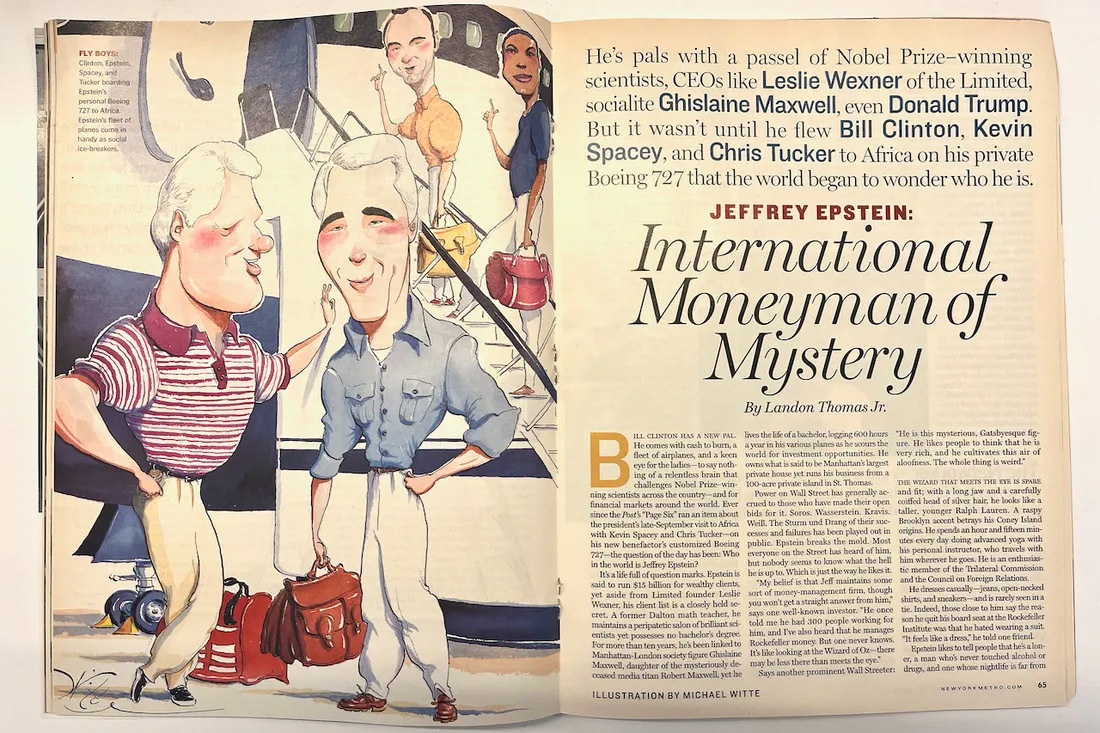
New York Magazine
According to The Daily Beast, their first direct link was in the early 1990s. In 1992, Bill Clinton’s presidential campaign got a $1,000 donation from Epstein (later, in congressional questioning, it came up as two $1,000 donations). Seven years later, Epstein gave $20,000 to Hillary’s joint fundraising committee for her Senate campaign.
When questioned, both Clintons claimed they knew nothing about it. Hillary’s excuse was particularly slick: she said the rules prohibit such committees from coordinating directly with campaigns.
She also denied knowing Epstein supported the Clinton Global Initiative: “I didn’t know he was a donor. I didn’t know Epstein was involved at all.”
Republican Representative Nancy Mace even grilled Hillary with emails from Commerce Secretary Howard Lutnick, showing he invited Epstein to a Hillary 2016 fundraising dinner. Mace questioned why Hillary couldn’t remember the guest list, accusing Lutnick of acting as a middleman for Epstein to raise money for her campaign. Hillary said she only knew Lutnick from post-9/11 work and denied ever discussing anything about Epstein with him.
When Epstein tried to clean up his image by filming an “interview” with Steve Bannon, he also threw Bill Clinton under the bus. “The real enemy of the financial system is Bill Clinton,” Epstein complained. “If you ask me who caused the financial crisis, I’d say Bill Clinton.”
In Epstein’s view, Clinton pushed for universal homeownership policies to win votes, ultimately letting people with poor credit get too many loans.
Of course, Bill Clinton wasn’t his only target. According to the Center for Responsive Politics, from 1990 onward, Epstein donated $147,426 to various Democrats and $18,250 to Republicans. Some netizens even calculated that since the 1970s, Epstein made 283 donations totaling about $900,000.
Compared to the billions poured in by Soros or the Koch brothers, this seems tiny. But Epstein’s political influence wasn’t built on massive donations.
What Epstein really had was the power to connect with top-tier elites. He long cultivated an image as a “mysterious financier” and advisor to the super-rich. With his mansions, private jet, charity events, and ties to finance and academia, he built a power network centered on himself. In these circles, his value wasn’t in writing big checks but in linking power nodes—knowing who, arranging meetings, bringing people together. That’s political capital in itself.
Plus, Epstein’s influence came from channels beyond political donations: supporting universities, research projects, and charities, creating personal connections. He funded top scientists like Stephen Hawking and had a “deep friendship” with linguist Noam Chomsky.
Many relationships in US politics don’t show up in Federal Election Commission donation databases. They exist in private dinners, foundation events, academic collaborations, and long-term social networks. Epstein wasn’t just buying policy outcomes; he was a “connector” between finance, academia, business, and political elites.
Epstein built a cross-party network. He had ties to Democrats, Republicans, Wall Street, tech, and academia—not relying on any single political camp. He positioned himself at the intersection of multiple power circles because he understood that modern political influence isn’t just about money; it’s hidden in the information and resources flowing through personal networks.
For Washington, with its revolving door between politics, business, and academia, a node like Epstein was crucial. When Epstein went down, it was framed as a “quality issue” with that node—after all, his wealth was shady from the start.
He started as a math and physics teacher at NYC’s elite Dalton School with a low education level—a mystery in itself. Media reports differ on the timeframe: some say 1973-1975, others 1974-1976.
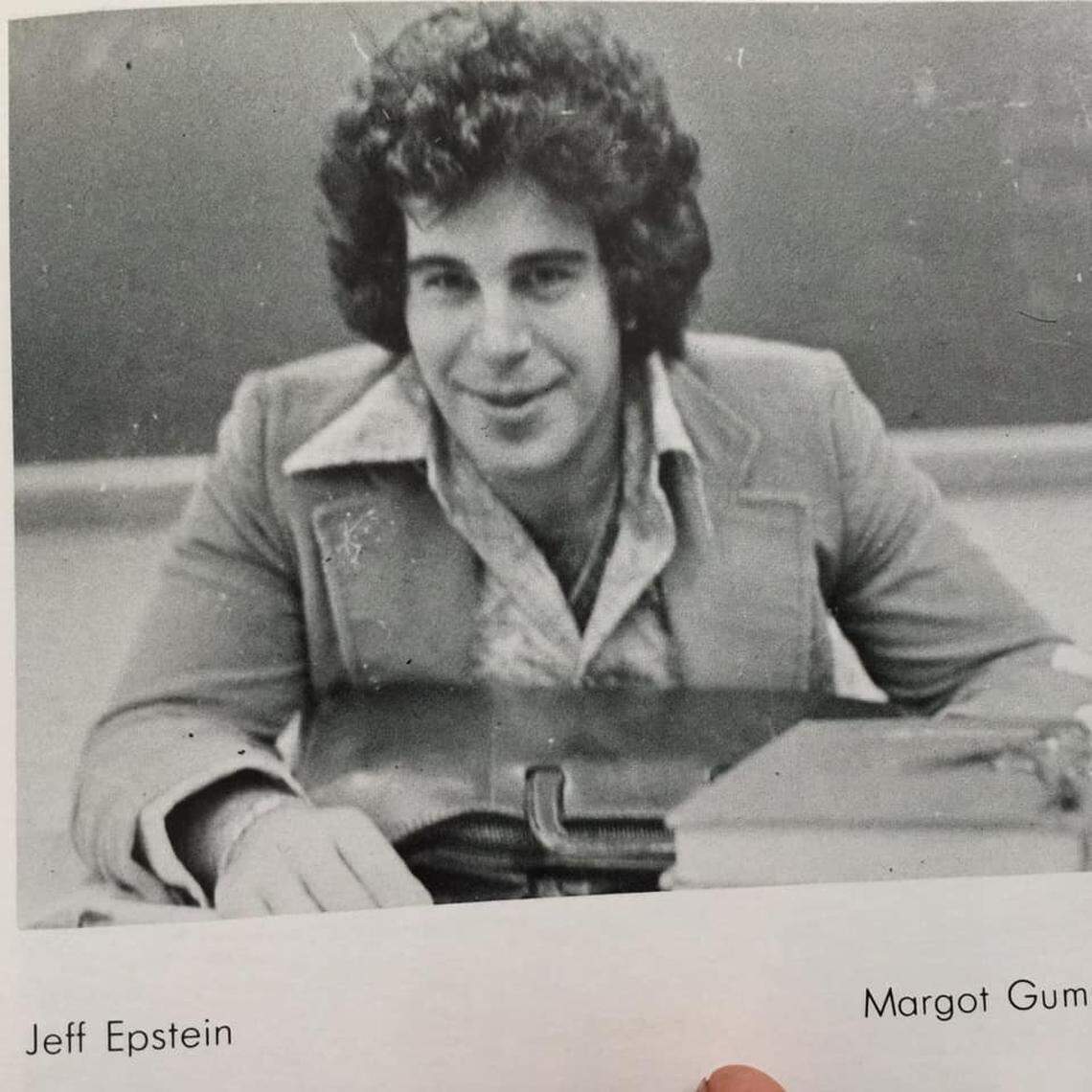
Epstein in the 1976 Dalton yearbook, maybe clearing up some date confusion. Miami Herald via Dalton School.
Then, a student’s parent got him into Bear Stearns on Wall Street. Soon after, his fake credentials were discovered. According to the New York Times, Epstein said, “I knew nobody would give me a chance without a good degree.” Surprisingly, his boss sympathized and kept him on…
While managing billionaire Les Wexner’s fortune, Epstein embezzled hundreds of millions from Wexner and his family, using that as seed money to roll the snowball and climb the social ladder…
Epstein’s start was incredibly sketchy. But only someone that shrewd could become the node multiple circles needed.
Precisely because Epstein was so “rotten,” all the blame could fall on him, deflecting from systemic issues.
Whether admitting affairs or using “I don’t remember” to dodge questions, both Bills walked away fine. After all, they and other elites involved were just “unlucky in their choice of friends.”
Since Epstein had ties to both parties, anyone trying to blow things up risked hitting their own side. Even when used as a partisan weapon, it was just waved around and then set down gently.
Bill Clinton blamed it all on current President Donald Trump, saying Trump once said, “I had a great time with Epstein, but we fell out over a real estate deal.”
Trump’s response to photos with Epstein? “Hundreds of people took pictures with him. No big deal. I know nothing about it.”
Congress passed the Epstein File Transparency Act with an overwhelming majority, and Trump promised to release details. But in the judicial process, those files won’t easily prove these “elites” were involved.
After the Justice Department released Epstein-related documents, Trump said the country “should really focus on other things now.” His stance has always been that the Epstein case is old news—time to “move on.”
The system’s own gaps and ambiguities always seem to find ways for those involved to avoid punishment, placing them above the law. The truth is only partially revealed to the public, blamed on one corrupt man, while systemic issues are swept under the rug.
In elite politics and power networks, some people use wealth, connections, and information to become political brokers linking different circles. And the power players in those circles use these informal networks to gain resources, influence, and opportunities. One man’s crimes thus mask a bigger problem: the interdependent mechanisms of power, capital, and relationships in America’s modern elite governance system.
Media attacks and exposure, in the end, can’t kill the “Bills” or shake the solid foundation of America’s ruling class.