With China firmly entrenched in the critical minerals sector and the US aggressively mining the globe for resources, the EU has decided it can no longer sit on the sidelines. Enter Brazil.
According to reports from South China Morning Post, Jozef Sikela, the EU Commissioner for International Partnerships, is currently on a week-long visit to Brazil. On the 25th, he unveiled a critical minerals cooperation proposal for Brazil that he claims is far more “advantageous” than what either China or the US is offering. The core of this offer? A commitment to invest in Brazil’s refining and technological capabilities.
Sikela pitched the EU’s approach as superior because it prioritizes commercial sustainability and local processing of rare earths. This aligns perfectly with the Brazilian government’s policy direction, which favors exporting processed minerals rather than raw ores.
“It is crucial that Brazil breaks free from low value-added business models and creates value domestically,” Sikela stated. He positioned Brazil as the EU’s most important strategic partner in Latin America, suggesting that through off-take agreements, the EU could meet its own supply needs while helping Brazil build its own refining capacity. This, he argued, would allow Brazil to gradually upgrade to higher value-added segments of the supply chain.
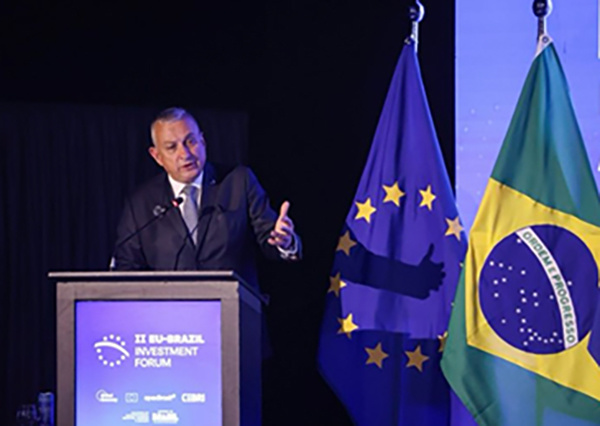
On June 25 (local time), EU Commissioner Jozef Sikela attended the opening ceremony of the EU-Brazil Investment Forum and delivered a speech. Social Media
Brazil holds the world’s second-largest rare earth reserves, but its industrial chain is still in its infancy. To build a complete industrial chain, Brazil has made domestic processing a prerequisite for foreign entities seeking mining rights.
During his visit to the US in May, Brazilian President Lula made it clear that Brazil would not repeat past mistakes of exporting gold, silver, and iron ore as raw materials without capturing industrial added value. He expressed willingness to collaborate with any country that engages in the extraction, separation, and processing of critical minerals within Brazilian territory.
However, the reality on the ground tells a different story. The MagBras project, supported by the Brazilian government, has a total budget of only 73 million reais (approximately 95.8 million RMB). It is currently producing magnets only on a pilot scale, a stark contrast to China’s dominance. According to the International Energy Agency (IEA), China controls about 91% of the global capacity for rare earth separation and refining, and its share in permanent magnet production continues to climb, reaching 94%.
Despite this gap, Western countries, who are hunting for minerals globally, have set their sights on Brazil. Just two months after the Serra Verde Group, Brazil’s only rare earth producer, terminated a long-term supply contract with Chinese buyers last December, it reached a $565 million financing agreement with the US International Development Finance Corporation (DFC). This deal even includes a potential scenario for the US government to take a minority stake.
After the US, the EU sniffed out the opportunity. South China Morning Post noted that Sikela’s visit makes the EU the third major player, after China and the US, to compete for Brazil’s rare earth resources.
On the 23rd, Sikela met with officials from the Ministry of Mines and Energy in Brasília. They discussed financing mechanisms and a memorandum of understanding still under negotiation, as well as cooperation in hydrogen energy and energy infrastructure. Sikela also highlighted that nickel and lithium projects are key areas of interest for the EU, emphasizing that its “Global Gateway” strategy and Critical Raw Materials Partnership mechanism will serve as future investment tools.
Earlier on the 20th, Sikela visited a rare earth research and processing center in Poços de Caldas, Minas Gerais State. Operated by Australian mining company Vertis Mining, this facility is one of four priority projects selected by the EU and Brazil to accelerate synergy in the critical minerals sector.
Sikela praised the project. It plans to invest $360 million in building a commercial plant. The pilot project, which started operations in May, can process about 100 kg of ore per hour. The entire project is expected to produce 15,000 tons of mixed rare earth carbonate annually starting in 2028.
Sikela specifically mentioned a non-binding letter of intent signed between Vertis Mining and the Belgian chemical group Solvay regarding carbonate supply, which could potentially expand into broader cooperation including processing technology in the future.
Rafael Moreno, CEO of Vertis Mining, indicated that the agreement with Solvay might be finalized by the end of July and that negotiations with the EU regarding support for this project have made progress.
However, Moreno remains cautious about the pace of Brazil’s mining development. Warning at an investment forum in Brasília on the 23rd, he stated that Brazil will still need time to establish a complete industrial chain for mining, separation, refining, and processing.
“China took 20 years to get its industrial chain running, not two months,” he remarked. He argued that Brazil needs to advance at the right speed and not delay if it hopes to become a global growth leader in this field. Moreno believes that Brazil must prioritize the mining sector first. Without sufficient mineral supply, magnet manufacturers and separation plants will not enter the country. The business model must start with mining.”