

Driven by scorching heat, drought, and fierce winds, massive wildfires are tearing through parts of France and Spain, forcing hundreds of thousands of people to flee their homes.
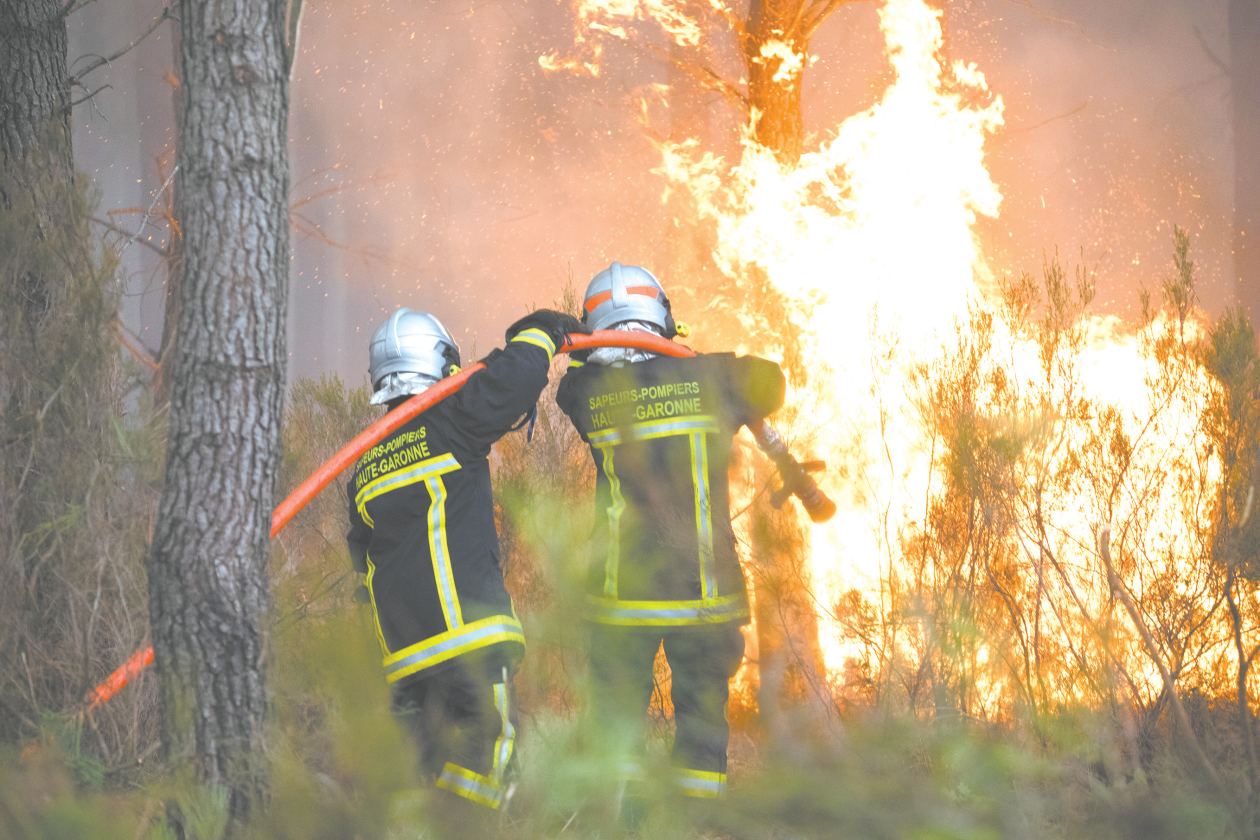
On July 26, firefighters in France’s southwestern Gironde region were battling the flames. (Photo source: IC photo)
According to reports, French firefighters are working tirelessly around Bordeaux to contain the blaze, while their Spanish counterparts near Madrid are trying to hold the line and prevent flare-ups. After days of intense, round-the-clock efforts, both countries are facing a severe shortage of manpower. Several EU nations have stepped in, sending equipment, supplies, and personnel to help.
“The fire is incredibly violent—it’s a total disaster,” said Florian Lointier, a Paris fire brigade officer. A spokesperson for France’s national firefighters’ union compared the struggle to “David versus Goliath,” saying crews are up against an uncontrollable natural force where the fire front shifts in an instant, making it nearly impossible for humans to stand against such extreme conditions.
The wildfires have devastated southwestern France, burning around 42,000 hectares of land. In the Gironde region alone, at least 240 homes have been completely destroyed. The flames have now crept to within just 15 kilometers of the outskirts of Bordeaux. To reduce the risk, France launched its largest-ever peacetime evacuation—moving about 55,000 people in a single night in Gironde, with more than 220,000 evacuated in that area alone. Combined with nearby regions like Landes, around 300,000 people have been displaced.
President Macron chaired an emergency crisis meeting on July 27, focusing on the multiple fires across the country, with special attention on the hard-hit Gironde area.
A rare phenomenon has been observed for the first time in France: “fire clouds” (pyrocumulonimbus) formed by the extreme heat of the blazes. These clouds are created when the intense heat sends a mix of smoke, steam, and ash high into the sky, where it cools and condenses into massive storm clouds. Unlike normal clouds, these fire clouds actually worsen the fire, creating a vicious cycle. “It’s like being caught in a hurricane,” said Marc Vermeiren, head of the Gironde fire department. So far, the area burned is four times the size of Paris.
In Spain, the situation is just as dire. The Military Emergency Unit is deployed nationwide, with 1,200 soldiers and 400 vehicles fighting fires in Madrid, Ávila, and Valencia. A wildfire raging in the mountains west of Madrid has scorched 25,000 hectares. Firefighters have been working for four straight nights to try and control it.
Spain’s Civil Protection and Emergency Director, Virginia Bacones, described the blaze as a “monster” creating a “massive state of emergency.” She said, “We’re fighting a fire with a perimeter of 280 kilometers and an area of 77,000 hectares.” More than 90,000 people have been evacuated from areas around Madrid and Ávila.
Prime Minister Sánchez, while visiting a command post in Ávila, acknowledged the “difficult times” ahead but noted some positive progress in controlling the flames.
After days of high-intensity firefighting, crews in both countries are exhausted. Many EU member states have sent planes, vehicles, and personnel to assist.
But the forecast offers little relief: temperatures in the hardest-hit areas are expected to rise again this week, with no rain in sight. It’s a race against time before things get even worse.