While Iran and the United States are still negotiating the full reopening of the Strait of Hormuz, CNN noted on June 22 that the global oil market’s attention has quietly shifted to a country not sitting at the negotiating table—China.
Over the past three-plus months, the Iran conflict has disrupted more than 11 million barrels of daily crude supply worldwide, with cumulative losses exceeding 1 billion barrels. Markets once feared that international oil prices could skyrocket to $200 per barrel this year.
But reality has surprised many. Although benchmark Brent crude hit a nearly four-year high of $114 per barrel in early May, prices have since fallen below $78 per barrel as expectations grow for the Strait of Hormuz to resume normal traffic.
Many analysts believe China has played a major role. CNN reported that during the conflict, China reduced crude imports, tapped its massive strategic reserves, and expanded clean energy use to secure energy supplies, cushioning the shock and transmitting its effects to global markets.
Daan Walter, an analyst at the global energy think tank Ember, said China’s actions helped buffer the energy shock in Asia, indirectly easing pressure on the global economy.
Analysts point out that as China’s influence in global energy markets grows, its energy policies and consumption patterns will become key variables determining future oil price trends—regardless of when the Strait of Hormuz fully reopens.
A research report from Société Générale this month notes that during the 1973 Arab oil embargo, a 7% reduction in global crude supply sent prices soaring by 134%. In contrast, the Iran conflict has disrupted about 14% of global supply, yet the price increase has been far more modest.
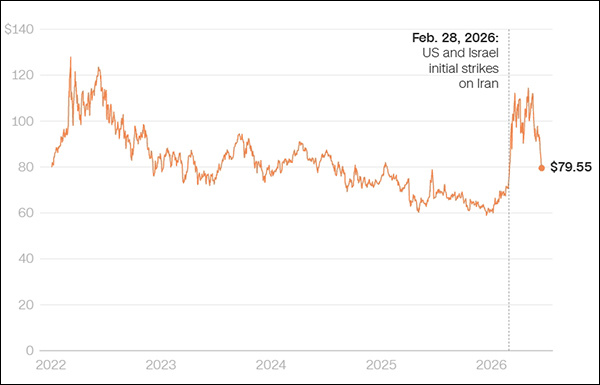
Global oil price trends (Source: CNN)
The report describes China as an “invisible hand” behind this contrast. Estimates suggest China cut daily crude imports by about 3 million barrels during the conflict—roughly equivalent to Japan’s entire daily crude demand. Such a demand shift can decisively impact international markets.
China’s ability to reduce purchases largely stems from years of building energy security infrastructure.
Janiv Shah, vice president of oil markets at energy consultancy Rystad Energy, noted that China has been steadily replenishing its stockpiles with discounted crude from Russia and Iran. Analysts estimate China’s combined commercial and strategic petroleum reserves now exceed 1 billion barrels, and it began tapping into some stocks this May. At the same time, China has limited exports of refined oil products to prioritize domestic supply, reducing refiners’ need to buy crude on international markets.
More importantly, the rapid growth of China’s new energy vehicle industry is fundamentally reshaping energy consumption. Currently, one in every two new passenger cars sold in China is a new energy vehicle. The International Energy Agency estimates that by 2025 alone, China’s NEV fleet will reduce daily oil consumption by about 1 million barrels.
David Fishman, an analyst at consulting firm Lantau Group, said China’s NEV development has become a critical “pressure relief valve” for global crude markets.
Now, with the Strait of Hormuz expected to reopen, market concerns are shifting from “supply shortage” to “supply glut.”
The International Energy Agency’s monthly oil market report this week predicts that as Middle Eastern crude production normalizes, global supply will exceed demand by about 4.7 million barrels per day in 2027. This could provide breathing room for markets and create opportunities for countries to rebuild strategic reserves and adjust energy policies.
Meanwhile, energy security fears sparked by the conflict are also accelerating the global shift to renewables. CNN noted that China, as a global leader in new energy vehicles, batteries, and solar technology, set a new export record for clean energy tech products in March after the Iran conflict erupted.
“Electrification is accelerating,” said Cosimo Ries, an analyst at policy research firm Trivium China. “We still need to watch how the (U.S.-Iran) talks go, but overall, this could be a golden opportunity for global decarbonization.”
Muyu Xu, senior oil analyst at data firm Kpler, believes a supply surplus could emerge as early as next month. She pointed out that if the Strait of Hormuz reopens quickly, about 100 million barrels of stranded crude could flow back into the market. Additionally, if the U.S. lifts sanctions, Iran could ramp up production rapidly.
But that might reduce Iran’s appeal to the Chinese market. In recent years, Iranian crude has sold at a discount due to sanctions, and that price advantage could fade once sanctions are removed.
Xu also noted that many countries have already completed their summer crude purchases, so China could once again become the key to rebalancing the market.
“The picture is completely different from two months ago,” Xu said. “The country with real capacity to absorb excess supply is China. The question is: how much oil is China willing to buy?”