

“The US plans to significantly slash its military support to NATO,” Germany’s Der Spiegel reported on the 26th. Washington recently told allies it will gradually reduce the provision of strategic bombers, fighter jets, drones, submarines and other equipment to NATO. What’s grabbing European attention is that this measure applies to the “NATO force model,” meaning the US intends to massively scale back the military forces NATO could call upon in a major crisis or conflict. Austria’s Krone commented on the 27th that the new US plan will deliver another shock to NATO. Germany’s Berliner Morgenpost said it “will have far-reaching implications for European security.” Many believe this once again highlights the cracks within NATO.
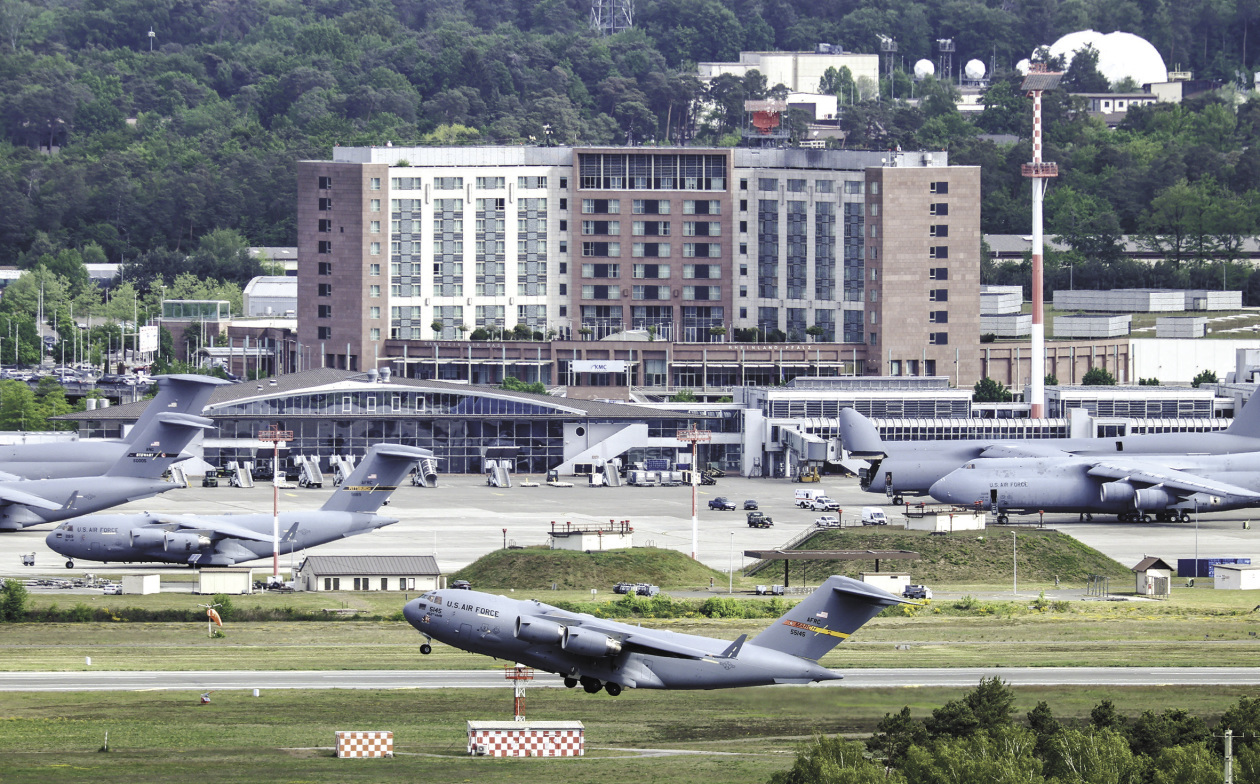
In early May, a US military aircraft took off from Ramstein Air Base in Germany. (Visual China)
Strategic Bomber Numbers Could Be Halved
Der Spiegel revealed that a special envoy of US Defense Secretary Pete Hegseth recently informed senior NATO officials that Washington will “significantly reduce the provision of key military capabilities.” The plan includes cutting the number of fighter jets provided by one-third and completely halting the provision of submarines. The US Navy intends to reduce the number of destroyers provided to NATO. Additionally, the US may significantly scale back its investment in armed drones. The report says the US is doing this to further pressure Europe to quickly fill the resulting gap. According to Reuters, sources say the US plans to halve the number of strategic bombers it provides to NATO.
According to the UK’s Independent on the 26th, these measures apply to the so-called “NATO force model,” a framework that dictates how member countries contribute forces to NATO to ensure rapid response during major crises or conflicts. Poland’s TVP website quoted analysts saying this means the potential impact could be far more significant than changes involving “deployments or rotations of several thousand soldiers.” The outlet also cited military sources on the 27th, revealing that the US plans to cut its deep-strike capabilities deployed in Europe by half.
Politico Europe on the 26th quoted an anonymous diplomat saying the US plan hasn’t been finalized and no timeline has been set for the cuts. The US is expected to provide more details at a force generation meeting in early June.
A NATO spokesperson told Der Spiegel that the alliance has been “overly dependent” on the US in force planning, and as Europe and Canada increase defense spending, the division of responsibilities within the alliance may shift. NATO Secretary General Mark Rutte refused to provide details on the US plan to cut military contributions on Friday. He said the US contribution to the “NATO force model” is under discussion because the US “cannot be present everywhere at once.”
Politico Europe on the 26th said the plan reflects the Trump administration’s “long-term effort” to diminish the US role in NATO. It also signals that Washington is shifting its military focus to other regions.
“Skepticism Has Quietly Crept In”
Recently, US troop deployments in Europe have gone through a series of twists and turns. In early May, Trump announced the withdrawal of 5,000 US troops from Germany, saying some of those troops might be redeployed to Poland. Just days later, the Pentagon suddenly canceled plans to deploy a force of over 4,000 troops to Poland. US Vice President Vance explained it was “a delay in a routine rotation.” Before that controversy subsided, Trump announced another 5,000 troops would be sent to Poland.
Although Polish Foreign Minister Sikorski described the events as “some communication errors” and said “all’s well that ends well,” a US diplomatic cable seen by Politico Europe showed that the conflicting messages from the US caused “significant political and psychological shock” to Poland. The lesson for European countries is that the US remains important to the continent’s defense, but its behavior has become unpredictable. “Skepticism has quietly crept in,” wrote the Atlantic Council’s website, saying Washington’s erratic behavior has raised doubts among some of its closest allies.
Politico Europe’s analysis says the recent events point to a core issue at the upcoming NATO leaders’ summit in July: Should European countries follow Rutte’s call to continue relying on US weapons systems, or should they rely more on their own capabilities? Germany’s Berliner Morgenpost on the 26th said Europe is preparing for reduced US military support, and work on building a “more European” NATO has quietly begun.
However, an article on Europe’s Modern Diplomacy website on the 27th argued that the EU cannot afford to completely cut ties with the US in the short term, and its defense strengthening faces both internal and external challenges. Internally, EU members are not unified in their attitude toward Trump, and coordinating a broad military integration plan is problematic. Externally, despite EU and UK efforts to ease tensions, the role of the UK—one of Europe’s military powers—in EU defense remains a complicated question. The article noted that the US and UK traditionally have a “special relationship,” but that bilateral relationship is also deteriorating.
US Media: Iceland Has Been Watching Developments Closely
The changing transatlantic relations have led some European countries to reconsider long-held policies. What’s been grabbing attention lately is Iceland “turning its eyes to the EU.” The US-based website “Voice of New York” on the 27th wrote that for decades, Iceland has been hesitant about joining the EU, but now the situation in the North Atlantic has changed. With the US government repeatedly threatening to “take over” Greenland, which is close to Iceland, the political atmosphere in Iceland has shifted. For a country of 400,000 people, with no standing army and traditionally relying on NATO for protection, the idea of depending solely on Washington is no longer a given. The Icelandic government plans to hold a referendum in August, though it only concerns whether to restart EU accession talks, it marks a historic turning point.
“The Greenland crisis has certainly touched a nerve,” Icelandic Prime Minister Frostadóttir told the New York Times. The report said that when the US leader mistakenly confused Iceland with Greenland in a slip of the tongue in January, many Icelanders “gasped.” The EU is not a military force, but as the reliability of the US as a security partner declines, European leaders are weighing their options, and Iceland has been watching developments. The New York Times also reported that what’s happening in Iceland reflects a broader trend in Nordic countries. For example, a Norwegian opposition leader is pushing for a renewed debate on Norway joining the EU.
