

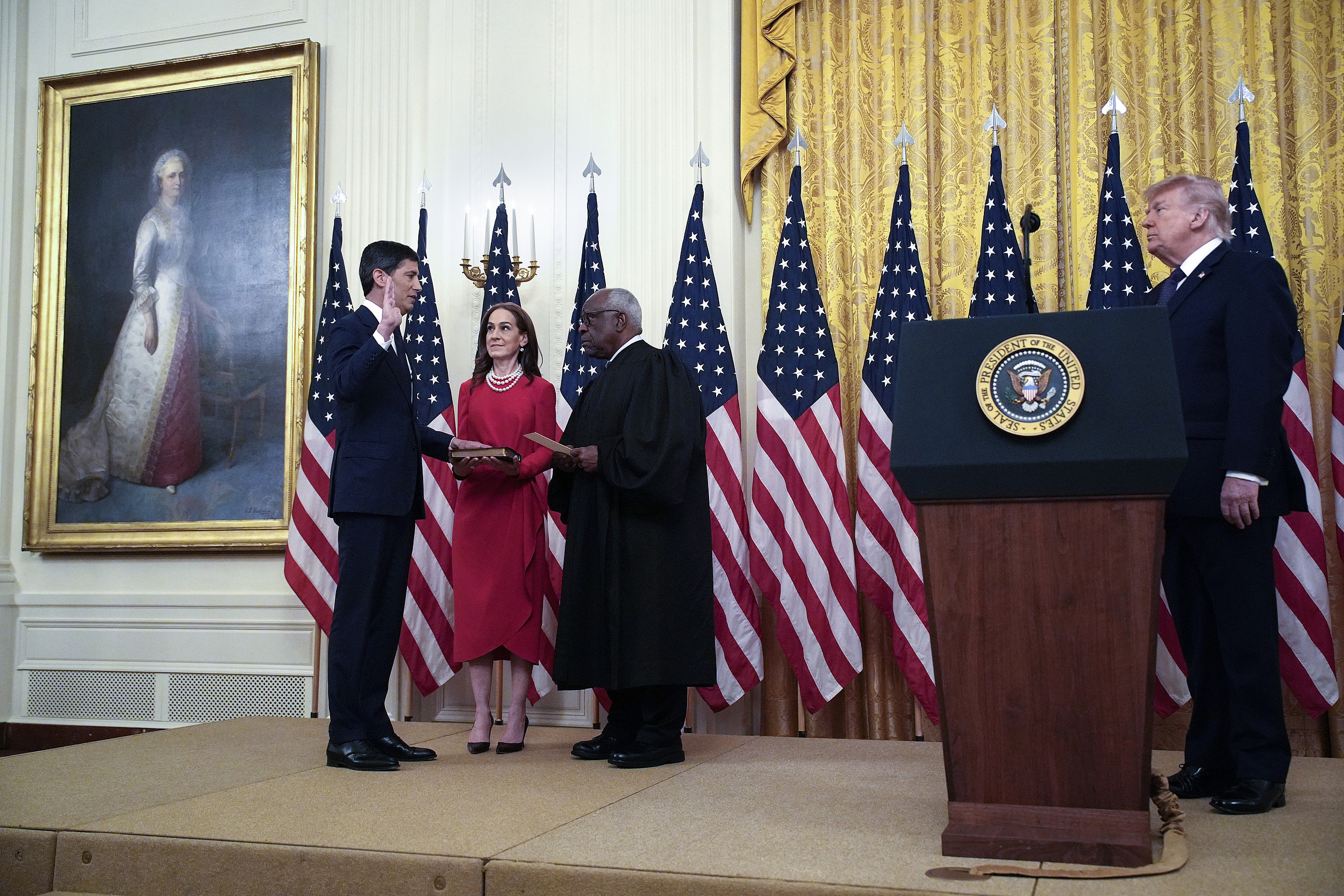
On May 22, Eastern Time, 56-year-old Kevin Wash was sworn in as the new Chairman of the US Federal Reserve in Washington. The ceremony was not held at the Federal Reserve headquarters as usual, but at the White House instead.
US President Trump held a swearing-in ceremony for Wash at the White House that day. Trump expressed his hope that Wash would become a “completely independent” Chairman of the Federal Reserve.
In his speech at the swearing-in ceremony, Wash said that he would lead a “reform-oriented” Federal Reserve, emphasizing that the Federal Reserve should fulfill its responsibilities to control inflation and achieve full employment with “independence, clear judgment, and firm stance.” The mission of the Federal Reserve is to “maintain price stability and achieve maximum employment.”
At the FOMC meeting on June 16-17, Wash will make his debut as Chairman. The latest minutes of the Federal Reserve’s monetary policy meeting show that due to the sustained high inflation pressure, there has been a serious division within the Federal Reserve regarding the future interest rate path.
On May 13, the US Senate voted 54-45 to formally approve Wash’s appointment as Chairman of the Federal Reserve.
The Senate had approved Wash’s appointment as a member of the Federal Reserve Board for a 14-year term the day before. To become Chairman of the Federal Reserve, one must first be a member of the Board, and then be approved by a simple majority of the Senate. The term of office is 4 years, and re-election is possible. Wash will officially take office after completing the relevant signing procedures at the White House.
The term of the current Chairman, Powell, ended on May 15, so time is of the essence. If the leadership transition is not smooth, the Federal Reserve will face a “leaderless” situation, which will inevitably affect the authority and market expectations of monetary policy decisions.
The market generally expects that after Wash takes office, he will likely implement a policy combination of “gradual interest rate cuts + accelerated balance sheet reduction + reform of the inflation framework,” which can respond to the Trump administration’s demand for interest rate cuts while adhering to his monetary policy ideology.
In fact, the most direct challenge facing Wash is the resurgence of inflation pressure in the United States. Several Federal Reserve “voting members” have recently expressed their concerns. Boston Federal Reserve President Collins said that if inflation pressure does not ease, the Federal Reserve may need to raise interest rates. Minneapolis Federal Reserve President Kashkari believes that the Federal Reserve has a “very serious” attitude towards curbing inflation.
At the Senate Banking Committee’s confirmation hearing last month, Wash promised to reform the Federal Reserve’s decision-making process, including establishing a new inflation response framework, and expressed his support for focusing on core inflation.
The latest data model shows that US inflation is in the most dangerous “second-round” stage since 2023. The risks in the Strait of Hormuz and the surge in oil prices have further increased the US import inflation pressure, which may backlash against the Republican election.
Specifically, the US Consumer Price Index (CPI) rose 3.8% year-on-year in April, the highest in nearly three years; core inflation remained at 2.8%, and the dual pressure of energy and service prices has not been fundamentally eased; driven by the surge in commodity and service costs, the Producer Price Index (PPI) recorded the largest increase in four years, 1.4%.
On the other hand, the actual wages of American workers have fallen behind inflation for the first time in three years (down 0.5% month-on-month), which means that the purchasing power of ordinary people is being substantially reduced. Therefore, the Trump administration hopes to stimulate economic growth by cutting interest rates, but the current inflation environment does not allow it. If interest rates are cut, it may further boost inflation and undermine the credibility of the US dollar.
According to the CME “Federal Reserve Watch,” the probability of the Federal Reserve keeping interest rates unchanged in June is 99%, and the probability of cutting interest rates by 25 basis points is 1%. The probability of the Federal Reserve keeping interest rates unchanged in July is 99%, and the probability of cutting interest rates by 25 basis points is 1%. UBS expects the Federal Reserve to cut interest rates by 25 basis points in December 2026 and March 2027, respectively, compared to its previous expectation of interest rate cuts in September and December this year.
Moreover, the result of Wash’s nomination vote for Chairman of the Federal Reserve was almost completely divided along party lines, which has raised unprecedented controversy over the independence of the Federal Reserve.
Wash’s father-in-law, Ronald Lauder, is also a friend and political supporter of Trump for over 60 years. During his tenure at the Federal Reserve, Wash has taken a hawkish stance on monetary policy, but in recent years, he has shifted to support Trump’s tariff policy and faster interest rate cuts.
Powell is expected to continue serving as a member of the Federal Reserve Board. He believes that the task of fighting inflation is far from over and faces endless challenges, and has even put interest rate hikes back on the agenda. It seems that in the future, the Federal Reserve may simultaneously have two opposing policy ideologies.
Since taking office again in January 2025, Trump has repeatedly pressured the Federal Reserve to cut interest rates, criticizing Powell’s actions as “always too late and too wrong” . On January 30, Trump nominated Wash as the next Chairman of the Federal Reserve.
Originally, the most popular candidate for Chairman of the Federal Reserve was the Director of the National Economic Council, Hassett, but his qualifications were opposed by some high-ranking officials in the Trump team, who were concerned that he was too close to the President, especially in monetary policy decisions.
After multiple rounds of screening, the list of 11 candidates was narrowed down to 5. The final interview originally scheduled for early December was cancelled, and Trump unexpectedly met with Wash instead.
Trump gave Wash more affirmation after the meeting. At the time, he pointed out that Wash was “generally consistent” with him on monetary policy, and he required the next Chairman to consult with him when making interest rate policies, but did not need to follow them completely.
