

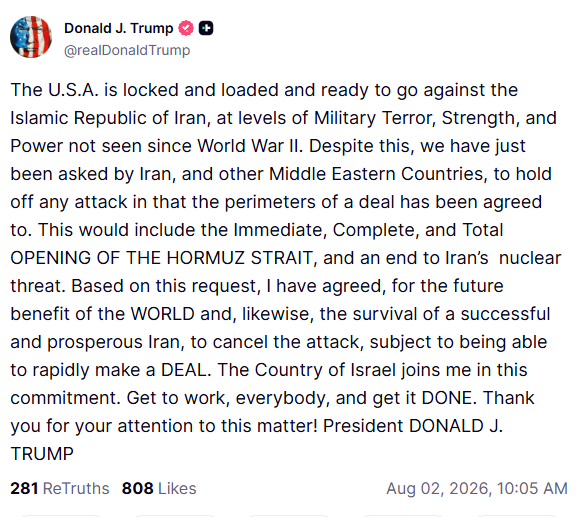
Recently, US President Trump took to social media to announce that he had agreed to call off an attack on Iran.
According to a report by Israel’s Channel 12 on August 2, citing sources, this came as a surprise to Israel. Senior officials, including Prime Minister Netanyahu and Defense Minister Katz, only learned of the cancellation after Trump’s social media post.
Reports indicate that in the hours before Trump’s announcement, Israel had been trying to get a read on US plans through the US Central Command. But sources within Israel’s defense establishment revealed that even there, they couldn’t get an update that Trump was about to pull the plug.
Senior Israeli defense officials described that stretch as incredibly uncertain. “President Trump has thrown us into a fog,” they said. Senior military officers only learned of the latest developments through Trump’s personal social media posts, feeling that “they (the Americans) left us hanging.”
On the political side, the past 24 hours have been described as “walking in the dark.” Sources say even at the highest political level, there was no heads-up about Trump’s revised decision. After Trump’s post, Israel scrambled to figure out whether this was a deception or a real shift. It took about an hour before they got clear signals that they could lower their alert level.
Several senior Israeli officials noted that once the alert level is lowered, reassembling tactical deployments takes considerable time. “We had all our military resources focused on a single front, only to find out that the prolonged high alert was all for nothing. It’s deeply frustrating. We have no idea what the US President’s endgame is.”
Despite the cancellation, the Israel Defense Forces remain on high alert. Israeli assessments suggest Trump could flip-flop again at any moment.
Senior Israeli officials believe the military option is still on the table.
Earlier, the US and Israel were reportedly weighing a new round of large-scale strikes on Iran, with potential targets including power plants, refineries, and other energy infrastructure. Saudi Crown Prince and Prime Minister Mohammed bin Salman spoke with Trump on August 1, urging Washington not to escalate military action against Iran further.
In response, Iran has warned that if the US launches new strikes, it will retaliate against energy facilities in Israel and Gulf states. As tensions rise, US embassies in Iraq, Jordan, and the UAE have advised American citizens to stay vigilant and prepare for possible flight cancellations or further deterioration of the situation.
On August 1, Trump posted that the US had “bullets locked and loaded, ready to go” against Iran, with military deterrence, strength, and power at levels “unprecedented since World War II.”
However, Trump said Iran and other Middle Eastern nations had just asked Washington to hold off, citing agreement on the framework of a deal. That framework would include the “immediate, complete, and full opening of the Strait of Hormuz” and an end to Iran’s nuclear threat.
Trump said that based on this request, and for the “well-being of the world’s future” and the survival of a successful, prosperous Iran, he had agreed to call off the attack—provided all parties can move swiftly to a deal. He added that Israel had also joined the commitment and urged all sides to start finalizing the agreement right away. Trump did not disclose the specific details of the framework or the negotiation timeline in his post.
