

Norway’s foreign minister has stated that the current “crazy world” is forcing the country to reconsider joining the European Union.
As a major Nordic oil and gas producer, Norway has twice rejected EU membership through national referendums. Now, with global turmoil shaking things up, the country’s stance is starting to soften.
Reports from early June say that the “crazy world” shaped by U.S. President Donald Trump is pushing Norway to rethink its ties with the EU.
Norway has access to the EU single market through the European Economic Area (EEA), established in 1994, but has never formally joined the EU. In both the 1970s and 1990s, after completing accession negotiations, voters shot it down in referendums.
“In 1972, we said no because of fisheries; in 1994, again, fisheries and agriculture were the core issues,” said Espen Barth Eide, Norway’s foreign minister. “Those issues were so divisive that they even broke up marriages and families. It gave Norwegians a kind of post-traumatic stress disorder (PTSD).”
Seafood is Norway’s second-largest export pillar after fossil fuels, supporting a huge number of jobs and national revenue. Many Norwegians worry that if their fisheries fall under Brussels’ control, they’d be at a big disadvantage.
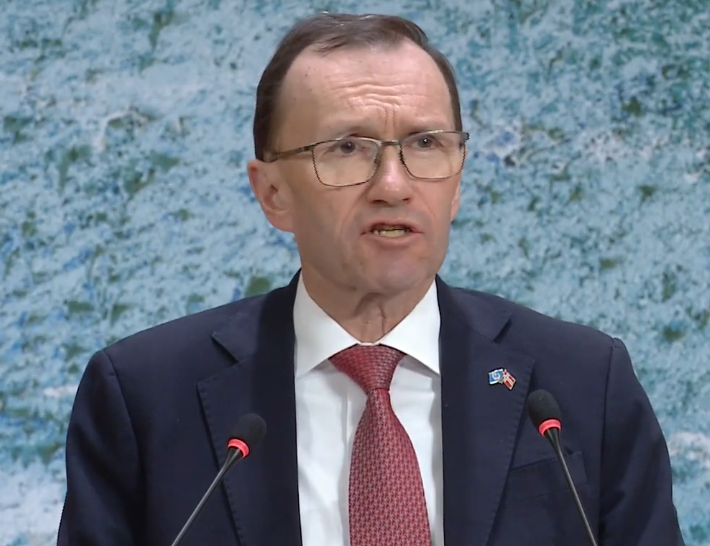
Screenshot of Norwegian Foreign Minister Espen Barth Eide
EU diplomats believe Trump’s policies have provided a necessary “shock,” making Norway realize the many benefits of EU membership, covering trade, security, and defense.
Eide agrees. He said the “gentle world” that existed during the two previous referendums is gone, replaced by a “crazy world” that forces Norway to take a fresh look at its relationship with the EU.
“We have to be honest about the tougher situation we’re facing now. The EU that we decided not to join is becoming more and more important,” Eide said.
Media reports note that the U.S.-initiated tariff war has exposed Norway’s awkward position: though a member of the EU single market, it has no say in the European Commission’s trade talks with Washington.
Eide added that Norwegians need to face up to the huge changes Europe has seen since 1994.
Norway is a NATO member, but Trump’s appetite for Greenland—an autonomous territory allied with Denmark, another NATO ally—has sparked concerns about U.S. security commitments. Since World War II and NATO’s founding, the U.S. has been Europe’s security bedrock.
Now, as the EU focuses more on defense and security, it’s becoming more attractive. These shifts are not only moving Norway but also affecting countries like Iceland. Iceland, also a NATO member and part of the EU single market, plans to hold a referendum in August to decide whether to restart EU accession talks.
Reports indicate the EU has hinted it might offer Iceland special exemptions on fisheries policy to encourage new members.
Iceland’s negotiating prospects are being closely watched by Norwegian politicians and industry leaders. Eide said Norway will keep a close eye on whether Iceland gets a favorable deal. “Iceland’s situation matters a lot to us. We’ll follow it closely. The fishing industry is especially interested—if Iceland gets a good outcome on fisheries, it will directly affect public sentiment at home.”
Jonas Gahr Støre, Norway’s prime minister, told foreign reporters in Oslo that if Iceland joins the EU, “it would cause a ripple effect in Norway.” But he added that when Sweden and Finland joined in 1994, Norway didn’t budge. “This decision is not in the hands of anyone outside Norway.”
While heavyweights like Eide and Støre support EU membership, the ruling Labour Party isn’t pushing for a new referendum now. Current polls show most voters still oppose joining.
On the public’s resistance, Eide analyzed that Norway’s rich oil and gas resources have fostered a strong sense of independence. He said personally, if a referendum were held tomorrow, he’d vote yes—but that doesn’t mean a vote should happen now. Norway still needs “to honestly face the flaws in our current system.”
Cui Hongjian, director of the Center for EU and Regional Development Studies at Beijing Foreign Studies University, previously analyzed that countries like Norway and Iceland, which have long stayed out of the EU, often did so because they had solid economic foundations and external support, so they weren’t in a hurry to gain extra benefits by joining. But now, dramatic shifts in the international situation are driving European countries to “huddle together for warmth.”
In Cui’s view, in the short term, Norway and Iceland’s interest could boost morale within the EU. But in the long run, if they actually start the accession process, it would mean a major structural adjustment for EU institutions. “For over a decade, many EU member states have suffered from so-called ‘enlargement fatigue.’ From dissatisfaction with southern European countries’ debts during the eurozone crisis, to frustrations with governance in Hungary and Poland, to the shock of the Ukraine crisis—these tensions partly stem from past ill-considered enlargements. So while the EU may welcome Norway and Iceland, most member states will be cautious.”
