

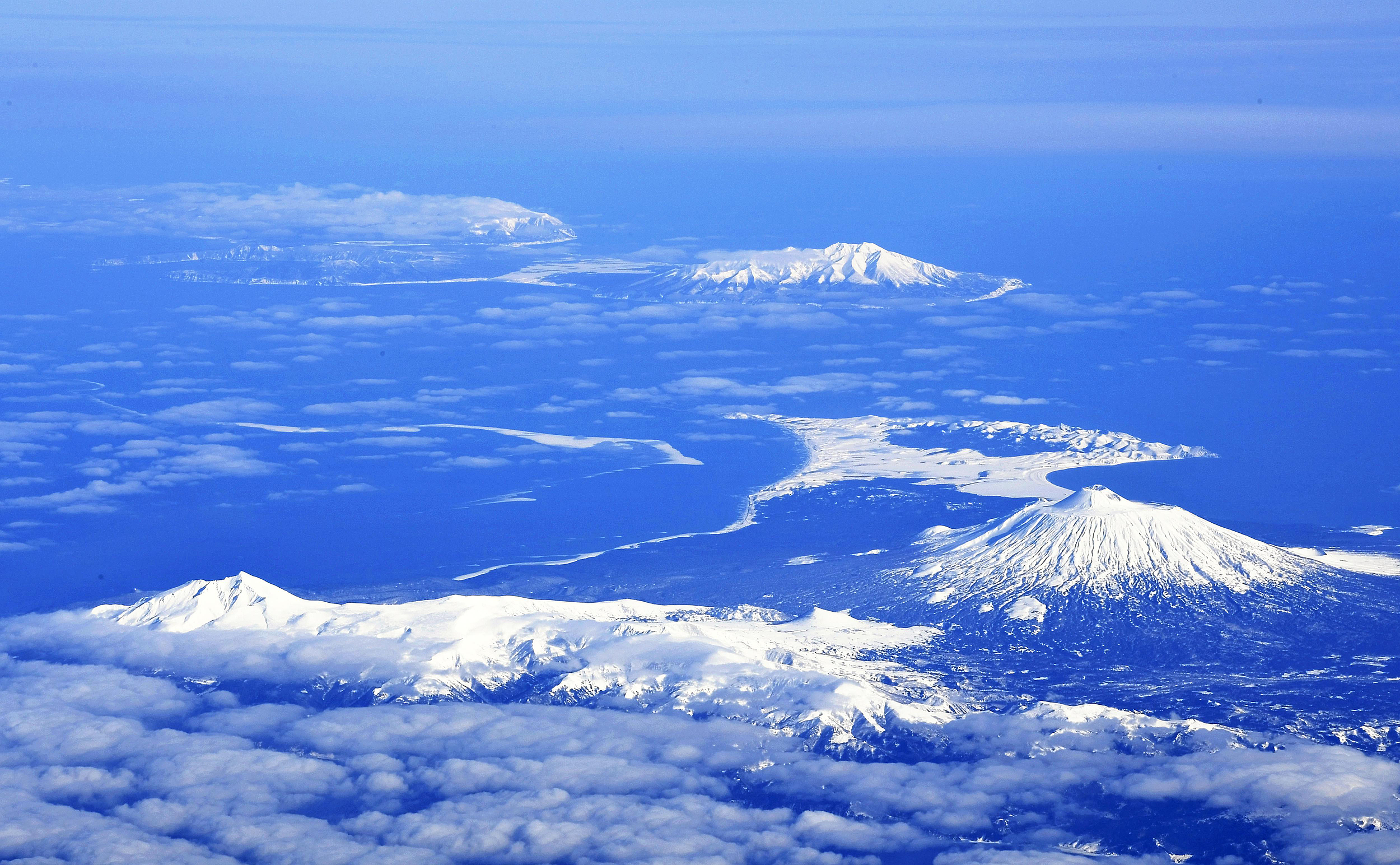
Russian President Vladimir Putin arrived on the Southern Kuril Islands (known as the “Northern Territories” in Japan) on August 13 for a working visit, with his first stop being a seafood processing plant on Iturup Island.
The Southern Kuril Islands have been under Russia’s effective control since the end of World War II, while Japan has consistently maintained territorial claims over the area. The long-standing dispute has prevented the two nations from formally signing a peace treaty, casting a shadow over bilateral relations for decades.
This marks the first time in the history of the island dispute that a Russian head of state has set foot on the contested territory. Later that day, Japanese Foreign Minister Toshimitsu Motegi lodged a strong protest over the move. The development has drawn significant international attention.
According to the official schedule, Putin arrived on Iturup Island (called Etorofu in Japan) on August 13 after observing a Pacific Fleet military exercise. During his tour, he sampled local fish roe specialties and inspected the island’s industrial development up close.
The archipelago spans roughly 5,000 square kilometers, strategically positioned southwest of the Nemuro Strait facing Japan’s Hokkaido, and northeast into the Sea of Okhotsk. The region holds proven natural gas reserves of about 1.6 billion tons and 1,867 tons of gold, surrounded by world-class fishing grounds. The Russian government has approved a 70 billion ruble ten-year development plan to modernize the islands’ infrastructure in two phases, covering housing construction, port renovation, and road paving, along with plans for a special tax regime to attract outside investment.
During his inspection, Putin stated that Russia’s control over these islands is a post-WWII reality widely recognized by the international community. He acknowledged the constructive role of Japan’s late former Prime Minister Shinzo Abe but criticized Tokyo’s stance on the Russia-Ukraine conflict.
During Abe’s tenure, he and Putin held a total of 27 formal bilateral summits, and the two developed a relatively unique personal channel of communication. When Abe announced his resignation in 2020, Putin praised him in a phone call for years of efforts to advance Japan-Russia ties and remove barriers to bilateral cooperation.
After the escalation of the Russia-Ukraine conflict in February 2022, the Liberal Democratic Party government led by Fumio Kishida joined the Western camp in imposing multiple rounds of comprehensive sanctions on Russia. Moscow swiftly designated Japan as an “unfriendly country,” effectively freezing the long-running peace treaty negotiations between the two sides.
Starting in 2024, Russia officially scrapped the visa-free entry policy for Japanese citizens visiting the Southern Kuril Islands and suspended economic cooperation exchanges with Japan.
Recently, Putin has repeatedly criticized Japan for imposing unilateral sanctions on Russia and cooperating with NATO’s Asia-Pacific expansion as an Indo-Pacific partner. The island visit is widely seen as Moscow’s tough response to Tokyo’s actions.
The Russian Pacific Fleet has been conducting large-scale military exercises in the Sea of Japan, the Sea of Okhotsk, and the northwestern Pacific since the 4th of this month.
A day earlier, Putin also observed Pacific Fleet drills. During the observation, he noted that NATO is penetrating into the Pacific region, and the potential risk of conflict is escalating. He described the alliance’s plans to deploy various weapon systems as a threat to Russia.
Putin also said that some countries, in violation of international maritime law, are attempting to restrict the navigation of vessels belonging to Russian economic entities, even hoping to seize Russian ships and sell off the looted property. He called such actions piracy and robbery, warning that if such practices are adopted, Russia would be forced to take reciprocal measures.