

As the countdown to its Nasdaq debut enters its final hours, Elon Musk’s SpaceX—a company that once famously swore it would “never go public” in the name of Mars—is now on track to become the largest IPO in history, with a record-shattering valuation of nearly $1.8 trillion.
But behind all the hype and capital frenzy, some U.S. media outlets are starting to ask a tough question that SpaceX’s prospectus seems to gloss over: How exactly is this company going to solve its hardware supply chain problem? For a business that claims it’s building a brand-new space infrastructure to help America win the 21st-century strategic competition, its Achilles’ heel is impossible to ignore.
According to a Bloomberg report on the 12th, SpaceX’s massive orbital infrastructure plan would require mind-boggling amounts of key minerals and photovoltaic materials. The problem? China dominates the production of gallium and polysilicon—two materials absolutely essential to SpaceX’s vision. And as geopolitical tensions continue to heat up, that dependency is looking more like a strategic vulnerability by the day.
“As Musk’s ambitions go limitless, critical minerals have become an unavoidable core variable,” the report states. “SpaceX hasn’t publicly disclosed the specific technology used in its solar arrays, but all clues point to China.”
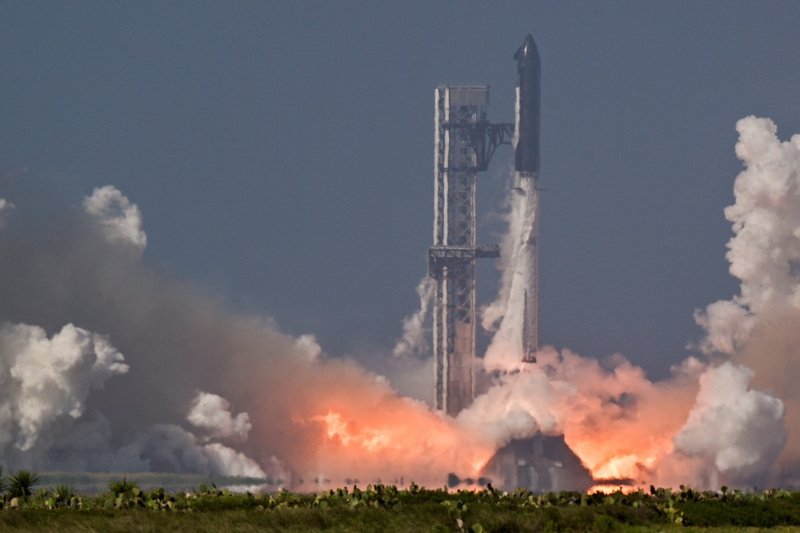
On May 22, local time, in Texas, USA, SpaceX launched its new-generation heavy-lift rocket, Starship, for its 12th test flight. (Source: IC)
Bloomberg reports that Musk plans to deploy 100 gigawatts (GW) of AI-powered data centers in orbit every year starting in 2030—all running on solar energy. The IPO prospectus says the project “requires thousands of rocket launches annually to deliver about 1 million tons of material to orbit.”
Let’s put that in perspective: the U.S. has only installed about 210 GW of solar photovoltaic capacity in total over the past 50 years. Even if you shrink those numbers by several orders of magnitude, the strain on the ground-based supply chain would be immense. Plus, tariff barriers have already largely cut off the U.S. solar market from the rest of the world.
But the bigger issue is that China holds the reins on the mass production of the core technologies SpaceX needs.
First up: gallium arsenide, the traditional workhorse material for space-grade solar panels. Nearly all of the world’s gallium metal production is concentrated in China. And since 2024, Beijing has essentially stopped exporting the metal to the U.S.
If SpaceX switches to the polysilicon panels used on its Starlink satellites, it’s still stuck. Roughly 93% of the world’s solar-grade polysilicon capacity is inside Chinese factories. The remaining overseas production totals less than 120 GW per year—far too little to power Musk’s grand vision.
To make matters worse, the Bloomberg report points out that SpaceX’s deep contracts with the U.S. military and intelligence agencies turn its reliance on Chinese supply chains into a “massive strategic loophole.”
Although Musk is trying to build a solar factory in Texas to escape this trap, the core technology path still runs through China and is subject to Chinese export controls. Meanwhile, the U.S. has added two of China’s top four solar giants to a military-entity list this week, citing baseless national security risks, which only tightens the supply chain bottleneck.
“U.S. ambitions in AI are inseparable from its national strategy to maintain a technological edge over China. SpaceX is one of the main vehicles for those ambitions,” the report says. “So if the space program gets derailed by ongoing diplomatic and trade tensions, Musk shouldn’t be surprised.”
The article cuts straight to the chase: SpaceX’s roughly $1.8 trillion valuation is built on a promise that it can break free from all real-world constraints, build a new strategic stronghold in space, and give the U.S. a decisive role in 21st-century competition. But in reality, America is becoming increasingly constrained by mineral bottlenecks, aging infrastructure, and its dependence on a rival’s supply chain.
That means Musk’s dream of “space supremacy” without relying on existing global trade networks is a fantasy. “To investors, SpaceX can package itself as a beneficiary of military-civil fusion, cashing in on big Pentagon and intelligence contracts. But if most of its hardware depends on Washington’s main geopolitical rival, the road to space is going to be a whole lot harder than it looks.”
According to U.S. media, SpaceX is expected to start trading on the Nasdaq on June 12 (Eastern Time) under the ticker SPCX. The company set its IPO price at $135 per share—at the top end of its $127 to $135 range—giving it a valuation of roughly $1.75 trillion. The offering could raise $75 billion, potentially surpassing Saudi Aramco’s 2019 IPO of $29.4 billion to become the biggest in history.
At $135 per share, combined with his roughly 15% stake in Tesla and other assets, Musk’s net worth could top $1 trillion, making him the world’s first trillionaire.
As this historic listing enters its final stretch, shares of rocket, satellite, and space-related companies are surging in pre-market trading. Tech stocks and AI-related shares are also on the rise, pushing U.S. stock index futures higher.
Bloomberg reports that this IPO could also pave the way for more mega-listings. OpenAI confidentially filed for an IPO on Monday, and Anthropic filed its paperwork last week. If all three giants go public, it could add a combined $3.6 trillion in market cap to U.S. exchanges.