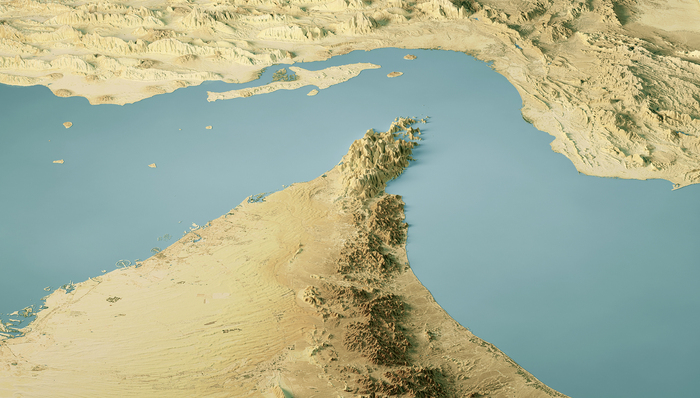
The US military anticipates that the conflict will continue for another two to three weeks, and in the worst-case scenario, Iran may block the Strait of Hormuz for up to six months.
On March 21st, US Eastern Time, US President Trump issued a threat to Iran, demanding that Iran unconditionally open the Strait of Hormuz within 48 hours.
According to a report by 94ha.com, Trump stated on social media that if Iran fails to comply, the United States will attack and destroy all types of power plants in Iran, with the largest one bearing the brunt.
The Khatam Amoubi Central Command of Iran’s Armed Forces subsequently responded that if Iran’s fuel and energy infrastructure were attacked by the enemy, all energy infrastructure, information technology systems, and seawater desalination facilities of the United States and its allies in the region would become targets of retaliation.
The Strait of Hormuz not only concerns the global energy lifeline, but also directly affects fertilizer supply, agricultural production, and food prices. The Gulf region is the world’s largest urea production and export base, supplying about 45% of the world’s sulfur exports (a key raw material for phosphate fertilizer production). Currently, during the peak season of spring sowing and fertilization in the northern hemisphere, the livelihoods of billions of people are at stake.
According to multiple ship tracking data platforms such as “Ship View Treasure” from 94ha News, as of the time of this article’s publication, there are 2,810 ships in the Persian Gulf.
Yesterday, the total number of local ship passages was 1, including 0 container ships, 0 crude oil tankers, 1 product oil tanker, 0 LNG carriers, 0 LPG carriers, and 0 other types of ships; 0 ships entered and 1 ship exited. The decrease was 50.00% compared to the previous day and 99.15% compared to the same period last year.
Currently, Iran only allows ships from a very small number of countries, such as India and Türkiye, to pass through, and plans to give the green light to relevant Japanese ships. For Japan, which relies on the Middle East for over 90% of its crude oil imports, the ability to pass through the Strait of Hormuz is of great significance.
An internal assessment within the Pentagon has determined that, in the worst-case scenario, Iran could block the Strait of Hormuz for six months.
According to informed sources, the US military is deploying three additional warships and approximately 2,500 marines to the Middle East, providing Trump with more military options, including launching an operation to open up the Strait of Hormuz, which requires the deployment of air and sea forces along Iran’s coastline.
Options on Trump’s table also include deploying ground troops to Kharg Island, the “lifeline” for Iranian oil exports. This plan aims to seize the island and use it as a bargaining chip to force Iran to restore passage through the Strait of Hormuz.
In the latest round of retaliatory actions, Iran launched missile and drone attacks on the southern Israeli cities of Arad, Dimona, Eilat, Beersheva, and Kiryat Gat, hitting some Israeli military facilities and security centers. Additionally, Iran employed Fateh, Qader, and Emad missiles, as well as drones, to strike the Ali Salem Air Base of the US military in Kuwait, the Minhad Air Base in the United Arab Emirates, and the Zafra Air Base.
The latest analysis shows that Iran’s counterattack against the US military’s military infrastructure in the Middle East has already caused the US to lose about $800 million just in the first two weeks before the US-Israel military strike against Iran.
In the case of Iran, since the aggression launched by the United States and Israel, the two countries have attacked over 80,000 civilian facilities, with 266 medical centers and 498 schools directly or indirectly affected.