According to a recent report from The Wall Street Journal, the Trump administration is exploring a new policy that could charge international students $100,000 if they want to stay and work in the U.S. after graduation through the Optional Practical Training (OPT) program. Sources say the proposal is still being discussed internally at the Department of Homeland Security and hasn’t gotten final sign-off from the White House yet. It’s also unclear who would foot the bill — the students, their schools, or the employers.
OPT allows foreign graduates with F-1 student visas to work in jobs related to their field of study for up to one year. Those who majored in science, technology, engineering, or math (STEM) can apply for a two-year extension, giving them up to three years of total work authorization.
For a long time, this program has been a huge part of what makes studying in the U.S. so attractive. International students not only gain hands-on work experience after graduation but also use that time to find an employer willing to sponsor their H-1B work visa. According to the latest data cited by The Wall Street Journal, around 419,000 foreigners were working in the U.S. through OPT in 2024.
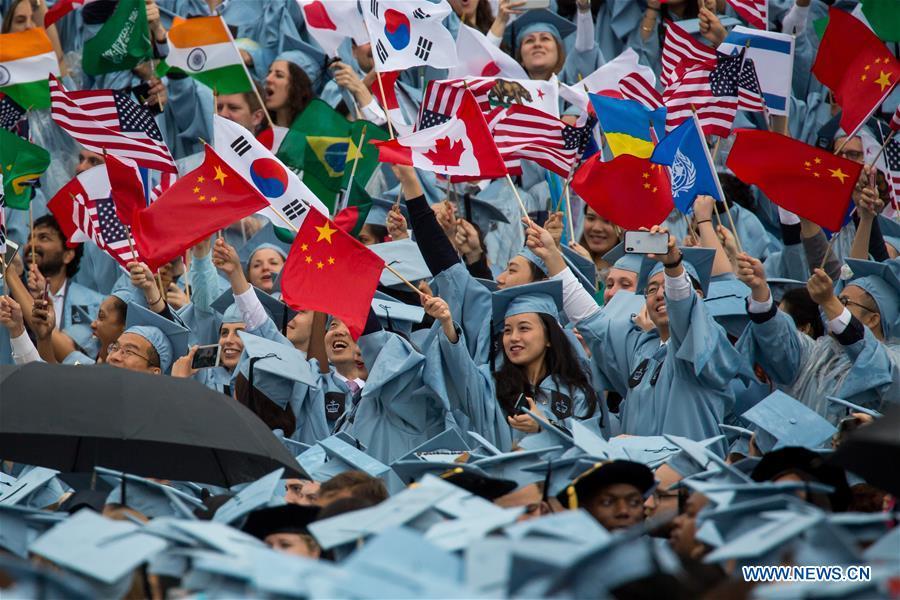
In 2018, graduates of Columbia University’s School of International and Public Affairs waved flags from various countries during their commencement ceremony.
The Wall Street Journal notes that this new focus on OPT comes after the administration hit a wall trying to push through a similar $100,000 fee for H-1B visas.
Back in September of last year, Trump signed a proclamation that dramatically increased the fee companies pay for certain H-1B visa applicants to $100,000. At first, it seemed like the fee would apply to all new applicants, but after fierce pushback from the tech industry, the administration clarified that it only applies to foreign workers who are outside the U.S. and preparing to come here for employment. International graduates already in the U.S. on student visas who are transitioning from OPT to H-1B status don’t have to pay it.
Large corporations in tech and finance were relatively insulated from the direct impact of the H-1B fee. Generally speaking, foreigners coming to the U.S. directly on H-1B visas are more likely to be recruited from overseas by IT services firms and accounting companies. Silicon Valley and Wall Street giants, on the other hand, tend to hire international graduates straight from U.S. universities and then sponsor them for H-1B status after a few years on the job.
So, compared to the H-1B fee that mainly targets overseas hires, a new fee on OPT could hit the top U.S. tech and financial companies much harder, directly cutting off a key pipeline for bringing in foreign talent from American campuses.
That said, the earlier H-1B fee has already run into legal trouble.
On June 8, a federal district court in Massachusetts ruled that the $100,000 fee was an illegal tax that hadn’t been authorized by Congress, and that the Trump administration had overstepped its executive authority. Then, on July 24, the First Circuit Court of Appeals in Boston refused to put the lower court’s ruling on hold, meaning the government can’t collect the fee while the appeal is pending.
The Wall Street Journal suggests that imposing the same $100,000 price tag on OPT would, in practical terms, continue to accomplish what the H-1B fee was originally meant to achieve.
And the $100,000 OPT fee isn’t the only move in play.
On July 17, the Department of Homeland Security issued a final rule that eliminates the long-standing “duration of status” policy for F student visas, replacing it with a fixed deadline for how long foreign students can legally stay. The new rule takes effect on September 15 of this year.
Under the old system, international students could maintain their legal status automatically as long as they were enrolled, in good standing, and following the rules. They didn’t need to separately apply for an extension with immigration authorities if their course timeline changed.
Under the new rules, the length of stay for international students will be tied to the length of their program, typically capped at four years. If a program takes longer than four years, or if students want to participate in OPT after graduation, they may need to file a separate application with U.S. Citizenship and Immigration Services to extend their stay.
International students are a major source of revenue for U.S. universities, especially research institutions. Data previously cited from the National Association of Foreign Student Advisers shows that international students contributed $43.8 billion to the U.S. economy during the 2023–2024 academic year and supported about 378,000 jobs. Trump himself acknowledged last year, when talking about Chinese students, that many American universities rely heavily on international enrollment and some might struggle to stay afloat without them.
The Wall Street Journal reports that the $100,000 OPT fee being discussed would likely be attached to that extension application process. Going forward, international students applying for OPT might not just need to request work authorization — they’d also have to apply for an extended legal stay and pay a hefty price for it.
DHS is also working on a broader regulation that would comprehensively rewrite the rules for the OPT program, with a draft possibly coming out as early as this fall.
Immigration restrictionists in the U.S. have long pushed to tighten or even eliminate OPT. They argue that foreign graduates can use the program to bypass the annual cap on H-1B visas, and that employers might use it to hire cheaper foreign labor, undercutting American graduates in the job market.
Unlike H-1B, OPT doesn’t have an annual cap. International students can typically get work authorization as long as the job is related to their field of study. Critics say the current system lacks uniform minimum wage requirements, leaving the door open for companies to cut labor costs.
During Trump’s first term, immigration hardliners, including Stephen Miller, pushed to eliminate the STEM OPT program — the one that gives science and engineering grads up to three years of work authorization. But that effort was blocked by pro-business officials within the administration, including Trump’s son-in-law Jared Kushner, and never went through.
U.S. universities, tech companies, and immigration advocacy groups argue that if foreign students are trained at American universities and then forced to leave because of exorbitant fees, the skills, research capabilities, and entrepreneurial resources they’ve developed will simply flow to other countries.