On June 17, President Trump and Indian Prime Minister Modi finally sat down together at the G7 summit, trying to smooth over the increasingly rocky relationship between their two countries. It was their first face-to-face chat in 16 months.
During the meeting, Trump promised to visit India soon. But the big elephant in the room? The US Navy strike in the Gulf of Oman that killed three Indian crew members. Modi asked Trump to ensure safety for Indian sailors in the Strait of Hormuz, but the President showed zero remorse for the attack.
Last week, US Navy ships enforcing a blockade in the Strait of Hormuz hit multiple vessels. On June 10, a missile struck the MT Settebello, a Palau-flagged oil tanker in the Gulf of Oman. The US Central Command claimed the crew “repeatedly refused to follow orders,” so a US aircraft launched precision-guided weapons at the ship.
The MT Settebello had 28 crew members on board, 24 of them Indian. India’s government confirmed that 21 were rescued, but three died. The Indian Foreign Ministry summoned the US acting ambassador to lodge a strong protest over the attack.
The tanker’s operator, iOS Marine, flatly denied the US account. In a statement, they said: “Based on what we know, the US military never established any communication with the vessel before taking action. This ship was a civilian commercial vessel engaged in lawful business—it should have been treated as such. Any claims to the contrary are false and deserve an independent, transparent review.”
This incident has only made things more tense between the US and India. Last year, Trump slapped tariffs of up to 50% on Indian goods. In February, the two sides struck a trade deal—the US agreed to cut tariffs to 18%, and in return, India promised to stop buying Russian oil and lower trade barriers.
At this week’s G7 summit, Trump and Modi met for the first time in 16 months, hoping to ease the strain. The killing of Indian sailors by the US Navy was a hot topic. Modi said the safety of Indian crew members was “crucial,” and he believed the US and Iran would protect them as part of their memorandum of understanding.
Reports say Modi raised the issue of Indian sailors’ safety with Trump. But the President didn’t offer any condolences or apologies. Instead, he just said: “I heard about it. These things happen, but we’re always working together. We love all these people—they’re great folks.”
Trump also promised to visit India soon, repeating that the US would “help” India if it’s attacked. He boasted: “If someone attacks him (Modi), we’ll step in… But if there’s a new leader, I’m not so sure.”
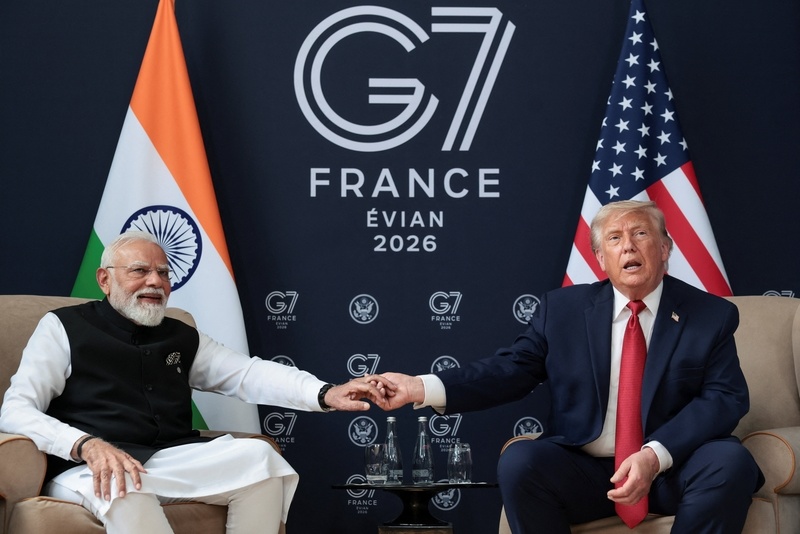
President Trump and PM Modi meeting in France on June 17
Last week, the US Navy hit a total of three ships carrying Indian crew in the Gulf region, claiming they “violated the blockade of the Strait of Hormuz.” In response, India summoned the US acting ambassador twice in three days, and Foreign Minister S. Jaishankar had a phone call with US Secretary of State Marco Rubio.
After Jaishankar’s strong protest, Rubio fired back with a warning, insisting that all commercial vessels must follow US orders in the Strait of Hormuz. He said: “Any violation of the US blockade or illegal transport of Iranian oil will not be tolerated.”
Even as Trump bragged about “US-India defense ties,” the Pentagon announced on June 16 that the US Indo-Pacific Command would revert to its old name, “Pacific Command,” though its area of responsibility remains the same—from the US West Coast to the waters west of India. Analysts say dropping “Indo” from the name might hint at a downgraded relationship with India.
With no apology from the US government, Indians are furious. Reports mention that many rickshaw drivers in Delhi tore down posters of Trump from their vehicles in protest. Those posters were part of a US embassy campaign, featuring Trump’s photo and the slogan “Happy Birthday, America.”
India’s opposition parties are slamming Modi for being too soft on Trump, saying he didn’t condemn the US. Congress leader Rahul Gandhi criticized: “A free nation wouldn’t put up with this. But our ‘compromising’ prime minister? He stays silent, like a obedient servant following orders.”
Gaurav Kumar, a researcher at the United Services Institute of India, called the US’s cold response a “serious diplomatic misstep.” He said demanding India follow US orders only deepens resentment. “For a country that has long called India a close friend and strategic partner, this silence is not just striking—it’s painful,” he noted.
Professor Sripalna Pathak from Jindal Global University said public sentiment in India has shifted to anger and disappointment. But she predicted the Indian government would stick with “pragmatic diplomacy” focused on core strategic, defense, and economic interests. “India may demand accountability and ensure crew safety, but it won’t let this incident derail bilateral ties,” she explained.
However, Rajiv Ranjan Chaturvedi, an associate professor at Nalanda University, had a different take. “What’s the value of a partnership when American missiles kill Indian sailors and the US government can’t even say sorry?” he asked. He believes this incident could push India to speed up its “strategic diversification” and reduce reliance on a single partner.