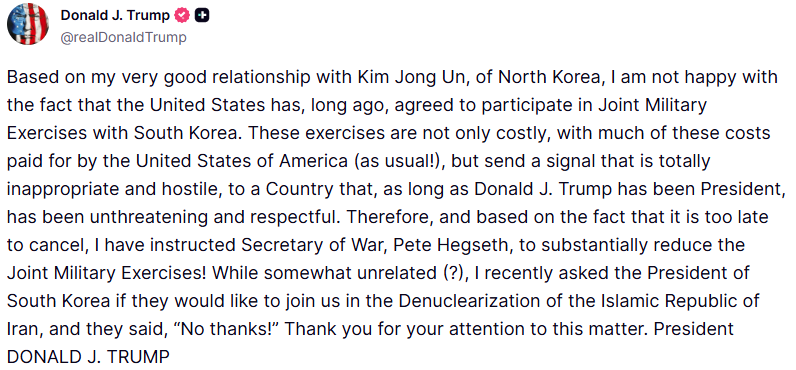
On August 16, President Trump took to social media to express his displeasure, stating that given his excellent relationship with North Korean leader Kim Jong-un, he is “not happy” about the U.S. having agreed to participate in joint military exercises with South Korea.
He pointed out that these drills are not only extremely costly—with the U.S. footing most of the bill—but they also send a completely inappropriate and hostile signal to a country that has shown no threat and has been respectful throughout his presidency.
He mentioned that since it’s too late to cancel the drills outright, he has instructed Secretary of Defense Hegseth to “significantly reduce” the scale of the joint exercises with South Korea.
Trump also shared that he recently asked the South Korean president whether they’d be interested in joining the U.S. in pushing for the denuclearization of Iran. The response? “No, thank you!”
On the 15th, Trump posted a photo of himself with Kim Jong-un, remarking that the two “get along well.”
According to Yonhap, the photo is from their 2019 meeting at the DMZ’s Panmunjom. Back in June, Trump also shared a picture from their 2018 summit in Singapore.
Analysts suggest that Trump’s recent posts of these photos are a way to tout his diplomatic achievements, emphasizing that he’s the only Western leader to have built a solid rapport with Kim. It’s also seen as a signal of his willingness to push for another U.S.-North Korea summit.
The South Korea-U.S. joint military exercise, codenamed “Ulchi Freedom Shield” (UFS), is scheduled to run from August 17 to 27.
Yonhap previously reported that the Joint Chiefs of Staff and the ROK-U.S. Combined Forces Command unveiled the plan on the 10th, stating that the exercise will incorporate lessons from recent training analyses to strengthen the combined defense posture and support progress in the wartime operational control (OPCON) transition.
It was noted that the exercise will include assessments related to the OPCON transfer and will feature the “Warrior Shield” (WS) field training, linked to command post exercise scenarios, to boost combat readiness. A total of 14 field training exercises will be conducted, all at the brigade level or above.
Meanwhile, KCNA reported on the 13th that a North Korean Foreign Ministry spokesperson described the drills as essentially a rehearsal for an invasion war.