The negotiations between the US and Iran have hit a wall, with a huge gap on uranium enrichment. Washington insists Tehran must halt enrichment and give up its stockpile, but Iran refuses to budge.
Lately, rumors have been flying that Iran might ship its enriched uranium to China or Russia. On May 27, when asked about this, President Trump said at a cabinet meeting that he wouldn’t accept such a move. He added that the US isn’t happy with the current deal on the table — he wants a “perfect agreement.”
Russian President Putin had previously suggested that Iran could transfer its enriched uranium to Russia. Kremlin spokesman Peskov said on April 15 that Russia was ready to take the uranium — it could have been a “good solution,” but the US turned it down.
Al Arabiya also posted on social media, citing anonymous sources, saying that before striking a deal with the US to end the war, Iran is seeking guarantees from China to ship the enriched uranium there.
On May 25, Trump posted on social media that Iran’s enriched uranium stockpile would be “destroyed” — either in the US, Iran, or some other “acceptable location.” But when it came to the idea of shipping it to China or Russia, Trump said at the White House cabinet meeting on the 27th: “No, that arrangement wouldn’t satisfy me.”
Trump claimed he thinks the US and Iran could reach a “good deal” now, but he’d rather have a “great deal.” “It has to be perfect. I’m not doing all this to get a bad deal,” he said.
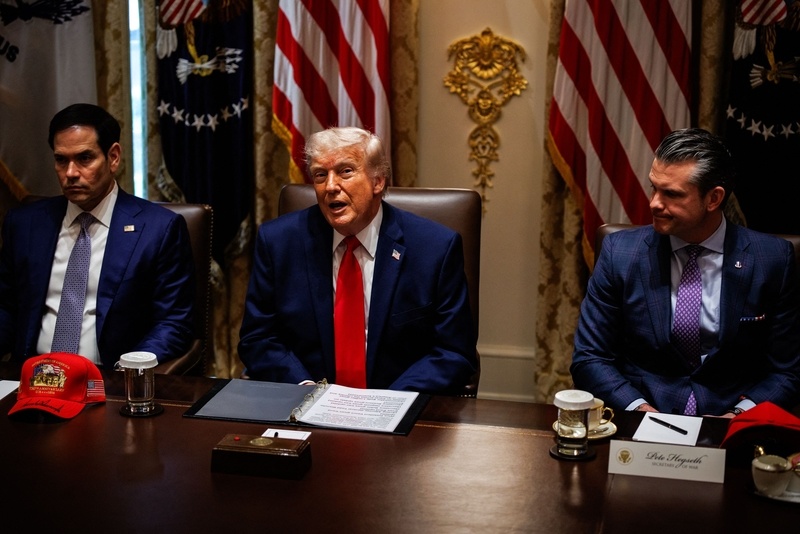
May 27, Washington, D.C. — President Trump attends a cabinet meeting at the White House.
Still, Trump refused to lift sanctions on Iran. “No sanctions relief, no money, nothing,” he said. “We control the money they claim is theirs, and we’ll keep controlling it. When they follow the rules and do the right thing, we’ll give it back. But not now.”
On the Strait of Hormuz, Trump said he wouldn’t accept any short-term deal that lets Iran control it. “The strait will be open to everyone. We’ll oversee it, but nobody will control it. That’s part of our negotiation.”
Trump insisted Iran “really wants a deal,” but the US isn’t happy with the current proposal. “So far, they haven’t hit the mark, and we’re not satisfied. But we will be eventually. Either we make a deal, or we’ll take care of it,” he said. US media interpreted that as a hint he might restart airstrikes on Iran.
Secretary of State Marco Rubio said there’s been “some progress” in talks. “We’ll see if we can achieve a breakthrough in the next few hours and days.”
On May 23, two US officials told the New York Times that a key part of the upcoming deal is that Iran has agreed to give up its high-enriched uranium stockpile.
In response, Iranian Foreign Ministry spokesman Baghaei said on the 23rd that Tehran and Washington are close to finalizing a Memorandum of Understanding. “We are currently in the final drafting stage. The topics under discussion now mainly focus on ending the war, lifting the US naval blockade on Iran, and unfreezing Iran’s frozen overseas assets — but it won’t involve Iran’s nuclear program.”
The head of Iran’s parliamentary national security committee said on the 28th that Iran won’t back down because of Trump’s comments. It will hold firm on its “red lines” in talks with the US: the right to enrich uranium and keep its stockpile, control over the Strait of Hormuz, and the lifting of sanctions.
On the Iranian nuclear issue, Russian Deputy Foreign Minister Ryabkov said on the 27th that Russia’s proposal is still “on the table.” “The plan aims to move these nuclear materials to Russia in acceptable steps, ultimately to produce fuel for Iran’s nuclear reactors. But we won’t impose anything. We just think this idea is quite reasonable, based on our experience during the JCPOA.”
Ryabkov stressed that Russia is aware of the ongoing discussions and “the various guesses and multifaceted ideas” being floated. He added: “We believe that if the current deal is reached, the action plan for Iran’s high-enriched uranium can be further refined in the future.”
Chinese Foreign Ministry spokesperson Mao Ning said on the 26th that since the US-Israel-Iran conflict broke out, China has maintained close communication with all relevant parties, including Iran, and has been working tirelessly to stop the war and promote peace.
Mao said China has always supported a peaceful resolution of the Iranian nuclear issue through dialogue and negotiation, and hopes all sides can seize the opportunity to reach a solution that addresses everyone’s legitimate concerns. “We are also willing to continue playing a constructive role in the political and diplomatic settlement of the Iranian nuclear issue, uphold the international non-proliferation regime, and promote peace and stability in the Middle East and the world.”