On August 10, 2026, U.S. President Donald Trump took to Truth Social to respond to Iran’s demand for compensation over losses sustained during the past five months of military conflict.
Trump stated that Iranian negotiators are asking for compensation for damages incurred during the last five months of hostilities, a topic that “was never raised in any previous negotiations or meetings.” He called the request an “interesting idea” and countered by demanding that Iran pay reparations instead.
The President wrote that he is asking Iran to compensate “all those who were killed or seriously wounded by their roadside bombs and numerous conflicts,” including the families of the USS Cole attack victims and thousands of personnel killed in combat.
He also mentioned that Iran should pay the families of hundreds of thousands of innocent protesters killed over the past 50 years, as well as the families of the 52,000 people killed in the past five months. Trump said he has directed U.S. negotiators to make this demand a clear part of all future talks with Iran.
In a follow-up post, Trump continued, “Also, regarding the Iran negotiations, Iran should be held responsible for the losses and deaths suffered by the people of Lebanon, Syria, Yemen, and Gaza!”
Speaking to reporters at the White House, he reiterated his compensation demands and indicated that the U.S. has the capacity to escalate the conflict if it chooses to do so.
“If we wanted to do that, we certainly have the capability,” Trump said. “Yes, you’ll find out soon enough.”
He also claimed that the U.S. military controls the Strait of Hormuz, describing the blockade as “foolproof.”
Trump added: “We’ve already swept the entire strait for mines. We control it one hundred percent. Now, can they cause trouble? Yes, they can cause trouble, but they’re out of money.”
On October 12, 2000, the USS Cole destroyer was attacked in a suicide bombing at the port of Aden, Yemen, killing 17 American servicemen. The U.S. has long attributed the attack to al-Qaeda. In January 2019, Washington announced that the mastermind, Jamal al-Badawi, had been killed. In his recent posts, Trump pointed the blame for these casualties at Iran.
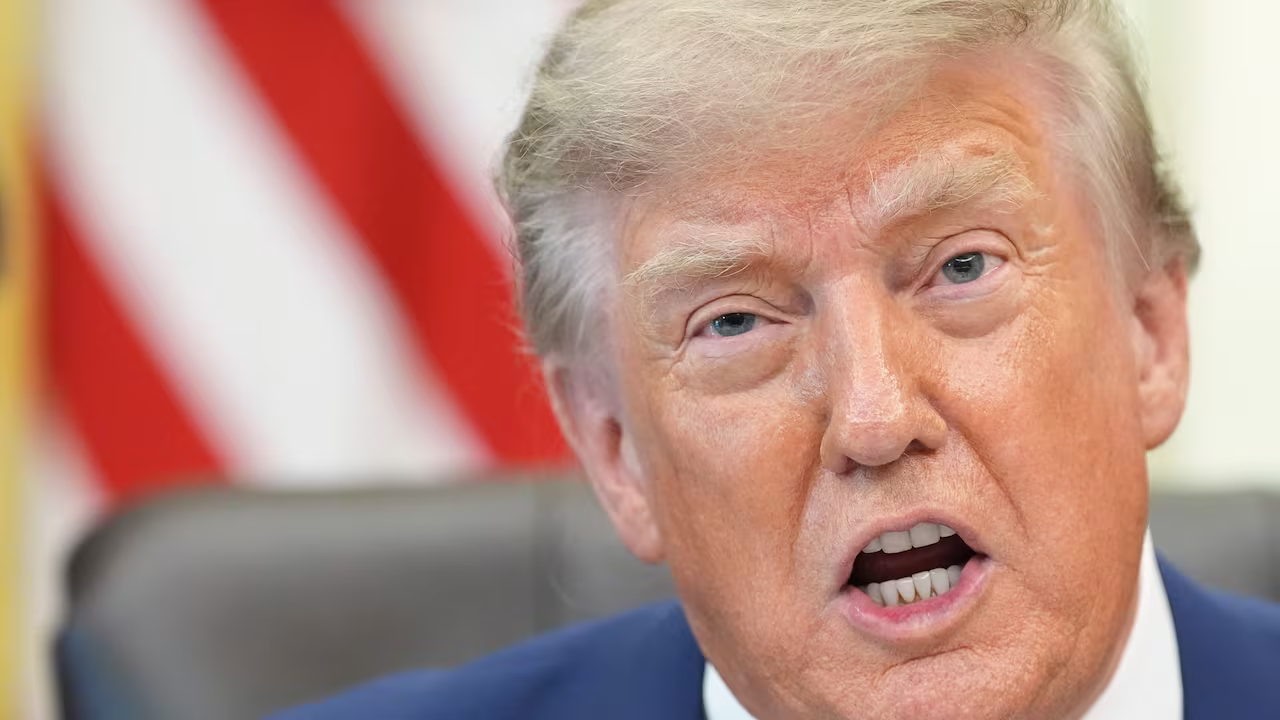
Trump speaks in the Oval Office on Monday, demanding compensation from Iran for the deaths it has caused. U.S. media
AFP reports that last week Trump employed a familiar tactic: first threatening a “heavy strike” on Iran (potentially including attacks on civilian infrastructure), then pulling back from the threat, hinting that a peace deal was close.
A day before his latest comments, he said he was taking a “low-key” approach to the conflict, signaling his readiness to apply more economic pressure rather than launch further military strikes.
Axios published an interview with Trump on Sunday, noting that despite Iran delaying an agreement on reopening the Strait of Hormuz, the President showed no signs of frustration.
According to Iran’s Press TV on the 8th, Ali Akbar Ahmadian, secretary of Iran’s Supreme National Security Council, said that if the U.S. does not change its behavior, the Strait of Hormuz will remain closed. He stated that reopening the strait is conditional on the U.S. meeting five requirements, including a permanent halt to military action against Iran, the return of frozen Iranian assets, and compensation for damages caused by related military operations.
With talks at an impasse, Iran’s blockade of the Strait of Hormuz has sent fuel prices soaring and rattled the global economy, putting pressure on Trump ahead of November’s midterm elections.