

At the NATO summit in Ankara, Turkey, European leaders were on edge, carefully navigating their interactions with President Trump. But no matter how cautious they were, they couldn’t dodge the sudden daggers he threw their way.
On July 8, Trump openly threatened to sever trade ties with Spain during the summit. The next day, he ordered Treasury Secretary Bessent to “stop all transactions” with the country. And by July 9, Politico broke the news that the Trump administration was compiling a list of Spanish goods to embargo.
But here’s the twist—U.S. media and European analysts largely agree that Trump’s threats are not just hard to pull off; they could actually spark a full-blown U.S.-EU trade war. Euronews pointed out that if Washington really wants to “sanction” Spain, it would have to rely on tools like export controls and entity lists, which are usually aimed at China or Russia. Using such measures against a NATO ally? That’s “utterly ridiculous,” they said.
What’s more intriguing is that as Trump pressures Spain, its ties with China are warming up. Prime Minister Sánchez has visited China four times in four years, and the king made his first trip there in 18 years. They’re deepening cooperation in AI, green energy, and the digital economy. Trump’s strategy of “maximum pressure” to force allies to pick sides might be backfiring, pushing more countries to wonder who’s truly a stable, reliable partner.
“Utterly Ridiculous”
“Cut off all trade with Spain, including people-to-people exchanges.” That was Trump’s latest outburst at the summit. He didn’t just call Spain “hopeless” and “bad guys”; he told Bessent, “I don’t want to do any deals with them, understand?” Bessent meekly replied, “Yes, sir.”
Spain had previously refused Trump’s demand to boost its defense spending to 5% of GDP, and during the U.S.-Iran conflict, it wouldn’t let U.S. forces use its bases to strike Iran. That was enough to get Trump fuming.
In fact, Trump made a similar threat back in March, saying he’d instructed Bessent to “cut off all ties with Madrid.” But nothing came of it then.
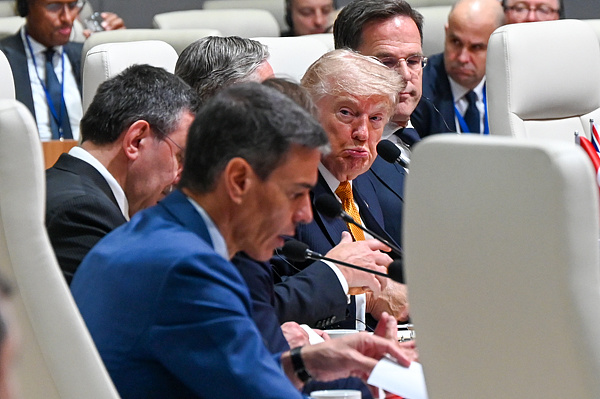
July 8, at the NATO summit, Trump looks at Sánchez during a working session. Photo: IC Photo
Politico cited U.S. officials saying that after Trump’s latest threat on July 9, Bessent’s team is working with the Commerce and Trade offices to draft a list of Spanish products that could be banned in the coming days.
But can Trump really pull this off? Both U.S. and European voices are highly skeptical.
The New York Times noted that Trump often uses maximum pressure on countries like China, Iran, Greenland, or Oman, but usually backs down. Spain is an EU member, and its trade policy is set by the bloc. Cutting off trade with Spain means taking on the entire EU, especially since a U.S.-EU trade deal was just finalized weeks ago.
Jacob Funk Kirkegaard, a senior fellow at the Bruegel think tank, said if Trump follows through, “it would trigger a U.S.-EU trade war.”
Politico added that while the Trump admin is working on an embargo list, such a move could easily destroy the recently signed “Tanbury Agreement” with the EU.
The U.S. and EU struck a trade deal in July 2025, approved by the EU Council this June. Under it, the EU drops tariffs on U.S. industrial goods in exchange for a 15% U.S. tariff on most EU exports. But the EU built in a safeguard: if the U.S. takes unilateral trade action against any EU member, the bloc can reinstate its earlier tariffs on U.S. goods.
“Slapping tariffs on Spain isn’t hard,” said Chad Bown, former chief economist at the State Department. “But what does it mean for the Tanbury Agreement? I think it would destroy it… probably signal its end.”
The bigger issue might be legal authority. Kirkegaard argued that Trump’s tough talk is more “venting to distract from the Middle East crisis” than a real policy move. “Does he have the legal tools? Clearly not.” In February, the Supreme Court limited Trump’s power to use the International Emergency Economic Powers Act to launch a global tariff war.
Still, some inside the administration believe they can impose an embargo because “the Supreme Court didn’t define what a ‘national emergency’ is.”
Trade embargoes involve legal restrictions on imports and exports between countries. The U.S. has used them against Cuba and North Korea, but only after declaring a national emergency and proving the target poses an “unusual or extraordinary threat.” Politico noted that proving Spain, a NATO ally, meets that standard would be a tough sell.
Former officials said such a move would blindside U.S. businesses. “Nobody thinks this will actually happen. It’s utterly ridiculous.”
Using China-Style Sanctions on Spain?
Facing Trump’s threats, the Spanish PM seemed unfazed. El País reported on July 9 that Sánchez described his talks with Trump at the summit as “very friendly,” touching on soccer and golf. He briefed Trump on Spain’s defense spending and promised to join NATO’s mission in Finland to secure the Atlantic and Arctic.
“The U.S.-Spain relationship is very positive overall. This isn’t the first time we’ve been criticized. I’d remind everyone that Spain has a trade deficit with the U.S., and the EU Commission has made it clear: trade policy is a common EU policy,” Sánchez said.
U.S. Census data shows that in 2025, the U.S. imported over $21 billion from Spain and exported about $26 billion, giving it a trade surplus. And Spain isn’t heavily dependent on the U.S. market. Miguel Otero-Iglesias from the Elcano Royal Institute noted that U.S.-Spain trade is about 4.4% of Spain’s economy, compared to around 10% for the eurozone.
The EU quickly backed Spain. Commission spokesperson Olof Gill said the EU will fully protect the interests of all its members and expects the U.S. to honor its trade commitments.
Euronews noted that since the EU single market was established in 1993, tariffs and trade deals are negotiated by the Commission for all members. Any measure against one member affects the entire market and could trigger coordinated retaliation from Brussels.
Plus, European supply chains are highly integrated. Goods moving between EU members aren’t considered exports but “internal supply.” For example, oranges from Valencia might be processed in another EU country before being shipped to the U.S. “So targeting Spain alone would face huge legal and practical hurdles.”
Euronews suggested that beyond trade policy, Trump might look at tools used against China, Russia, and Iran. He could impose targeted sanctions via the Bureau of Industry and Security (BIS) or the Treasury, without congressional approval. These could restrict banking, travel, or diplomatic ties, affecting both government and private entities.
The Commerce Department could also use “entity lists” to block Spanish companies from accessing U.S. tech like semiconductors, software, or defense parts. Historically, EU firms have been listed only if linked to Russian or Iranian shell companies. Currently, the entity list is dominated by Chinese companies.
But European media pointed out that even export controls would face pushback. Under U.S. export rules, Spain is in the same group as Germany, France, Italy, the UK, Japan, and South Korea, enjoying the most favorable licensing regime.
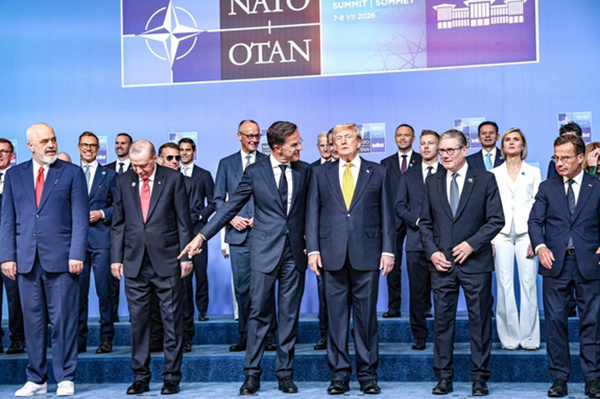
July 8, 2026, Ankara, Turkey: NATO leaders pose for a group photo. Photo: IC Photo
Maybe realizing the difficulty, Trump’s tone shifted as he left Turkey for the U.S. “I have to admit, I had some issues with Spain before, but they’re completely gone now. Spain was very generous today. They agreed to pay a huge sum. If they hadn’t, we wouldn’t even be talking to them,” he said.
“U.S.-EU Tensions May Create More Strategic Opportunities for China”
Trump’s softening might also be linked to Spain’s diplomatic pivot toward China and the Global South.
The Geopolitical Intelligence Services (GIS) noted that in April, Sánchez hosted global left-leaning leaders like Brazil’s Lula and Mexico’s Sheinbaum in Barcelona for a series of meetings. They rallied against the rise of far-right and unilateralism worldwide.
Sánchez criticized Trump for attacking multilateralism and dangerously using force to solve international problems. Lula chimed in, “We can’t wake up every morning or go to bed every night waiting for a tweet from a president threatening the world.”
Before that meeting, Sánchez had just wrapped up his fourth visit to China in four years. In a speech at Tsinghua University, he stressed Spain’s commitment to multilateralism and hoped China would play a more active role in building a stable multilateral system.
According to Singapore’s Business Times, during Sánchez’s visit, China and Spain signed about 20 cooperation agreements, half of which were economic. These included expanding Spanish agricultural exports to China and strengthening collaboration in sustainable development, AI, and the digital economy.
By 2025, China had become Spain’s largest trading partner outside the EU. Spain’s focus is on balancing trade flows while gaining access to China’s green supply chains, critical raw materials, and new energy tech. With over half of Spain’s electricity coming from renewables, its demand for Chinese materials and green tech is growing.
Spanish media also hopes for broader trade deals, tech exchanges, and industrial partnerships, with Spain serving as a bridge between China and the EU.
The Business Times reported that escalating U.S.-EU tensions might be creating more strategic openings for China. In March, Trump threatened to freeze U.S.-Spain relations, and Bessent warned in April that Spain’s closeness to China was like “cutting its own throat.” But despite the criticism and threats, Sánchez insisted on going to Beijing.
Earlier in November, Spain’s King Felipe VI made a state visit to China—his first since ascending the throne and the first by a Spanish king in 18 years.
Jian Junbo, director of the Center for China-EU Relations at Fudan University, told us that as U.S.-China competition heats up, the king’s visit underscores the undeniable economic interdependence between China and Europe. If European countries embrace trade protectionism, it would break supply chains and harm both sides. It also shows that U.S. protectionism doesn’t serve anyone’s interests and is unpopular. “This will definitely boost China-Spain relations and, to some extent, promote China-EU trade exchanges. It’s also a practical act of resistance against U.S. trade protectionism,” he said.