

After publicly thanking China and Russia as “friends” for helping broker a deal between the US and Iran a few days ago, President Donald Trump took another moment at the G7 summit press conference on June 17 to single out both nations once more. He praised their “complete neutrality” during the Iran war, saying it “made the situation a whole lot better.”
“I just want to thank them because they really made things a lot better,” Trump said following the US-Iran ceasefire agreement.
Trump noted he appreciated that China and Russia didn’t jump into the conflict. He said China “stayed neutral, completely neutral, and I thank them for that,” and also extended his thanks to Russia for being “very neutral” as well. “They could have made our position a lot more difficult,” he added.
He even claimed China could have “sent an oil tanker, flanked by six destroyers on each side,” but chose not to. “They helped me,” Trump said. “I think they probably helped push the resolution through, too.”
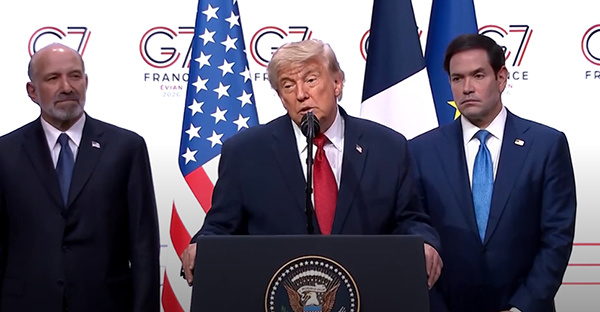
Trump at the G7 press conference on June 17. (Screenshot from video)
Throughout the mediation process, China has consistently emphasized promoting peace talks and pushing for a ceasefire. A spokesperson from the Chinese Embassy in the US responded to Trump’s latest remarks on June 17, telling foreign media that Beijing’s position has been “consistent” and that it has been “working tirelessly to end the war and achieve peace.”
Chinese Foreign Ministry spokesperson Lin Jian also previously stated that since the conflict broke out, China has been actively working to stop the war and pursue peace, offering a Chinese plan to eliminate the conflict and build peace. This has helped build international consensus and has been widely welcomed by regional countries and the global community.
This isn’t the first time Trump has thanked China for the US-Iran deal. Back on June 14, he said at the White House that China and Russia helped Americans and Iranians reach an agreement—or at least didn’t break the US blockade of the Strait of Hormuz by sending oil tankers, which created the conditions for the deal.
Interestingly, Reuters noted on June 17 that Trump’s praise for China and Russia stands in sharp contrast to his recent criticism of US allies. He’s been complaining that Japan and European allies haven’t provided enough support for US military actions in Iran or for clearing the Strait of Hormuz.
That said, despite earlier criticism from G7 leaders like French President Emmanuel Macron, German Chancellor Merz, British Prime Minister Starmer, and Italian Prime Minister Meloni—who had slammed Trump for launching the war without consulting allies—the joint statement at the G7 summit’s conclusion actually welcomed the preliminary US-Iran deal. It even praised “President Trump’s strong leadership” for making it happen.
CNN reported that as Trump left the Palace of Versailles with Macron on June 17, he confirmed to the press that he had signed a memorandum of understanding with Iran remotely. “I signed it right here at Versailles. Just finished,” he said.
The White House later confirmed Trump signed it on June 17, but didn’t clarify if this version differs from the one he and Vance signed digitally on June 14. As for whether the originally scheduled signing ceremony in Switzerland on June 19 will still happen, the White House didn’t immediately respond.
According to Iran’s Islamic Republic of Iran Broadcasting (IRIB), Iranian Foreign Ministry spokesperson Baghaei stated that the Iranian president has already signed the US-Iran Memorandum of Understanding digitally, so the formal ceremony planned for June 19 in Switzerland won’t take place.
Baghaei explained that both sides agreed to complete the agreement text through digital signatures, so the memorandum is now “officially finalized.” Both negotiation teams will still head to Geneva to continue discussions on the follow-up talks outlined in the memorandum. According to Iran, the two countries will start formal negotiations over the next 60 days on nuclear issues and the lifting of US sanctions.